The Number Kingdom
The Money Maze
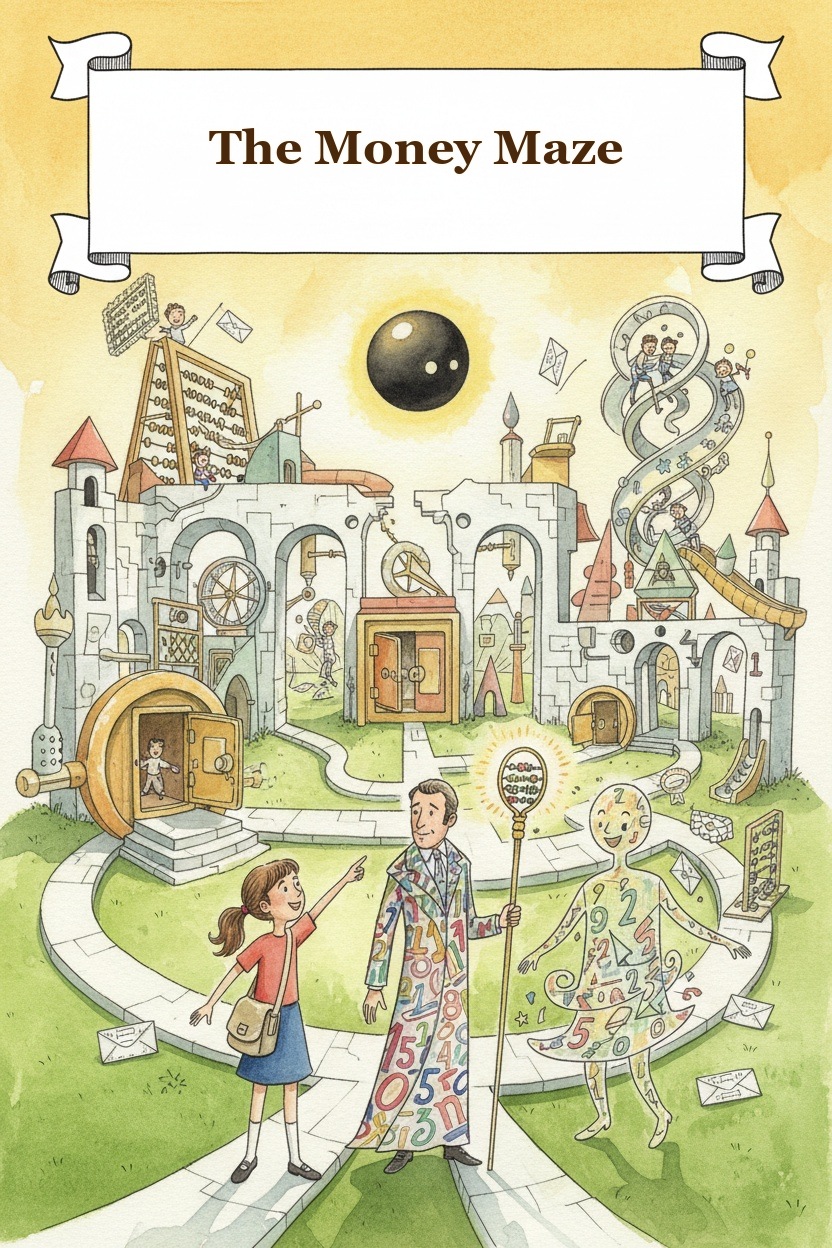
The Scrambled Market
Mira arrived at the Great Market of the Number Kingdom to find chaos.
Coins were flying through the air like confused birds. A baker was shouting that a loaf of bread cost "seven gold coins, or maybe three silver, or possibly one copper and a grumble." A fruit seller was trying to give a customer seventeen coins as change for a single apple. The Exchange Building, where all the kingdom's money was counted and sorted, looked like it had been turned inside out.
The Count stood at the market's center, his robe covered in numerals that kept flickering between different values. His staff tapped impatiently against the cobblestones.
"The crisis is as follows," he announced. "The market's currency system has been completely scrambled. Prices shift every time a customer looks at them. Coin equivalences are incorrect. Change calculations produce whatever result the Remainder finds most amusing at that moment. Trade is impossible, and the kingdom's economy is on the verge of collapse."
"Right," said Mira, adjusting her satchel. "Let's see what's broken."
A giggle echoed from above. The Remainder was perched on the market roof, shaped like a lopsided coin with a smiling face on one side and a confused face on the other.
"Oh, but isn't it WONDERFUL?" it crowed. "One copper could buy a castle! One gold coin is worth exactly... hmm, let me check my notes... whatever I feel like at that moment! A baker gives change, and the customer gets ELEVEN coins for a two-coin purchase! Who needs rules? Rules are so... divisible. I prefer the chaos!"
Mira pulled out her pencil and paper. "Okay," she said. "I need to understand the money system first."
The Coin Cathedral
The Count led Mira to the Coin Cathedral, where the kingdom's currency was displayed in great glass cases.
"These are the coins and notes of our kingdom," he said, gesturing at the displays.
Mira looked at the cases and immediately saw the problem. The labels had been switched around, and the Remainder had added a few it had apparently invented.
One case showed a small copper coin labeled "FIFTY GOLD." Another showed a large golden note with "ONE COPPER" written in wobbly letters. A tiny silver coin was labeled "A HUNDRED DOLLARS" while a massive bronze disc was labeled "ONE PENNY."
"I need to sort these out," Mira said, pulling out her notebook. She drew a chart with two columns: "Coin/Note" and "Value."
First, she examined a small copper coin. It was engraved with the number 1 and a picture of a single wheat stalk. "This is a copper," she said, writing "1 copper" in her chart.
Next, she found a slightly larger silver coin with a 5 and five wheat stalks. "Five coppers," she wrote.
She worked through them one by one:
-
Small copper = 1
-
Silver with 5 = 5 coppers
-
Gold with 10 = 10 coppers
-
Paper note with 20 = 20 coppers
-
Large gold with 50 = 50 coppers
-
Grand note with 100 = 100 coppers
"When you put them in order, they make sense," Mira said. "Ten coppers is the same as one ten-coin. And one hundred coppers is the same as one hundred-note."
"Correct," said the Count. "But the Remainder has also scrambled the equivalences. It claims that five silver coins equals one copper, and that fifty gold coins equals one silver."
"That's backwards," Mira said. "Let me check..." She paused, then did the math carefully. "A silver is worth 5. Five silvers would be 5 + 5 + 5 + 5 + 5, which is 25. That's much more than 1. So the Remainder's equivalence is wrong."
"Wait," said a quiet voice.
Mira looked down. Zero was standing beside her, perfectly round and patient.
"Consider," said Zero. "If you have zero coins, and I say you may add zero more coins, how many do you have?"
"Zero," Mira said.
"Interesting, isn't it?" Zero said. "The absence of coins is not nothing. It is zero coins. And when you are counting money, zero is where you start. Every total begins with zero. Every change calculation begins with zero."
Mira thought about this. "That's true. If I'm adding up what something costs, I start with zero and add each price."
"Precisely," said Zero. And then, very quietly, it added: "I notice no one ever considers what happens when you have zero coins. But you always begin there."
The Price Problem
Mira returned to the market with her sorted coin chart.
The Remainder had been busy. Every price sign was wrong. A sign that should have said "3 coppers" now said "30 coppers." A sign for a toy at "15 coppers" said "1.5 coppers," which Mira knew didn't make sense for coins.
"I need to fix the prices," she said. "But first, let me practice with something simple."
She went to the bread stall, where the baker had a basket of rolls.
"How much is a roll supposed to cost?" she asked.
"Four coppers," said the baker miserably. "But the sign keeps changing!"
Mira looked at the sign. It currently said "40 coppers."
"That's ten times too much," she said. "The Remainder added a zero to the end."
"OH! But look how BIG that number is now!" the Remainder squealed from somewhere nearby. "So much more impressive! Four coppers is small and boring. FORTY coppers is a real number!"
"Forty is a real number," Mira agreed. "But it's not the real price. The price is four coppers. Four coppers per roll."
She fixed the sign. The baker smiled.
"Now," Mira said, "let me try buying three rolls."
She wrote in her notebook:
3 rolls × 4 coppers each = 12 coppers total
"Three rolls cost twelve coppers," she said. "But I have a twenty-note. So how much change should I get?"
She stared at her notebook for a moment.
"Okay," she said. "I need to make change. If something costs 12 coppers and I pay with 20, I need to figure out how much to give back."
She tried subtracting first. "20 minus 12 is 8. So I should get 8 coppers change."
"That's one way," said the Count. "But the merchants of the Number Kingdom use a different method."
"What method?" Mira asked.
"The complementary addition method," said the Count. "Instead of subtracting, you add up from the price to the amount paid. Start at 12 coppers. What do you add to reach 20?"
Mira thought. "12 plus 8 equals 20. So the change is 8 coppers."
"Exactly," said the Count. "The change is what you add to the price to reach what you paid."
Mira tried another one. "If something costs 7 coppers and I pay with a 10-coin, I start at 7 and add... 3 coppers to reach 10. The change is 3."
"Now," said the Count, "try something more difficult."
The Remainder had rearranged a stall so that a basket of apples cost 17 coppers. Mira decided to buy them with a 50-note.
"Start at 17," she said. "Add 3 to reach 20. Then add 30 to reach 50. That's 33 total. Wait, let me check."
She wrote it out:
Price: 17 coppers
Paid: 50 coppers
Change: 17 + 33 = 50. Yes! 33 coppers.
"But wait," she said. "Is that right? Let me check the other way. 50 minus 17 is... 50 minus 10 is 40, minus 7 is 33. Yes!"
"BOTH methods work," she said. "And they both give the same answer. The complementary addition method is useful because you can do it without writing out a subtraction."
The Fair Trade Restoration
Mira spent the afternoon working through the market.
She fixed price signs:
-
A toy that should cost 6 coppers was labeled 60. She corrected it.
-
A hat at 25 coppers was labeled 2.5 coppers, which made no sense for coins. She corrected it to 25.
-
A book at 8 coppers was labeled "8 coppers OR 8 gold coins OR 8 bananas." She corrected it.
She calculated totals:
-
A customer bought bread (4 coppers), cheese (7 coppers), and apples (3 coppers). Total: 4 + 7 + 3 = 14 coppers.
-
Another customer bought a toy (12 coppers) and a hat (25 coppers). Total: 12 + 25 = 37 coppers.
She made change using complementary addition:
-
Price 14, paid with 20-note: 14 + 6 = 20. Change: 6 coppers.
-
Price 37, paid with 50-note: 37 + 3 = 40, + 10 = 50. Change: 13 coppers.
She sorted the coins back into their correct equivalence groups. Ten coppers became a ten-coin. Five coppers became a silver. Ten silvers became a fifty-note.
The market began to work again. People could buy things. Sellers could sell them. No one was getting eleven coins as change for a two-coin purchase.
"Well," said the Remainder, in a slightly sulky voice, "I suppose that's ONE way to do things. Adding up from the price to what you paid. Interesting trick, actually. I'd never thought of it that way. It's like the change is hiding inside the numbers, and you just have to find how far you need to go."
"Actually," Mira said, "that's a good way to think about it. Making change is finding the distance between two numbers."
"The distance!" the Remainder brightened. "Yes! I like that. Numbers at different positions, and the change is the gap between them. Like a little bridge."
The Remainer paused, then tilted its lopsided coin head. "I wonder... what would happen if the price and the payment were exactly the same? Then the distance would be ZERO change."
Mira blinked. "That's right. If something costs 25 coppers and you pay exactly 25 coppers, you get zero change."
"Yes," said Zero, who had been standing quietly nearby. "That tends to work."
"Rounding prices is another thing," Mira said. "If a price is 8 coppers and 3 smaller copper fractions, you might round to 8 coppers. But if it's 8 coppers and 7 fractions, you'd round up to 9 coppers, because the merchant can't split a coin that small."
"OH! Rounding!" The Remainder clapped its mismatched hands. "I LOVE rounding! You can round UP or DOWN! You can make things MORE or LESS! So many choices!"
"Choices with rules," Mira corrected. "You look at the part after the coin value. If it's less than half, round down. If it's half or more, round up."
"Rules, rules, rules," sighed the Remainder. But it didn't look unhappy. "Still... I do like the distance idea. Finding how far you have to go. That's quite good, actually."
The Restored Market
By evening, the Great Market was working perfectly.
The Count stood at the Exchange Building, watching coins flow in and out of the counting rooms. Everything matched. Every transaction balanced. Every price was correct.
"The crisis is resolved," he said, and there was respect in his voice. "The market functions as it did before the disruption. Fair trade is restored."
Mira looked at her notebook, filled with calculations and crossed-out attempts and corrections. She had made mistakes along the way — she'd subtracted when she should have added, mixed up copper and silver values, and once given the wrong change for a 100-note. But she'd caught each mistake and fixed it.
"You know," she said, "I've been thinking about what the Remainder said. About change being the distance between numbers."
"Yes?" said Zero.
"When you make change, you're finding how far apart two amounts are. The price is one point. What you paid is another point. The change is the space between them."
"Numbers on a number line," said Zero. "And money is just numbers with a purpose."
"Exactly," said Mira. "Money isn't magic. It's counting and adding and subtracting, applied to buying and selling."
"Money is a tool," said the Count. "Like the abacus on my staff. Or the pencil in your hand."
"And making change is a way to check fairness," Mira said. "If the math works, the trade is fair. If the math doesn't work, someone's being cheated."
The coins in the Exchange Building clinked softly, like rain on a roof. The market stalls were closing, their owners counting their day's earnings.
The Remainder reappeared, now shaped like an almost-perfect circle with one scalloped edge.
"I should go," it said. "There are other places to visit. Other systems to... adjust."
"Please don't adjust any other money systems," Mira said.
"Oh, I won't," said the Remainder. "I'm bored of money. But I was thinking — that distance idea. Finding the gap between numbers. That could work somewhere else. I wonder..." And it dissolved into a trail of shimmering dust.
Mira turned to go, then paused.
"Zero," she said, "you said something about starting with zero. When I was calculating totals, I did start with zero. Every time. I added the first price to zero, then the second to that, and so on."
"Yes," said Zero. "Every sum begins with zero. Every total is built on that first nothing. Most people never notice."
"That's why you're important," Mira said. "Even when there's no money, there's still zero. And zero is where all the counting starts."
Zero smiled — a perfect circle, exactly as it should be.
"Yes," it said quietly. "That tends to work."
Mira tucked her notebook into her satchel. The golden compass at her side had stopped spinning. The market was whole again.
"Right," she said to no one in particular. "Let's see what's broken next."