The Logic League
Breaking It Down
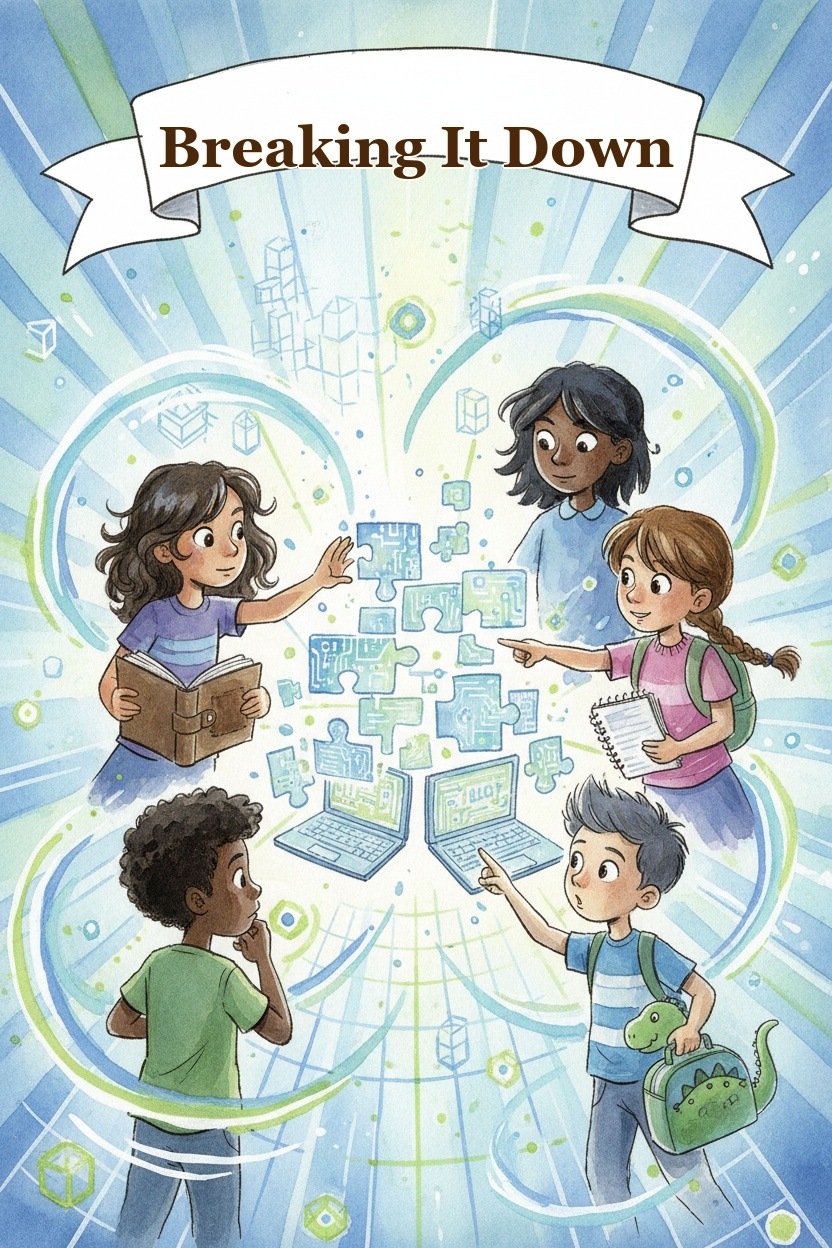
The Puzzle on the Plain
The laptop's glow spilled across the lost-and-found closet like spilled moonlight. Priya's fingers found the keys before she finished saying "Everyone ready?" The world tilted, stretched, and snapped—and the four kids were standing in the Loop Lands.
It was greener than they remembered. Teal light spiraled up from the ground in lazy coils. Copper-colored paths curled in on themselves like rolled-up scrolls. And everywhere, everywhere, there were moving parts.
"It's busy today," Sam said.
That was an understatement. The Loop Lands had always been full of repeating patterns, but this—this was something else. The kids stood at the edge of a vast plain that looked like a giant machine had coughed up its insides. Gears turned inside glass towers. Rivers of glowing liquid ran in circles. Bridges folded and unfolded themselves. Doors opened and closed and opened and closed. In the center of it all, a massive gate rose into the sky, and on that gate, three enormous locks gleamed like copper suns.
"Okay," Kwame said slowly, pulling out his journal. "So we're supposed to get through that gate."
"Three locks," Lily observed. "Three keys, probably. Somewhere out there." She pointed at the plain. "And everywhere else, apparently."
Priya was already pacing, her eyes scanning the chaos. "There's a pattern here. There has to be. The Loop Lands always have a pattern." She frowned. "I just can't see it yet."
A screen flickered into existence in front of them:
ERROR: Problem too large for current processing capacity.
Suggested action: Process less problem.
"The Grid is very funny," Sam said flatly.
"I don't think it's being funny," Lily said. She was already walking toward the nearest glass tower, peering at the gears inside. "I think it's being literal. This is too much for us to handle all at once."
"We've handled plenty," Priya said. "We've done loops, we've done patterns, we've—"
"Not like this." Lily pointed at the tower. "Look. That gear only turns when the light hits it from that angle. Which only happens when the river flows backward. Which only happens when the bridge is down. Which only happens when—"
"Okay, okay," Priya said. "I see the connections. I just don't see where to start."
Sam walked up to the tower and pressed a hand against the glass. The gear inside stopped turning. "Maybe we don't have to see where to start."
Priya made her familiar expression—half exasperation, half curiosity. "What do you mean?"
Sam shrugged. "You always say I ask the obvious question. So here's the obvious question: why do we have to solve the whole thing at once? What if we just..." They gestured vaguely. "Start with one piece?"
The First Piece
Kwame's journal came out before anyone could argue. He flipped to a clean page and wrote:
Today the Grid gave us a problem too big to see all at once. It's like a story with a hundred chapters, but we've only read the first page. The trick, I think, is to stop trying to read the whole book and just read one chapter. Then the next. Then the next. A story doesn't get written all at once. It gets written one moment at a time, and each moment matters even if it doesn't look like the whole story yet.
"Okay," Priya said, reading over his shoulder. "So we break it into pieces. But how do we know which piece to start with?"
"The tower," Lily said. She was already inside it.
They followed her in. The tower's interior was simple: one room, one wall of gears, one lever in the center. The lever was stuck. Above it, a small screen displayed:
IF river_flow = reverse THEN gears_turn
ELSE gears_stay
CONDITION: river_flow = reverse (false)
"It's a condition," Priya said. "We've done these before. The river isn't flowing backward, so the gears aren't turning, so the lever won't move."
"So we need to make the river flow backward," Sam said. "What makes that happen?"
Lily was already at the window. "The bridge. It has to be down. When it's down, it blocks part of the river, and the water goes the other way."
"Then we lower the bridge," Priya said.
They exited the tower and walked to the bridge. It was a metal drawbridge that crossed the copper river, and it was currently raised. On its side, another screen:
BRIDGE STATUS: raised
CURRENT LOAD: empty
INSTRUCTION: bridge_lower() requires LOAD >= 1
"Load," Kwame read. "It needs something on it to lower."
"Something heavy," Sam said. They looked around. The plain was full of strange objects—glowing orbs, spinning cubes, floating diamonds. "One of those?"
"No," Lily said. She was reading the error message underneath the screen, chewing her lip. "It says load, not weight. We need to put something on the bridge that counts as a load. Something the bridge recognizes."
Priya started pacing again. "Something...." She stopped. "Wait. The gears. The tower only needs the river flowing backward to turn them. But what are the gears for?"
They all looked back at the tower. The gears were connected to a long copper shaft that ran from the tower to... something in the distance. Something that looked like a door frame.
"I think," Priya said slowly, "we're supposed to follow the chain. The gears turn the shaft, the shaft moves the door, the door leads somewhere, and somewhere has the key. It's all connected."
"Like a whole story," Kwame said, smiling. "Made of chapters."
"So the first chapter is: get the bridge down." Sam walked onto the bridge.
LOAD: empty
INSTRUCTION: bridge_lower() requires LOAD >= 1
"Sam," Lily said. "What are you—"
"LOAD: Sam," Priya finished. And then she grinned. "The load doesn't have to be an object. It just has to be something the bridge counts."
The bridge shuddered. LOAD: Sam. LOAD accepted. And then, with a long, groaning sound, it began to lower.
Chapters and Chapters
The bridge lowered with a boom. The river churned, reversed, and began flowing backward. The gears in the tower turned. The copper shaft rotated. And somewhere in the distance, the door frame began to slide open.
"Piece one done," Kwame said, checking off an imaginary list. "Bridge, gears, shaft. What's next?"
They followed the shaft to the door. It had opened onto a small chamber filled with—spinning orbs. Hundreds of them. They floated in the air, each one pulsing with light, each one identical.
"This is a lot of orbs," Sam said.
"Maybe they're not all important," Lily said. She was reading the screen on the wall. "It says: 'Function: find_orb(). Input: {orb_color}. Output: {orb_matching_color}.'"
"So we need to find the orb that matches something," Priya said. "But they're all the same color."
"Are they?" Kwame stepped closer. And then he saw it. After a moment, they all saw it. Most of the orbs were blue. But one—just one, floating near the ceiling—was green.
"That one," Sam said.
Lily reached up and grabbed it. The orb pulsed, and the chamber's far wall slid open, revealing a corridor.
"Find the thing that's different," Kwame said, writing in his journal. "That's the whole chapter. Not the whole book. Just the chapter."
They walked down the corridor. It opened into a second chamber, this one filled with floating cubes. Most were square. A few were slightly lopsided.
"The pattern continues," Priya said. She was already scanning. "We need to find the one that doesn't fit."
They did. The cube was slightly too shiny, and when Lily touched it, it opened the next wall.
"Three chambers," Sam counted. "That's a pattern too. One for each lock on the gate."
"Maybe," Priya said. "But we're still missing the keys themselves."
They emerged into a final chamber. It was circular, with a pedestal in the center. On the pedestal sat something that looked like a glowing key—copper, spiral-shaped, perfect. But around the pedestal, the floor was made of tiles. Hundreds of tiles. And every few seconds, the tiles rearranged themselves into new patterns.
"The key," Sam breathed.
"Protected by the tiles," Lily said. She crouched down, examining the floor. "There's a message. 'Path_only_found_through_pieces.'"
Kwame tapped his chin. "The path only appears when you look at the pieces."
"Look at what?" Priya said. "The tiles keep changing. There's no stable pattern."
"There's no stable whole pattern," Lily corrected. "But look at the corner. Those four tiles haven't moved. They spell... left, forward, right, forward."
"A sequence," Priya said. "A short one. We can do that."
They stepped carefully: left, forward, right, forward. The tiles held. And the key was theirs.
The Whole Story
The three copper locks on the great gate clicked open one by one. The gate swung inward, revealing a long, quiet path that led back to the Entry Zone—and, beyond it, to the laptop's glow.
"That was too easy," Priya said.
"It wasn't easy," Lily said. "It was broken into pieces. Each piece was simple. The whole thing was impossible."
"I mean," Sam said, "we didn't even get an error message this time. Except the first one." They paused. "Is the Grid getting nicer?"
A screen flickered on the gate:
PROCESS COMPLETE.
DECOMPOSITION SUCCESSFUL.
ERROR: None detected.
THIS MESSAGE WILL SELF-TERMINATE.
"Not nicer," Kwame said, laughing. "Just accurate."
As they walked back through the gate, Kwame wrote the final entry of the day:
The best stories aren't one big thing. They're lots of little things that fit together. The bridge. The gears. The orbs. The cubes. The tiles. Each one was a chapter. None of them mattered alone, but all of them mattered together. That's what the Grid was teaching us. You don't solve a whole book at once. You read it page by page. And when you're done, the whole story is there—but you got there by breaking it down.
In the lost-and-found closet, the laptop went dark. The four kids sat in the quiet, catching their breath.
"So," Sam said. "Big problems are just small problems wearing a disguise?"
"That's exactly what it is," Priya said.
"I like that," Sam said. "I like that a lot."
Lily was already reaching for the closet door. "Tomorrow. The next adventure."
"Tomorrow," they all agreed. And they went home, carrying the key-shaped memory of a problem broken into pieces small enough to hold.