Professor Plunks Impossible Lab
The Deepest Puddle
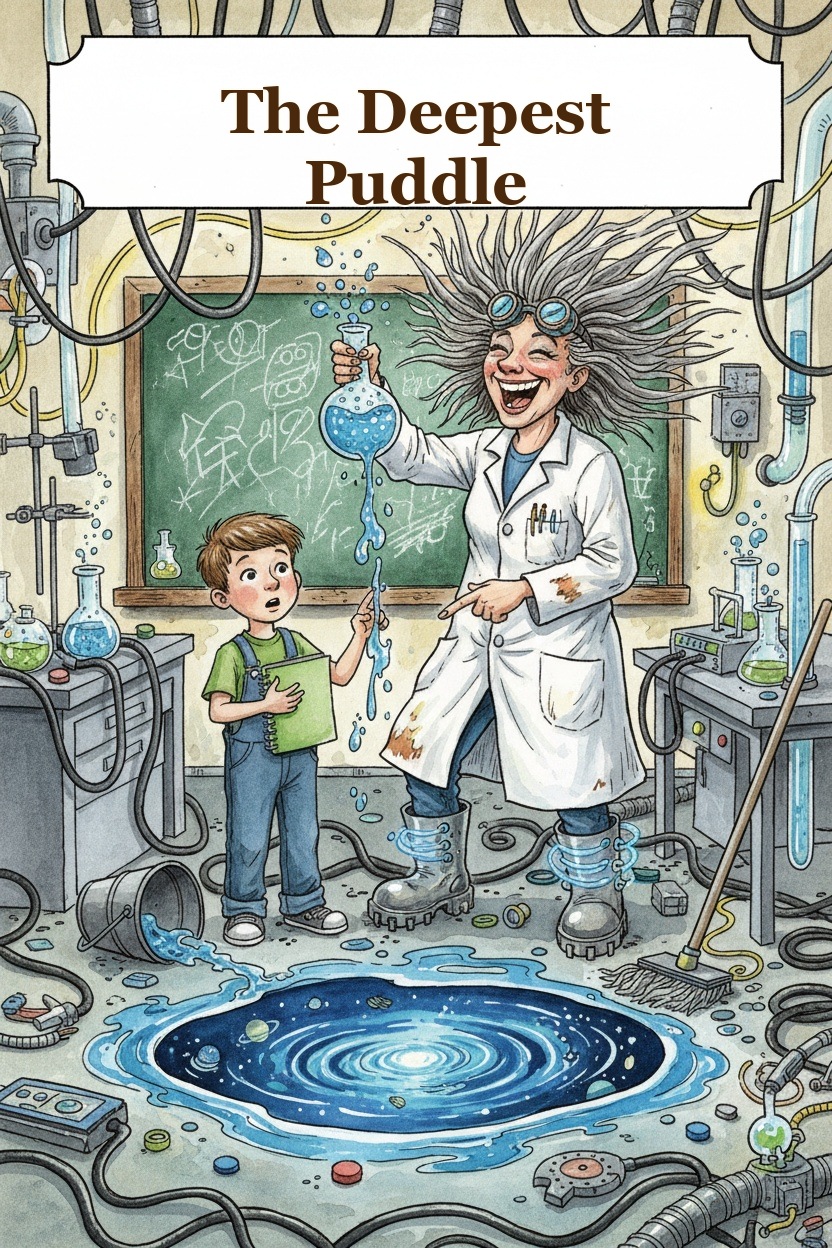
Chapter One: A Very Tall Tank
Professor Plunk burst through the lab door with a cart rattling behind her. On the cart sat the strangest thing Otto had ever seen: a clear plastic tank, tall as a grown-up, with three round holes drilled in a straight line down its side. Each hole was plugged with a rubber stopper.
"Behold!" she announced, flinging her arms wide. "The Water Pressure Demonstration Apparatus, Mark One!"
Otto lowered his lab notebook. He had been sketching a very neat diagram of the lab's ceiling, which was still slightly scorched from Book Seventeen's heat experiment. "Is that... a fish tank?"
"NOOO!" Plunk cried. "Well, yes. I bought it from a pet shop. But its life as a fish tank is OVER, Otto! It is now a scientific instrument of great importance!"
Otto walked around the tank. He counted the holes. One near the top. One in the middle. One very near the bottom. Each hole was exactly the same size.
"Why three holes?" he asked.
"To demonstrate water pressure!" Plunk patted the tank lovingly. "Water pressure increases with depth, my careful colleague. The deeper you go in water, the more the water above you pushes down. And that pressure pushes out in ALL directions."
Otto opened his notebook to a fresh page. He wrote: Water pressure increases with depth.
"Here's my plan," Plunk continued, pacing. "We fill the tank with water. Then we remove the stoppers—ALL AT ONCE! The water will shoot out of each hole with different force. The top hole will produce a gentle trickle. The middle hole will produce a proud stream. And the bottom hole—"
Plunk's eyes gleamed. "The bottom hole will produce a POWERFUL JET of water, demonstrating that the deepest water has the greatest pressure!"
Otto studied the bottom hole. It was about knee-height from the floor. "And where will we stand when we remove the stoppers?"
"The best viewing position is directly in front of the tank!" Plunk spread her arms. "We must see the streams in all their glory! I'll take the left. You take the right. Perfect scientific observation!"
Otto wrote in his notebook: Standing directly in front of experimental apparatus may not be wise. Mentioned concern to Professor. Professor said "nonsense."
He underlined the word "nonsense."
Gloriana appeared in the doorway. She held a large bucket and a very long mop.
"Water?" she asked.
"Quite a lot, I expect!" Plunk said cheerfully.
Gloriana nodded once and disappeared. Otto had a feeling she had not left the bucket and mop far away.
Chapter Two: Three Stoppers
Otto helped Plunk fill the tank with water. This took a while. They used every bucket in the lab, plus a teapot, plus a watering can shaped like a flamingo that Plunk kept for reasons she would not explain.
The water rose. Higher. Higher. When it reached the top, Plunk climbed onto a stool and poured in the final bucket.
"PERFECT!" she shouted. "The tank is full! The moment of truth approaches!"
Otto stood to the right of the tank. Plunk stood to the left. Between them, the three rubber stoppers waited.
"Now," Plunk said, "I'll count to three. When I say 'three,' we pull all the stoppers simultaneously. Ready, my careful colleague?"
Otto looked at the bottom hole. It was near the floor. He looked at his shoes. They were his only good shoes.
"Professor," he said, "should I stand a little further back? Just in case?"
"In case of what?" Plunk laughed. "Otto, water pressure is a perfectly natural phenomenon! It behaves exactly as physics predicts! There is NOTHING to worry about!"
Otto wrote in his notebook: Professor says there is nothing to worry about. Professor has said this before. It has never been accurate.
He underlined "never" three times.
"ONE!" Plunk counted.
Otto's fingers hovered over the top stopper.
"TWO!"
Otto noticed that the tank was very, very full. The water surface was perfectly still. It looked calm. It looked peaceful.
"THREE!"
Otto pulled his stopper. A gentle stream of water arced from the top hole, about the thickness of a pencil, curving down to splash softly into the bucket Gloriana had left nearby.
"Excellent!" Plunk cried, pulling the middle stopper. Her stream was thicker—about the thickness of a thumb—and it shot out with more energy, landing further from the tank.
"See the difference, Otto? MORE pressure at greater depth! The middle hole produces a STRONGER stream than the top hole!"
Otto looked at the middle stream. Then he looked at the bottom stream.
The bottom stream was not a stream at all.
It was a CANNON.
Water exploded from the bottom hole in a thick, roaring column, blasting straight across the lab with incredible force. It hit the far wall with a sound like a hundred hammers striking a drum. For a moment, Otto was simply too amazed to be afraid.
Then Plunk said, "Hold on," in a tone Otto had never heard her use before.
She rushed around the tank to the far side, holding her hands over the hole—but not before she turned to Otto.
"Otto," she said, "you might want to—"
But Otto had already moved. Not because of Plunk's warning, but because of a sound he had learned to recognize after twenty books of experiments: the sound of water finding a path.
The jet had hit the wall. The wall had redirected it. And now the water was coming back.
Otto dove to the right, rolling under the lab table just as the redirected jet swept through the space where he had been standing. The water slammed into the chalkboard, knocked over a jar of rubber bands, and then—because it had nothing else to do—began filling the lab's floor series by series.
Otto, dripping and unharmed, watched the water pool around his abandoned notebook. It turned a nice shade of pale blue.
"FASCINATING!" Plunk screamed, but it was a happy scream. "Look at that stream, Otto! The bottom hole is producing a jet that carries water half the length of the lab!"
She put her hand over the bottom hole to stop it.
The water pressure, which was quite significant, lifted her hand straight off the hole with a sound like a giant kissing a fish.
"OOH!" she shouted, laughing. "That's pressure for you!"
Chapter Three: The Pressure of the Situation
By the time Gloriana arrived with the bucket and mop, the lab floor was a shallow lake. The flamingo watering can floated past Otto's knees.
Gloriana looked at the scene. Plunk was holding both hands over the bottom hole, laughing. Water was spraying around her fingers in all directions. The top and middle holes had emptied themselves long ago, but the tank still held water above the bottom hole, and it was not done demonstrating pressure.
"Towel," Gloriana said. She produced a very large, very absorbent towel from her tool belt. Otto had no idea how. The tool belt did not look large enough.
"Thank you, Gloriana!" Otto said.
Gloriana nodded. "Wrench," she said, producing a wrench. Otto did not ask questions anymore.
"CLASSIC!" Plunk shouted, finally removing her hands. She let the last of the water jet until it sputtered and dribbled and stopped. "A PERFECT demonstration of water pressure in ALL directions!"
Otto stood up. He was soaked. His notebook was soaked. His only good shoes were now water shoes.
"Professor," he said, wringing out his sleeve, "was that what you expected?"
Plunk blinked. "Well. The physics behaved EXACTLY as predicted! The top hole: gentle. The middle hole: moderate. The bottom hole: DRAMATIC! Water pressure does increase with depth! The bottom hole had the most water above it pushing down, so it pushed outward with the most force!"
She turned to the tank, which was now empty.
"But I must admit," she said, pushing her goggles up from her forehead, "I did not expect the jet to be quite so... enthusiastic."
Otto picked up his notebook. It made a squelching sound. He opened it carefully. The ink had run, but some of it was still readable.
Experiment 21: Water Pressure in All Directions.
Observation 1: The top hole produced a gentle stream. Water pressure at shallow depth is mild.
Observation 2: The middle hole produced a stronger stream. Water pressure increases as depth increases.
Observation 3: The bottom hole produced what can only be described as a water cannon. Water pressure at the bottom is VERY significant.
Observation 4: I am incredibly wet.
He paused, then wrote:
Observation 5: Pressure acts in all directions. The water left the tank sideways, then hit the wall, then came back at me. This means the pressure was pushing outward in the direction of the hole, but the water could also be redirected by the wall, which is a different kind of pressure transfer. The wall's pushing force changed the water's direction but not its force. The water kept its energy. I had to move out of the way.
He underlined "had to move out of the way."
Plunk read over his shoulder, dripping water onto him. "That's EXACTLY right, Otto! Water pressure is about force spread over area. The deeper you go, the more water is pressing down from above, and that pressure is transmitted outward in every direction. That's why the bottom hole shows the most force—it has the MOST water above it!"
She spun around, slipping slightly in the puddle. "That's also why deep-sea submarines have to be so strong, Otto! At the bottom of the ocean, the water pressure is so enormous that even thick steel can be crushed if it's not built properly!"
Otto thought about this. "So the deeper the water, the greater the force pushing outward?"
"YES!" Plunk clapped her wet hands together. "The water above pushes down, and because water can't be compressed—wait. No. Let me think."
She stopped, frowning. Then she brightened. "Actually, Otto, here's the important part. The pressure comes from the WEIGHT of ALL the water above pushing down. The more water above you, the more weight is pushing, and water transmits that pressure equally in all directions. So at the bottom of a deep tank, the water is pressing outward against the sides with much more force than at the top!"
Otto looked at the empty tank. "So the bottom hole had more force because there was more water above it?"
"EXACTLY! And that pressure pushed outward—not just in the direction of the hole, but in ALL directions! The water was pressing against the whole side of the tank. The hole was just where it could escape!"
Otto wrote this down. The ink was runny, but it was true.
Chapter Four: The Deepest Puddle
Gloriana had put a large bucket under the bottom hole before mopping. She had also placed a smaller bucket under the top hole, and a medium bucket under the middle hole.
Otto watched her work. She moved with quiet efficiency, squeezing water from rags, pushing it toward the drain in the floor.
"Gloriana," he said, "did you know this would happen?"
Gloriana paused. She looked at the tank. She looked at the puddle covering the floor. She looked at Otto's soaked trousers.
"Deep water," she said. "Deep mess."
Otto nodded. That was probably the most words he had ever heard her say at once.
Plunk was already sketching the next experiment on the chalkboard. The chalk made a squeaking sound, which Otto had learned was Plunk's way of thinking.
"Otto! Come look at this!"
Otto squelched over to the chalkboard. Plunk had drawn a submarine under the ocean. Beside it, she had drawn the same submarine at the surface.
"At the surface, the water above you is shallow—low pressure!" she said. "But dive deep, and every metre of water above you adds more weight pressing down, and more pressure pushing in from all sides. That's why deep-sea creatures have special bodies that can handle the pressure. And why a bathysphere has walls as thick as two fists!"
She turned to Otto with bright eyes. "It's the same in a puddle, Otto! Even a puddle! The water at the very bottom of a puddle is under slightly more pressure than the water at the top. Not much—a puddle is shallow—but it's TRUE! Every depth has its pressure!"
Otto looked down at the puddle he was standing in. He tried to feel the pressure at his ankles. He couldn't feel anything besides cold and wet.
But he believed it.
"Tomorrow," Plunk announced, "we will build a deeper tank! TWICE as tall! With MORE holes! And we will demonstrate—"
"More water?" Otto guessed.
"DRAMACALLY more water!" Plunk declared.
Otto reached for his notebook, but it was too wet to write in. He closed it carefully and tucked it inside his shirt, where it might dry.
"Professor," he said, "can I request something?"
"Anything, my careful colleague!"
"Next time," Otto said, "can we put the holes in the SIDE of the tank, with a wall behind us?"
Plunk frowned. "But where would we stand?"
"Somewhere else," Otto said firmly.
Plunk tilted her head, considering. Then she laughed her great, booming laugh.
"Otto, you are the most sensible scientist I have ever worked with! And you're right! The physics was perfect, but the positioning... well."
She pushed her goggles down from her forehead to her eyes and looked at the tank with a scientist's gaze.
"The jet traveled a great distance. Impressive! But it did make a rather large puddle."
She looked at the lake that had been the lab floor. Then she looked at Otto, standing in the middle of it, his clothes dripping.
"Still," she said softly, "look at what we learned. Water presses harder when it's deeper. It pushes outward with greater force. And because of that, we know why dams are thicker at the bottom. Why submarines are strong. Why fish at the bottom of the ocean are shaped differently than fish at the top."
Otto looked at the puddle. The water had stopped moving now. It lay flat and still.
But it was pressing outward. Even now. Even in the puddle.
He could feel it.
Maybe.
"Professor," Otto said, "is the puddle at the bottom experiencing more pressure than the puddle at the top?"
Plunk's face lit up. "YES! Otto, that is EXACTLY right! Even in a puddle! The deepest part of the puddle has more water above it, pressing down, pushing out! The pressure is tiny—you'd never feel it—but it's THERE! Physics is everywhere, Otto. Even in the puddle you're standing in!"
Otto looked down. He had not moved. He was standing in the very deepest part of the puddle, where the floor dipped slightly.
He thought about the tiny pressure pressing against his ankles. The weight of all that water above it.
For the first time all afternoon, he smiled.
"I'm standing in the deepest puddle in the lab," he said.
"You ARE!" Plunk cheered.
Gloriana, who had returned with a second mop, paused to look at Otto.
"Puddle's only deep," she said, "if you're small."
Five words. Otto had counted.
He laughed. And Plunk laughed with him, her wet hair splattering water in every direction.
Chapter Five: The Notebook That Almost Wasn't
Later, after the floor was dry and the tank was put away and Gloriana had gone home, Otto sat at the workbench. His notebook lay open, pages crinkled from the water. The ink had run, but he had written the important parts over again in red pen.
Experiment 21: The Deepest Puddle
Hypothesis: Water pressure increases with depth. Deeper water has more water above it, pushing down. That pressure pushes outward in all directions.
Procedure: Fill a tall tank with water. Put three holes in it at different depths. Pull out the stoppers. Observe.
Observations:
-
The top hole made a gentle stream. LESS water above = LESS pressure = LESS force pushing outward.
-
The middle hole made a stronger stream. MORE water above = MORE pressure = MORE force pushing outward.
-
The bottom hole made a water cannon. MOST water above = MOST pressure = MOST force pushing outward.
-
The water burst across the lab and then came BACK. This shows that water pressure pushes outward in ALL directions, and that water can be redirected by a wall without losing its energy.
Conclusion: The deeper the water, the greater the force pushing outward. Pressure works in all directions. I was standing in the wrong place.
THIS WAS NOT IN THE PLAN.
The last line was written in very large letters. Red ink. Underlined with so much force it had torn the paper.
He closed his notebook. It was slightly bent. Some of the pages stuck together. But the information was there.
Professor Plunk was at the board, still sketching her next experiment. Otto could see the outline of an enormous tank, taller than the ceiling, with a ladder attached and a very small boat on top.
"Professor?" Otto said.
Plunk spun around, chalk in hand, her eyes bright with excitement. "Yes, Otto?"
"Why do we need to know about water pressure?" Otto asked.
Plunk stopped spinning. She set down the chalk. She walked over to Otto and sat on the stool beside him, which was a rare thing—Professor Plunk was almost never still.
"Because the ocean is deep, Otto," she said softly. "And beneath the ocean, there's a whole world we can't explore without understanding pressure. And beneath our feet, there's water in the ground, and the pressure of that water tells us about the Earth. And inside our own bodies, there's pressure that keeps us alive."
She pointed at the puddle on the floor where a few drops of water had pooled under the tank.
"And in that puddle, there's a tiny, tiny bit of pressure that barely exists. But it's there. And it's the same rule, all the way down."
Otto followed her finger. The puddle was small. Insignificant. Almost gone.
But it was still there. And it was still pressing.
"Every depth has its pressure," Otto said.
"Every depth has its pressure," Plunk agreed.
They sat for a moment in comfortable silence. Otto's notebook was dry enough to close. Plunk's hair was almost dry. The lab smelled like clean water and wet chalk.
"Professor," Otto said, "for the next experiment, can I suggest that we put the holes in a tank that is SHORT and WIDE instead of TALL?"
Plunk raised an eyebrow. "But then the pressure difference would be tiny! Hardly noticeable at all!"
"Exactly," Otto said.
Plunk laughed so loudly that the windows rattled.
"Otto! You brilliant, brilliant boy! You've already figured out the entire point! Pressure depends on depth! Short tank, tiny pressure! Tall tank, MASSIVE pressure! You're not running away from physics, Otto—you're RUNNING TOWARD IT!"
Otto smiled. Actually, he had been running away from it. But if Plunk wanted to call it running toward it, that was fine with him.
He wrote one final line in his notebook:
Tomorrow: we make the water cannon AGAIN, but from a safe distance.
He underlined "safe distance" twice.
And for the first time in twenty-one books, Otto's notebook did not end with the phrase "THIS WAS NOT IN THE PLAN."
Because, in a way, it was.
THE END