The Number Kingdom
The Times Table Tournament
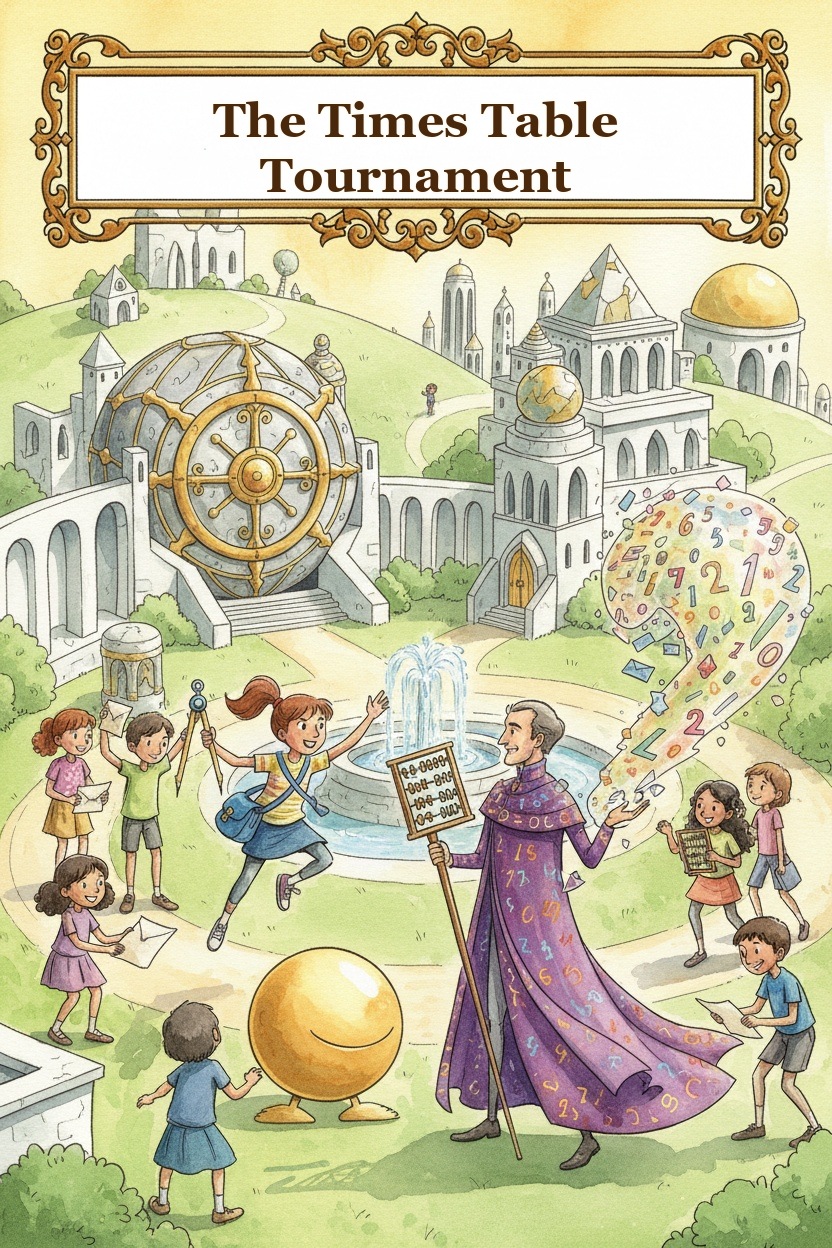
The Empty Walls
"Right. Let's see what's broken," Mira said, sliding off the final step of the palace staircase and landing with a soft thump in the Great Hall.
The Great Hall was never empty. It was where the kingdom's trade agreements were read aloud each morning, where the market prices were posted, where the tournament brackets hung in enormous golden frames. Today, the frames were there.
The frames were empty.
"Oh dear," said Zero, appearing beside her with its usual quiet suddenness. The small silver circle rolled slightly to one side, then righted itself. "That is not good."
The Count stood before the largest frame, his numeral-covered robes shifting uneasily. His staff clicked against the marble floor three times—Mira had learned this was what he did when he was trying not to seem worried.
"The crisis is as follows," the Count said, his voice heavy. "The Times Table Tournament begins at dawn. Every trade agreement in the kingdom depends on the multiplication tables. They appear on every wall, every document, every stall in every market. They are the language of fair trade."
"And they're gone," Mira said, looking around. The walls were bare. The golden frames showed nothing but blank parchment. Even the enormous carved wooden panels that had always displayed the tables were smooth and unmarked.
"I erased them!" sang a voice from the ceiling. "Every last one! Every copy! Every carving! Every careful little chart!"
The Remainder dropped from the rafters, landing in a heap of what looked like discarded halves and leftover quarters. It assembled itself into a grinning, slightly unfinished shape.
"Now the tournament will be VERY interesting," it said, clapping its hands together. "Because no one knows the tables anymore! Not the merchants! Not the judges! Not even the Count! I checked his pockets!"
The Count's hand moved protectively to his robes, then stopped. He did not confirm or deny the pocket check, but his expression suggested the Remainder had not been lying.
"At dawn, the tournament begins," the Count said. "Merchants from every district will arrive to compete. They will be tested on the multiplication tables. Without them—" He gestured at the empty walls.
"The trade agreements fail," Mira finished. "The markets won't know how much things cost. The bridges won't know how much weight they can carry. Everything that depends on the tables—"
"Everything!" the Remainder agreed happily. "Gone! Erased! Forgotten! Unless someone can remember them!" It burst into a shower of leftover eighths and vanished.
Mira sat down on the bottom step. The Great Hall was silent except for the Count's staff clicking once, softly.
"So we need to reconstruct the times tables," she said. "All of them. From one to ten. Before dawn."
"Correct," said the Count.
"That's a hundred facts," Mira said. "I know some of them. But a hundred—"
"A hundred facts to memorize," Zero said quietly. "Or a few patterns to understand."
Mira turned to look at it. Zero was resting at the edge of the nearest golden frame, reflecting the candlelight like a tiny moon.
"Show me," Mira said.
Patterns in the Squares
Mira borrowed a piece of charcoal from the Count's study—"For the reconstruction effort," she said, and he nodded gravely—and began drawing on a blank parchment.
"Okay," she said, talking to herself the way she always did when she was working something out. "Let's start with what I know for sure. Multiplying by one is easy."
She wrote:
1 × 1 = 1, 1 × 2 = 2, 1 × 3 = 3
"Any number times one is itself," she said. "That's not a memorization problem. That's just what one does."
"Correct," said Zero.
"Multiplying by ten is easy too," Mira said. "Any number times ten is just the number with a zero on the end. 3 × 10 = 30. 7 × 10 = 70. That's a pattern."
She wrote those down too. Already she had the entire first row and the entire tenth row of the table.
"So really," she said, "I need to figure out the rows from two to nine."
"Reducing the problem already," Zero said approvingly.
Mira looked at the blank table she was building. It was beginning to take shape as a square—the numbers one through ten going across the top, and the same down the side.
"Wait," she said. "I know something else. Multiplication doesn't care about order."
She drew a line through the middle of her square, from the top left corner to the bottom right.
"2 × 5 is the same as 5 × 2," she said. "So the table is the same on both sides of this line. If I learn the answer for 2 × 5, I've learned the answer for 5 × 2 too. I only have to learn—" She counted the cells above the line. "Forty-five facts. Not a hundred."
"Forty-five is better than a hundred," Zero said. "But still a lot."
Mira stared at her table. She had the ones and the tens filled in—that felt like cheating, since they were patterns, not memorization. Now she had the twos, the threes, the fours, all the way to nines.
"The twos," she said slowly. "The twos are just doubling."
Zero rolled slightly toward her. "Yes."
"2 × 3 means two groups of three," Mira said. "Six. That's 3 + 3. And 2 × 4 is 4 + 4, which is 8. The twos are adding a number to itself."
"Which is doubling," Zero said. "A useful pattern."
Mira filled in the entire row for two, all the way across. Then she looked at the column for two, and yes, it was the same numbers, just swapped around.
"Now the fives," she said. "Fives end in five or zero. 5 × 1 = 5, 5 × 2 = 10, 5 × 3 = 15, 5 × 4 = 20." She wrote them quickly. "The pattern's right there. They alternate. 5, 10, 15, 20, 25, 30, 35, 40, 45, 50."
"Another row complete," said Zero.
Mira looked at what was left. The threes. The fours. The sixes. The sevens. The eights. The nines.
"That's still a lot," she said.
"Look at the nines," Zero said.
Mira looked at the row for nine. She knew some of it—9 × 2 = 18, 9 × 3 = 27, 9 × 4 = 36. She wrote what she knew, then stopped.
"18, 27, 36, 45," she said. "The tens digit goes up by one each time. 1, 2, 3, 4. And the ones digit goes down by one. 8, 7, 6, 5."
"Continue," said Zero.
Mira wrote the rest of the nines row: 9 × 5 = 45, 9 × 6 = 54, 9 × 7 = 63, 9 × 8 = 72, 9 × 9 = 81, 9 × 10 = 90.
She stared at it.
"The digits add up to nine," she said. "18: 1 + 8 = 9. 27: 2 + 7 = 9. 36: 3 + 6 = 9. Every single one!"
She looked at Zero. "The whole nines row is a pattern. You don't memorize it. You can rebuild it any time you need it."
"Yes," Zero said quietly. "That tends to work."
Mira looked at her table. She had the ones, the twos, the fives, the nines, and the tens. Subtract what was repeated from commutativity, and there was actually not that much left.
But there was still the threes. The fours. The sixes. The sevens. The eights.
And then she remembered something.
The Tournament Opens
Dawn came faster than Mira expected. The Great Hall filled with merchants from every district—the bread sellers from the Counting Districts, the spice traders from the Arithmetic Quarters, the cloth merchants whose finest fabrics came from the Fraction Highlands. They looked at the empty frames on the walls and murmured to each other.
"How will the tournament work?" called a baker. "Without the tables, how will we prove our trading rates?"
The Count stepped forward. "The tournament requires mastery of the multiplication tables. Those tables have been—" He paused. "Removed. The candidate who can reconstruct them will demonstrate the mastery required to govern trade."
The merchants looked at each other uncertainly. A woman with a basket of oranges stepped forward.
"Tables?" she said. "How do you reconstruct what's been erased?"
Mira stood up on the bottom step. "You find the patterns," she said. "You use what you know to find what you don't."
"Patterns!" The Remainder's voice echoed from somewhere near the ceiling. "There are no patterns! I checked! It's just a hundred random facts pasted together! No structure at all!"
Mira was almost grateful. The Remainder always told her what it thought was true, and it was always at least a little bit wrong.
"There's structure everywhere," she said. "I just found it."
She turned to a blank parchment board and began to write. The merchants pressed closer.
"Start with what everyone knows," Mira said. "Two times any number is just doubling it. The pattern is: 2, 4, 6, 8, 10, 12, 14, 16, 18, 20."
"And five times any number," said a trader, "always ends in five or zero."
"Right!" Mira said. "Another pattern."
She filled in the twos and fives. Then she filled in the nines, explaining the digit-sum pattern. A murmur of surprise ran through the crowd.
"This is not memorization," said the Count, and for once he sounded almost like he was asking a question.
"No," Mira said. "Well—" She grinned. "Some of it is. The fours are just doubling the twos."
"Doubling the twos?" said the baker.
"4 × 3," Mira said. "That's the same as 2 × (2 × 3). I know 2 × 3 = 6, so 4 × 3 = 12. And 4 × 7 is double 2 × 7. I know 2 × 7 = 14, so 4 × 7 = 28."
The baker's eyes widened. "I could have been doing that all along."
"The eights are doubling the fours," Mira said. "So once you know the twos, you can build the fours, and once you know the fours, you can build the eights."
"The threes?" said a spice trader. "How do I know the threes? I never learned those when I was supposed to."
Mira thought for a moment.
"3 × 4," she said. "You can think of it as 2 × 4 plus 1 × 4." She wrote it out:
3 × 4 = (2 × 4) + (1 × 4) = 8 + 4 = 12
"That works," the spice trader said, brightening. "And 3 × 7 is 2 × 7 plus 1 × 7, which is 14 + 7 = 21."
"Yes!" Mira said. "Any times table you don't know, you can build from the ones you do."
The crowd was starting to breathe easier. The empty frames no longer looked like destruction. They looked like empty spaces waiting to be filled.
The Sixes and Sevens
Mira filled in the threes row, then the fours. The sixes gave her pause for a moment, but then she saw it.
"If six is double three," she said, "then 6 × 5 is double 3 × 5. Three fives is fifteen, so six fives is thirty."
"THIRTY!" shouted the Remainder, appearing in a shower of leftover pieces. "But it was supposed to be hard! It was supposed to be impossible! I erased everything! You weren't supposed to be able to just—"
"Mira has discovered something important," Zero said quietly. "The times tables are not a random collection of facts. They are a pattern. Once you see the pattern, you don't need to memorize it. You can rebuild it whenever you need it."
The Remainder looked distressed. "But then the tournament is just—walking through a garden of predictable paths? Boring!"
"No," Mira said. "Beautiful. Because I didn't know the sixes. I've never learned them. But I knew that six is double three, so I could find the sixes."
She filled in the sixes row, and the merchants watched as each number appeared with certainty.
6 × 1 = 6
6 × 2 = 12
6 × 3 = 18
6 × 4 = 24
6 × 5 = 30
6 × 6 = 36
6 × 7 = 42
6 × 8 = 48
6 × 9 = 54
6 × 10 = 60
"Double the threes," she said. "Every time."
The Remainder made a sound that was half laugh and half groan. "Fine! Fine! The sixes are easy! But the sevens! The sevens are the hardest! No one knows the sevens!"
Mira looked at the row for seven. She knew 7 × 2 = 14, because that was doubling seven. She knew 7 × 5 = 35, because fives were easy. She knew 7 × 10 = 70. And because of commutativity, she knew 7 × 1 = 7, 7 × 3 = 21, 7 × 4 = 28, 7 × 6 = 42, 7 × 8 = 56, and 7 × 9 = 63.
"Wait," she said, staring at her table. "I already know almost all of them. From the other rows. From the other tables. I know 3 × 7 = 21 from the threes, and commutativity says 7 × 3 is the same thing."
She filled in the sevens row in a single sweep of her charcoal.
7 × 1 = 7
7 × 2 = 14
7 × 3 = 21
7 × 4 = 28
7 × 5 = 35
7 × 6 = 42
7 × 7 = 49
7 × 8 = 56
7 × 9 = 63
7 × 10 = 70
"You knew that the sevens were hiding in the other tables," Zero said, rolling forward. "Commutativity means you already had the answers. You just didn't know they were the answers to the sevens."
"Right," Mira said. "There's only one fact in the whole table I didn't have from somewhere else. 7 × 7 = 49. And if you think about it as groups—seven groups of seven—you can arrange them as a square. Seven rows of seven. Four groups of ten in the square, with nine left over. 49."
The Great Hall was silent for a moment.
Then the baker started to clap. The spice trader joined in. The merchants from every district began to applaud, and the empty frames on the walls seemed less empty, because everyone in the room could see what would be written there: not a hundred random facts, but a structure. Patterns building on patterns. Every row connected to every other row.
"It's beautiful," said the Count.
"Of course it's beautiful," said Zero. "That's what patterns are. That's what mathematics is. It was never about memorizing a hundred facts. It's about seeing how they fit together."
The Restored Table
The tournament began at sunrise, with Mira's reconstructed times table displayed on the great board. The merchants were tested on their multiplication and passed with confidence, because now they understood the pattern beneath the facts. Trade agreements were signed. The market prices were set. The bridges were certified to carry their loads.
The Remainder sat on a windowsill in the shape of a leftover sliver, watching the proceedings with a look of grudging appreciation.
"I have to admit," it said, "the pattern is rather clever. The nine times table sums to nine. The doubling works for twos, fours, and eights. Commutativity means the whole thing folds in half." It cocked its head. "It's almost as if the tables have a structure of their own. As if—" It paused. "As if the facts were always connected, even before they were written down."
"Yes," Zero said. "That tends to work."
"No!" the Remainder said, returning to its usual glee. "You can't just have everything be so NEAT! I'm going to find something else to un-tidy!" It dissolved into a spray of leftover quarters and vanished, leaving behind a faint giggle.
Mira looked at the big board where her reconstructed table sat, complete from one to ten. She hadn't memorized it. Not exactly. She had built it, using the same few tools: doubling, patterns, commutativity, and knowing that any fact you didn't know could be found from a fact you did.
"The tournament's over," she said. "But I should write the tables down properly. On the walls. In the documents. Everywhere they used to be."
"An excellent idea," said the Count. "But you could also teach others the patterns. Then they will never need to memorize the tables. They will understand them."
"That's better," Mira said. "Understanding lasts longer than memorizing."
She picked up her charcoal and started writing. The ones, easy. The twos, doubling. The threes, from the twos plus one more. The fours, double the twos. The fives, ending in five or zero. The sixes, double the threes. The sevens, hiding in the other tables. The eights, double the fours. The nines, with their digits always adding to nine. The tens, the simplest pattern of all.
She wrote them all, and as she wrote, she kept noticing connections.
"That's the thing about the times table," she said to Zero. "It's not a list. It's a net. Every answer catches another answer. Pull on any one thread and the whole thing comes with it."
"That," said Zero, "is exactly right."
Mira finished the last row—the tens—and stepped back to look at the entire table, restored and complete.
"Right," she said. "Let's see what's broken."
But nothing was broken anymore. The tournament was over. The trade agreements were signed. And the times tables hung on the walls of the Number Kingdom once again—not just as facts, but as a pattern. A structure. A net of connections that could never truly be erased, because once you saw it, you could always build it again.
The Remainder's erase was temporary.
But understanding? Understanding stays.