Professor Plunks Impossible Lab
The Everything Experiment
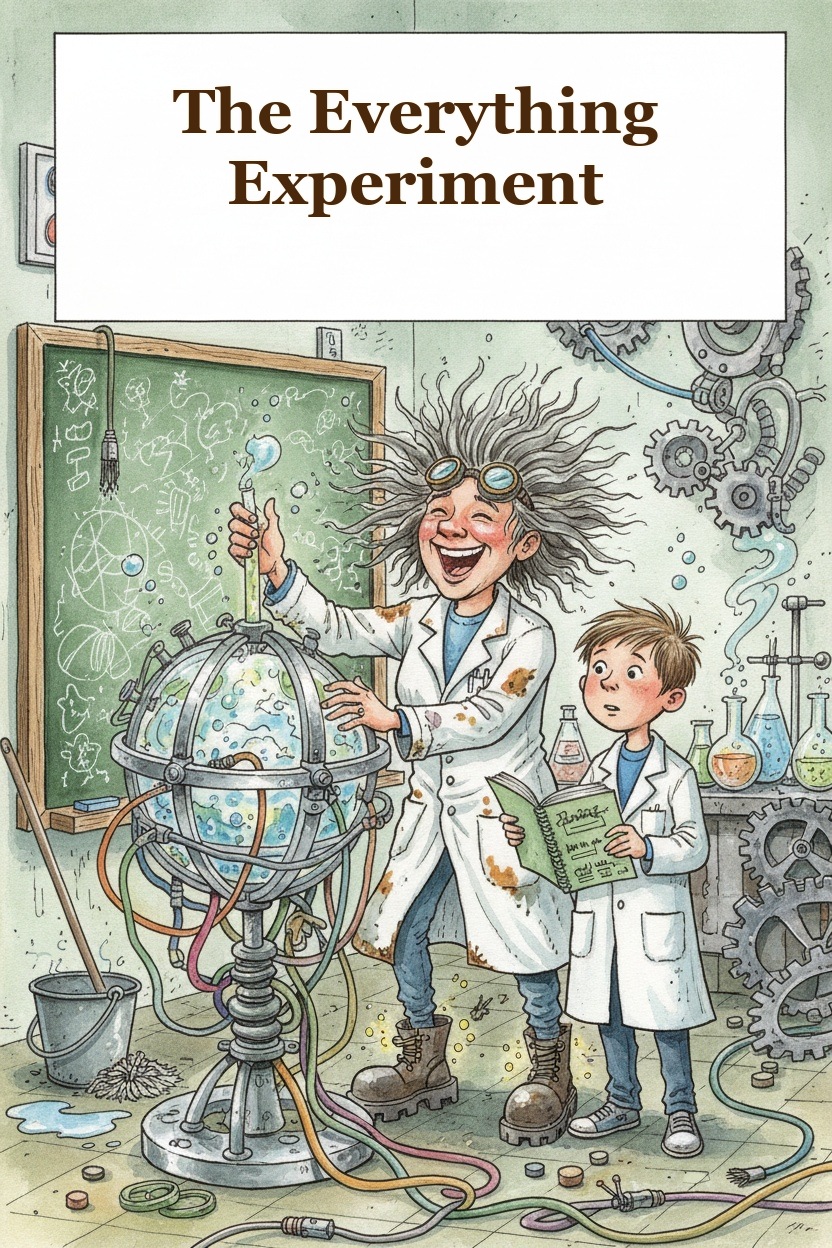
The Announcement
Professor Plunk burst through the lab door with a poster rolled under one arm like a cannon. Otto looked up from his notebook, where he had been carefully drawing a diagram of the lab's plumbing system.
"My careful colleague!" Plunk announced. "Today is the day we have been working toward for forty experiments!"
"Which experiment is that, Professor?" Otto asked, sliding his pencil behind his ear.
Plunk unrolled the poster with a dramatic snap. On it was a truly enormous diagram — a spiral of arrows and labels and connecting lines that wound around the page like a roller coaster designed by someone who had never seen a roller coaster.
"The Everything Experiment!" she declared. "Every physics principle we have ever studied. Gravity, motion, electricity, light, sound, heat, magnetism, waves — all of it. Simultaneously. In a controlled sequence."
Otto studied the poster. There was gravity going down one side. There was electricity going up the other. There were springs and magnets and lenses and pendulums — all connected by a complicated system of tracks, wires, and pulleys.
"That's very ambitious," Otto said carefully. "How will we control the sequence?"
"Perfectly!" Plunk beamed. "I call it the Everything Cascade! A ball rolls down a ramp — that's motion and gravity. It hits a lever — that's simple machines. The lever triggers a switch — electricity! The electricity powers a magnet — magnetism! The magnet releases a spring — potential energy! The spring launches a marble — kinetic energy! The marble passes through a lens — light and refraction! The lens focuses light onto a heat sensor — temperature! The heat makes steam — pressure! The steam blows a whistle — sound! And the sound makes the whole thing start over! Physics, all together, forever!"
Otto looked at the poster for a long moment.
"Forever?" he asked.
"Metaphorically!" Plunk said. "Probably."
Otto opened his notebook and wrote:
THE EVERYTHING EXPERIMENT
Prediction: Professor Plunk believes the sequence will complete one full cycle. I predict it will complete several cycles, in at least three different directions, and that we will have to leave the room.
He paused, then added:
I have packed my spare glasses.
The Setup
The lab had never looked less like a lab. The Everything Experiment covered every surface. Ramps zigzagged down from the rafters. Coils of copper wire snaked across the floor. A line of magnets was arranged on the workbench with military precision. Otto's job was to check the connections — all forty-seven of them.
"First connection," he said, tracing a wire from the pendulum to the switch. "Complete."
"Second connection," Plunk sang from atop a step stool, where she was balancing a bucket of steel balls. "Complete!"
Otto worked his way through the diagram. The third connection: the ramp to the lever. The fourth: the lever to the electrical switch. The fifth: the switch to the electromagnet. The sixth: the magnet to the spring release.
"The seventh connection," Otto said, peering at the diagram. "The heat sensor to the... Professor, is the heat sensor supposed to be connected to the steam whistle?"
"Yes!" Plunk said happily. "The whistle blows, which makes it quiet again!"
Otto looked at the diagram. He looked at the actual lab.
"The sound will travel through the air?" he asked. "To the other end of the experiment?"
"Sound waves need a medium," Plunk said. "Air is a medium. Perfect!"
Otto wrote:
Prediction update: Sound travels about 343 metres per second. The lab is about 12 metres long. This means the whistle will trigger the pendulum's release 0.035 seconds after it blows. Professor Plunk plans to use this. I plan to be behind the blast shield.
"Everything's connected," Otto said, finishing the last connection. "Forty-seven connections. All complete."
"Excellent!" Plunk rubbed her hands together. "Otto, would you do the honours?"
Otto reached for the starting handle — a polished crank attached to a gear system that would lift the first ball to the top of the first ramp.
"The Everything Experiment," Otto said, "begins."
He turned the crank.
The Cascade
The first ball — a shiny steel sphere — rolled down the ramp. That was gravity: a force pulling it toward the lab floor. The ball gained speed as it fell. That was acceleration, the same thing that makes dropped things go faster and faster until they hit something.
The ball hit the lever. The lever swung. That was a simple machine — effort force multiplied by distance, sending a second ball flying upward. It arcs through the air. Projectile motion: forward motion plus gravity pulling it down in a curve.
The second ball landed on a switch. The switch clicked. Electricity flowed through the wires — fast, almost instant, a current of electrons rushing to the electromagnet.
The electromagnet hummed. It attracted a third ball — magnetism, force at a distance, invisible. The ball rolled off its perch and dropped onto a spring platform.
The spring compressed. Elastic potential energy — stored, waiting. And then released, launching the third ball high into the air.
The third ball flew through a loop of wire — and this was the part that made Otto gasp — it was a copper loop, spinning freely. The ball passed through, and the changing magnetic field pushed electrons around the loop. Plunk had built a small generator!
A light bulb flickered on above the workbench.
"Electricity from motion!" Plunk clapped her hands.
The light from the bulb passed through a glass lens mounted on a stand. The lens bent the light — refraction — focusing it into a bright point on a black-painted sensor.
The sensor heated up. Heat flowed through a metal rod — conduction — and reached a small sealed container of water.
The water boiled. Steam pressure built. The container's lid popped open, releasing a jet of steam — pressure, force, expanding gas — and the steam turned a little paddle wheel.
The paddle wheel was connected to a chain. The chain pulled a small wooden hammer. The hammer struck a metal bell.
The bell rang.
The sound wave travelled across the room — pressure ripples pushing through the air — and hit the dish that was mounted above the start of the experiment. The dish concentrated the sound, focusing it, sending it back toward a second, smaller bell.
The smaller bell rang. The vibration travelled down a string — wave energy — and pulled a pin.
The pin held a fourth ball. The fourth ball rolled down the second, smaller ramp.
"Look!" Plunk shouted. "It's starting again — no! Wait! It's rolling away from the lever!"
Otto looked up from his notebook. The fourth ball was rolling down a ramp that Otto had not built. Because Otto had not built that ramp. That ramp was the lab's old marble-catapult track, which had been leaning against the wall, which Otto had been meaning to move.
Which Otto had not moved.
The ball hit the old catapult. The catapult launched. The ball sailed across the room and landed in the bucket of steel balls.
Thirty steel balls exploded out of the bucket like a fountain of silver. Gravity pulled them all down. Some hit the ramps. Some hit the magnets. Some hit the springs. All of them rolled, bounced, or flew into something that was part of the Everything Experiment.
The Everything Experiment went everywhere.
The Interconnected System
Otto stood behind the blast shield, notebook in hand, writing as fast as he could.
OBSERVED: Steel balls following multiple paths. Gravity determines the trajectory. The trajectory determines what they hit. What they hit determines what happens next.
A steel ball hit the pendulum. The pendulum swung — and kept swinging, because pendulums keep swinging, thanks to inertia. The swing knocked a magnet off its perch. The magnet fell onto the copper coil and created a tiny pulse of electricity — induction — which made the light bulb flash.
Another ball hit the steam whistle. The whistle blasted so loudly that the window rattled — sound waves making the glass vibrate. The vibration loose the window latch. The window swung open.
Open window. Breeze. The breeze pushed the paper sails mounted on the propeller near the heat sensor. The propeller spun, turning the generator again, making more light, which refracted through the lens, which focused onto the thermometer, which made the temperature gauge pop up and tap the bell again.
"It's an interconnected system!" Plunk shouted, laughing as a steel ball bounced off her shoulder. "Every force is pushing everything else!"
Otto watched it all through his spare glasses. A steel ball rolled in a curve across the table — projectile motion. The steam from the boiler condensed on the cold window — phase change. The magnet swung, the pendulum spun, the light flashed, the bells rang, the springs boinged, the sound echoed off the walls and set the other pendulum swinging too — resonance, natural frequency matching the vibrations in the air.
And somewhere in the middle of the chaos, the last steel ball came to rest in the exact centre of the lab floor, perfectly still.
Inertia. Nothing changes motion without a force.
The Everything Experiment had finished.
"It... stopped," Otto said, lowering his notebook.
"And it was beautiful," Plunk whispered.
The lab was wrecked. Ramp pieces stuck out of the chalkboard. The copper coil had unwound itself like a metal noodle. Steam wisped from three different containers. The window still swung gently, knocking against the wall.
But the light bulb — the small, simple light bulb — was still glowing. Powered by the last bit of motion — a tiny wheel still spinning as its momentum slowly bled away. One, two, three. Then it stopped.
Total darkness for half a second.
And then the light came on, because Gloriana had arrived.
"Spare fuses," she said, holding out a box. "And sandwiches."
Plunk dusted off her lab coat. "Well! That demonstrated interconnected physics rather more vividly than I intended!"
"Professor," Otto said, "your predictions were correct. Every single part worked — gravity, motion, electricity, light, sound, heat, magnetism, waves. They all did exactly what the physics said they would do."
"And your predictions were correct too, my careful colleague," Plunk said. "The sequence did repeat. It just... used the entire lab as its pathway."
Otto looked at his notebook. Through the chaos, he had written it all. Every ball, every bounce, every connection. The room was chaos, but the page was order.
He wrote, in his neatest handwriting:
The Everything Experiment did not go according to plan. That is why it worked. Every force interacted with every other force because that is what forces do. Physics is not a series of separate rules. Everything happens at once, all the time, in the same room together.
He paused. Then he added:
THIS WAS NOT IN THE PLAN. IT WAS BETTER.
The Wonder Moment
After Gloriana had quietly removed the wreckage and the sandwich crumbs, Plunk and Otto sat on upturned crates in the centre of the empty lab.
The only light came from a streetlamp outside, glowing through the open window. On the wall, a single drop of water — condensed from the steam — was slowly rolling downward.
Gravity. Heat. Change of state. Downward motion.
One small, perfect physics lesson in a single drop.
"It really is one system," Otto said softly. "Everything connects. The steam made the whistle, the whistle made the window open, the window let in the air, the air blew the sails, the sails made the light..." He trailed off. "It never ends."
"Not ever," Plunk agreed. "Every experiment is part of the biggest experiment of all."
"Which experiment is that?"
Plunk smiled. "The universe."
Outside, a second drop of water rolled down the window, following the trail of the first.
Physics, doing exactly what physics does.
Beautiful. Connected. And, this time, predicted.
Otto wrote in his notebook:
Tomorrow: another experiment. I will try to predict what happens. I will probably be wrong. That is okay. That is science.
Below it, in smaller letters:
I cannot wait.