The Number Kingdom
The Shape Shift
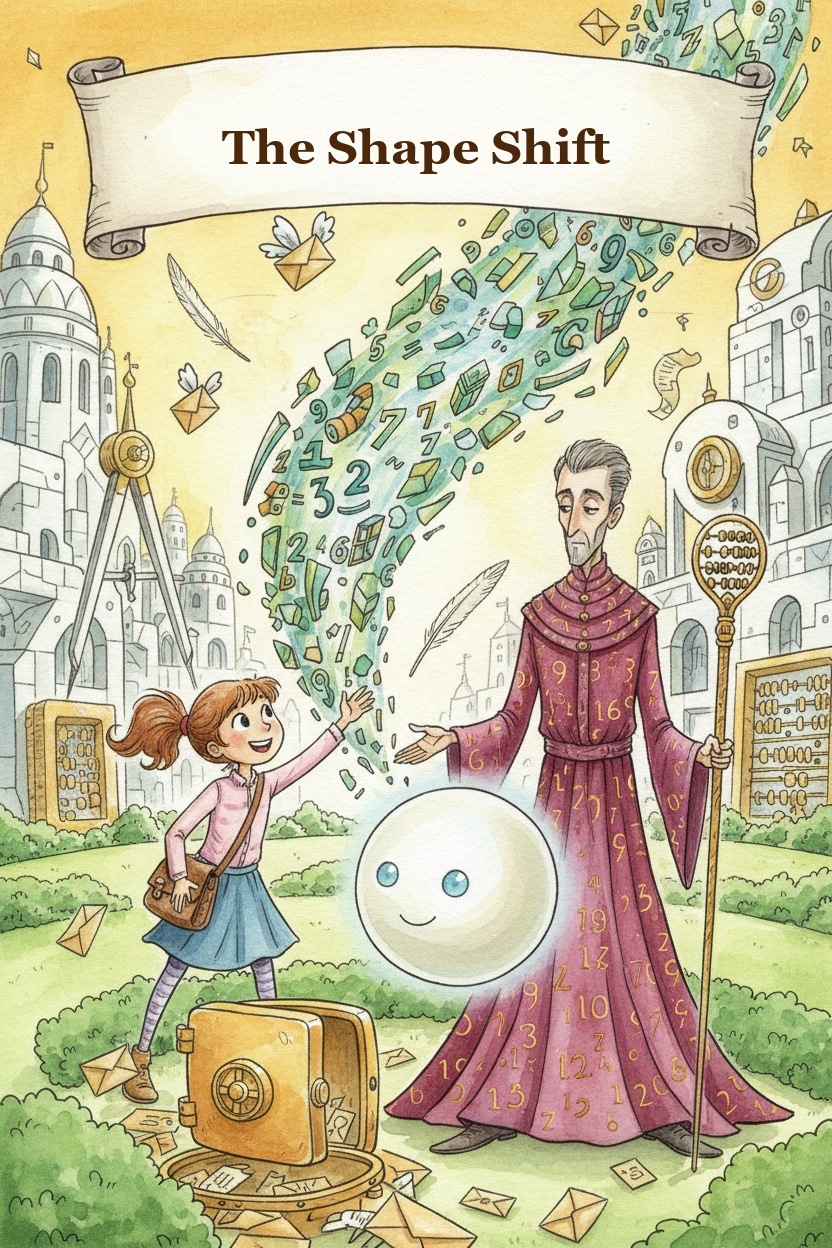
The Distorting Provinces
"Right. Let's see what's broken," Mira said, arriving at the border of the Geometric Provinces.
The Count stood rigidly beside her, his numeral-covered robes rustling in a wind that seemed to come from nowhere and everywhere at once. His staff's abacus beads were clicking against each other—a nervous habit Mira had learned to recognize.
"The crisis is as follows," the Count began, his voice heavy with formality. "The Remainder has altered the fundamental shapes of the Geometric Provinces. Triangles have gained sides. Circles have developed corners. And the buildings constructed upon these shapes are—" He paused, searching for a word. "—visibly distorting."
Mira looked out at the landscape ahead and saw exactly what he meant.
A triangular tower stood crooked, its three sides now apparently four. But the fourth side was small and lumpy, like the building itself was confused about what it was supposed to be. Nearby, a circular gazebo had developed a sharp, ugly corner that made its roof sag distressingly.
"The triangulation supports!" cried a nearby builder, running past them with tools and a look of panic. "They're not triangulating! The roofs are going to collapse!"
Zero appeared silently at Mira's elbow, its perfect silver circle catching the light. It said nothing, but Mira felt its calm presence like a quiet reassurance.
"Let's start by understanding what's actually wrong," Mira said, pulling out her pencil and paper from her satchel. "Show me the worst building."
The Confused Triangle
The worst building was the Great Triangulation Hall—the most important structure in the Geometric Provinces. It was supposed to be built entirely from triangles, which the builders had always said were the strongest shape for holding things up.
But now the building was... sagging.
Mira stood back and looked at its façade. She could see with her special sight—the way mathematics glowed faintly visible in the world—that something had gone wrong at the building's heart.
"A triangle has three sides," Mira said slowly, drawing one on her paper. "And the building's roof trusses are made of triangles. But look at this one." She pointed to a truss above their heads. "That's got four sides. It's a quadrilateral pretending to be a triangle."
The builder wrung his hands. "The Remainder came through last night! It said triangles were too strict, too simple. It said shapes should be free to be whatever they want!"
"That's not how shapes work," Mira said. "A triangle is a triangle because it has three straight sides. If it has four sides, it's a quadrilateral. You can't just call it a triangle and hope it holds up."
She drew more shapes on her paper: a three-sided triangle, a four-sided square, a five-sided pentagon, a six-sided hexagon.
"The number of sides is what makes a shape what it is," she said. "A triangle has three sides. A quadrilateral has four. A pentagon has five. A hexagon has six. That's not a rule someone made up—it's what the words mean!"
Zero nodded its silent agreement.
"Three sides means three angles," Mira continued, circling the triangle on her paper. "And here's the important part: the angles of a triangle always add up to 180 degrees."
The builder looked confused. "Always?"
"Always," Mira confirmed. "Every triangle that's ever existed or ever will exist has interior angles that total exactly 180 degrees. That's part of what makes it a triangle. That's what gives it its strength."
She paused, looking at the sagging truss. "If you add a fourth side and make it a quadrilateral, the angles add up to 360 degrees instead. That's a completely different structural situation. The building wasn't designed for it."
"So the triangles need to be triangles," the builder said, beginning to understand. "And the quadrilaterals need to be quadrilaterals. Each shape has its own rules."
"Exactly!" Mira said. "And the shapes that have been changed need to be changed BACK."
The Cornered Circle
But finding all the changed shapes wasn't simple. The Remainder had been extremely thorough.
They walked through the provinces, checking building after building. A circular fountain had grown corners and was now leaking at the sharp bends. A hexagonal pavilion had lost two sides and was wobbling dangerously. A rectangular storage shed had gained an extra side and was now an irregular pentagon that couldn't hold its own weight.
"Circles have corners!" cackled a familiar voice.
Mira spun around. The Remainder was perched on top of the leaking fountain, grinning its slightly-too-wide grin. It looked like a collection of leftover shape fragments, bits of triangle and quadrilateral and circle stitched together into something that wasn't quite any of them.
"Corners on circles! How delightful! How unexpected! A circle with a corner—what could that possibly be for?!"
"A circle has no corners," Mira said firmly. "That's what a circle is. It's a continuous curved line where every point is the same distance from the center. There are no straight sides. No angles. No corners. Not because those are forbidden, but because they're not what a circle IS."
The Remainder tilted its not-quite-head. "But wouldn't it be more interesting if it had corners?"
"No," Mira said. "It would be broken. The fountain's water flow depends on the circle being smooth. The reflection pool's shape depends on it being circular. A circle with corners isn't a better circle—it's not a circle at all. It's a different shape entirely, and different shapes do different jobs."
The Remainder looked thoughtful. "So the shape determines what it can do."
"Exactly!" Mira said. "Triangles are strong because their angles are fixed—you can't push a triangle out of shape. That's why buildings use them. Circles are smooth and even—that's why fountains and wheels use them. Each shape has its own properties, and those properties matter."
She drew a circle on her paper, then tried to draw one with a corner. It came out lumpy and wrong.
"A shape is defined by its sides and angles," Mira said. "Triangle: three sides. Quadrilateral: four sides. Pentagon: five. Hexagon: six. Circle: no sides at all, just a continuous curve. The properties follow from the definition."
The Remainder clapped its odd hands together. "But what about the REGULAR ones? The ones where ALL the sides are equal and ALL the angles are equal? Those are extra special, aren't they?"
Mira blinked. "Yes, actually. A regular triangle—where all three sides are the same length and all three angles are the same—is called an equilateral triangle. Every angle is 60 degrees, and 60 plus 60 plus 60 equals 180."
She drew an equilateral triangle. "A regular quadrilateral with all equal sides and equal angles is a square. Every angle is 90 degrees. Four times 90 equals 360."
"Regular pentagon!" the Remainder said eagerly. "All sides equal! All angles equal! What are the angles?!"
Mira paused. She hadn't memorized that one. But she knew a way to figure it out.
"Well," she said slowly, thinking out loud, "a pentagon has five sides. The total interior angles of any triangle is 180. A quadrilateral is 360. But what's the total for a pentagon?"
She drew a pentagon on her paper and then, without knowing why, drew lines connecting one corner to all the other corners. The pentagon divided into three triangles.
"Three triangles!" Mira said. "And each triangle has 180 degrees. So the total is three times 180, which is..."
She did the multiplication carefully. "540. The interior angles of a pentagon always add up to 540 degrees. And if it's a REGULAR pentagon, all five angles are equal, so each one is 540 divided by 5, which is..."
Another calculation. "108 degrees."
The Remainder looked genuinely impressed. "You figured that out without knowing it beforehand!"
"That's how math works," Mira said. "You don't have to memorize everything. You can figure things out from what you already know."
She turned to the builder. "Hexagons will be 720 degrees total—that's four triangles. And if they're regular, each angle is 720 divided by 6, which is 120."
The Remainder's voice was quieter now. "So the shapes each have their own numbers. Their own rules. And you can't just mix them up without breaking things."
"That's right," Mira said. "The wrong shape in the wrong place is structural failure. But the right shape in the right place—that's what holds everything up."
The Restoration
Mira and the builder got to work.
They measured every triangle in the Great Triangulation Hall, checking that each had three sides and that the angles added up to 180 degrees. Where the Remainder had added sides, they carefully removed them. Where it had removed angles, they restored them.
They walked through the provinces, examining every shape with fresh eyes. Quadrilaterals checking to see that their angles summed to 360. Pentagons confirming their 540. Hexagons verifying their 720.
"Regular shapes," Mira called out as they worked, "are special because all their sides are equal and all their angles are equal. But irregular shapes are still perfectly valid shapes—they just have sides and angles of different sizes. What matters is that a shape IS what it IS."
At the leaking fountain, she traced the circle with her finger. "A circle is special in its own way. It's the only shape where every point on the boundary is exactly the same distance from the center. That's not a rule someone made up—that's the definition of a circle."
By evening, most of the provinces had been restored. Buildings stood straighter. The fountain flowed smoothly. The hexagonal pavilion no longer wobbled.
But one problem remained.
The Count was standing before the Great Triangulation Hall, his face grave. "One truss remains incorrect. It appears the Remainder left a surprise."
Mira climbed the ladder to inspect. There, in the highest roof truss, was a shape that wasn't quite a triangle and wasn't quite a quadrilateral. It had three straight sides and one curved side.
"It's not any shape at all," Mira said. "It's a mess."
Zero had climbed up behind her—or rather, Mira realized, Zero had been there the whole time, just no one had noticed. Zero rarely needed to climb.
"Might I suggest," Zero said quietly, "that we remove it entirely?"
Mira looked at the truss. "If we take the shape out, there'll be a gap. The roof won't support itself."
"Perhaps," Zero said, "if we consider that the truss doesn't need an extra shape at all. It needs the absence of an incorrect one."
And suddenly Mira understood.
She'd been thinking she needed to replace the wrong shape with a right one. But the original truss hadn't needed a shape there at all. The Remainder had added it where there had been nothing.
"Removing it entirely is correct," Mira said. "Because zero shapes is the right number of shapes here. There can be exactly zero shapes where zero shapes belong."
She carefully cut away the incorrect shape, leaving an empty space. The truss, now properly shaped, held perfectly.
Zero nodded. "Yes. That tends to work."
At the base of the ladder, the Remainder was watching. For once, it wasn't grinning.
"You know," it said, almost thoughtfully, "shapes are stricter than I thought. They have their own... integrity. You can't just make them be whatever you want."
"You can't," Mira agreed. "But you can understand what they are, and then they hold things up. That's better than making them be anything."
The Remainder considered this. "I think I'll go visit the Territory of Infinity," it said. "Shapes there are... different. Less defined."
"Infinity isn't a shape," Mira said.
"Exactly!" said the Remainder, and vanished in a puff of disordered geometry.
The Count stood back and surveyed the restored Geometric Provinces. The buildings were straight. The fountain flowed. The trusses held.
"The shapes are correct again," he said, with something almost like warmth. "The kingdom is in your debt, Mira."
Mira looked at her paper, covered in sketches of triangles and quadrilaterals and pentagons and circles. Some were labeled with their angle sums. Several had crossed-out wrong attempts.
"I just remembered," she said, "that shapes are defined by their properties. The number of sides. The sum of the angles. Regular or irregular, they all follow their own rules. And those rules are what make them useful."
She tucked her pencil behind her ear and smiled at the orderly provinces.
"Right," she said. "Let's see what's broken next."