Just Like Me
The Hard Conversation
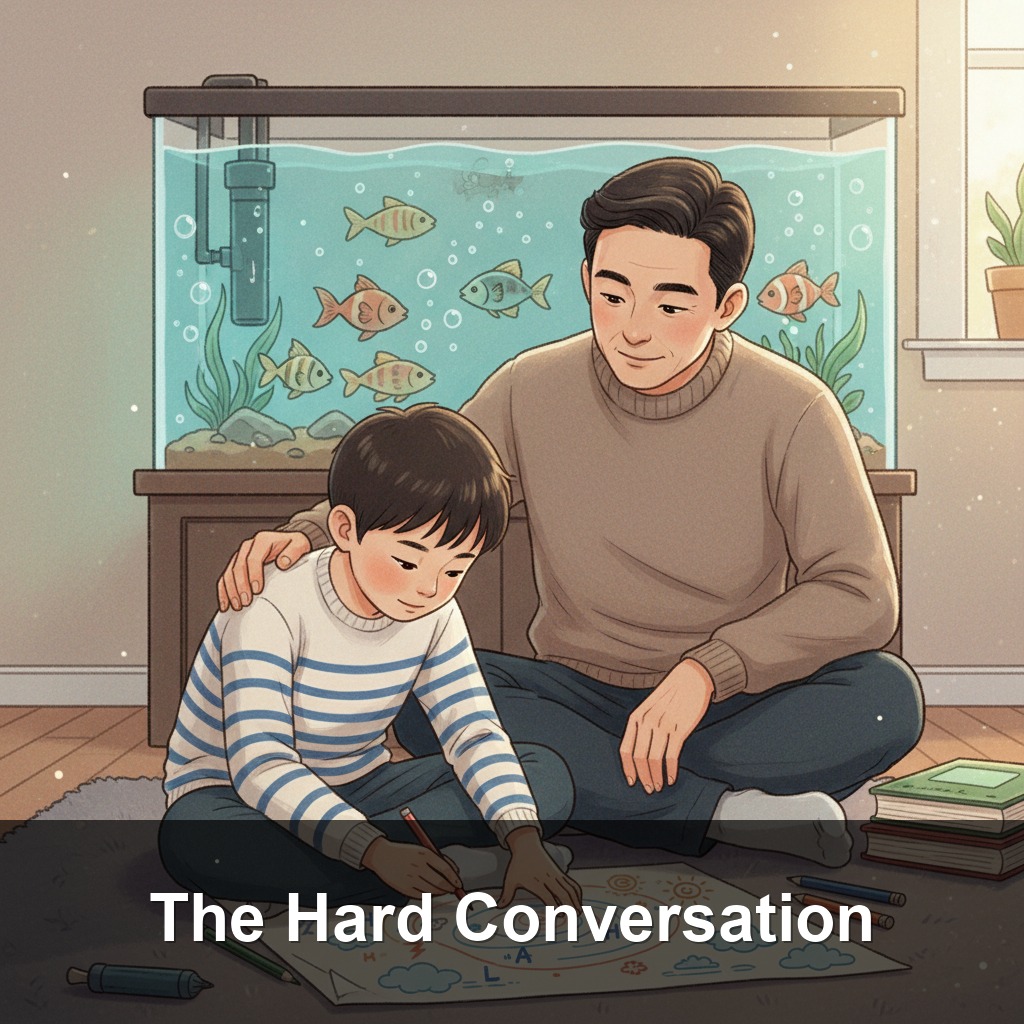
Sam's room was quiet. The only sound was the soft hum of the fish tank filter—the good kind of hum, steady and low, like a secret the room was keeping.
Sam was on the floor, surrounded by maps of weather patterns. Sam was drawing a new one. A cold front was moving in from the north, and Sam was tracing the line where the warm air would meet it. The line was satisfying. It curved just right.
The door opened. Not a knock—just the door, slow and gentle.
Papa stepped in. He sat down on the floor next to Sam, not too close. He waited.
Sam kept tracing.
"Can I ask you something?" Papa said.
Sam nodded. The line was almost done.
"I want to know what it's like," Papa said. "To be you. The real parts. The good parts and the hard parts."
Sam's hand stopped. The line was finished. It was perfect.
"You already know me," Sam said.
"I know your schedule," Papa said. "I know you like the same seat. I know you need the lights dim in the afternoon. I know you tell me the truth even when it's hard to hear." He paused. "But I want to know what it feels like. From the inside."
Sam looked at Papa. Papa's face was open. Not the face he wore when he was reminding Sam to put shoes on. This was a different face. A listening face.
"Inside," Sam said slowly, "is hard to explain."
"Try," Papa said. "I'll try to understand."
Sam picked up the blue pencil. "Do you remember the fire alarm last week? At the library?"
Papa nodded.
"It wasn't just loud," Sam said. "It was a wall. It was a wall made of sound that came at me from all directions at once." Sam made a shape with both hands, pressing inward. "It pushed on my ears and my chest and the back of my eyes. I couldn't see past it. I couldn't think past it. It was all there was."
Papa was quiet. Then he said, "I should have taken you out sooner. I'm sorry."
"That would have helped," Sam said. "But what I'm trying to say is—it wasn't the alarm. It was what the alarm did to my brain. My brain couldn't sort it."
Papa nodded. "So it felt like—too much?"
Sam shook head. "Not just too much. It felt like everything was the same thing. There was no difference between the noise and me. We were one thing. And I couldn't be me anymore."
Papa's face changed. It looked like Sam's own face when Sam found out a plan had changed. Like a piece had fallen out and Papa didn't know where it went.
"Let me try," Papa said. "If I can understand it right. It's like—your body is a radio. And normally you can pick your station. But when it's too much, all the stations play at once. And they're all inside you. So you can't even tell which voice is yours."
Sam looked at Papa for a long moment.
"Yes," Sam said. "That's exactly it." Sam felt a strange feeling. Not happy. Not sad. Something in between. Like being seen through a clear window after a long fog. "How did you know that?"
"I listened," Papa said. "And because I love you. And because I want to know."
Sam put the blue pencil down. "Do you want to know the hard part?" Sam asked.
"Yes," Papa said.
"The hard part is that sometimes I want to do things. Good things. Like Jordan's birthday party. I want to go. I want to celebrate. But I know that the noise will come. And the light will come. And I don't know if I'll be me anymore when it's over." Sam's voice got small. "So I don't go. And I feel lonely. But I also feel safe. And I don't know which one is more true."
Papa didn't say "it's okay" or "it'll be fine." He just sat with it.
"Both of them are true," Papa said finally. "Lonely is true. Safe is true. You don't have to pick only one."
Sam stared at him. "That's what I think," Sam said. "But no one has ever said it back to me."
"I'm saying it now," Papa said.
There was a long silence. The fish tank hummed.
"Is there anything else?" Papa asked. "The good parts. I want those too."
Sam picked up the red pencil. "The good parts are when I see the whole pattern. At school, when Ms. Chen was teaching the water cycle, everyone else was learning it. But I saw it. Not the picture in the book—the real thing. The way water rises and falls and rises again. Like a heartbeat the whole world has. I saw it so clearly I could taste it."
Papa smiled. "Taste it?"
"Like cold metal," Sam said. "When it's right, when the pattern fits, I can taste it. Like the world is running the way it's supposed to run."
"That's beautiful," Papa said.
"It is," Sam agreed. "That's the best part. When the pattern is there. When I can see it. When nobody has to explain it to me because I just know."
Papa was quiet again. Not the quiet of waiting. The quiet of holding what Sam had given him.
"Thank you," Papa said. "For telling me."
"Thank you for asking," Sam said. "Most people don't ask. They just guess. And their guesses are wrong."
"How do you feel?" Papa asked. "Right now. After telling me?"
Sam thought about it. The hum of the filter. The curve of the line on the map. Papa's listening face.
"Lighter," Sam said. "Like I was carrying a very heavy backpack and I didn't know I could take it off. But you took it off for me. Just for a minute."
"Can I take it off more often?" Papa asked.
Sam considered. "You can ask. Sometimes I won't want to talk."
"That's okay," Papa said. "I'll ask anyway. Because knowing you is worth asking for."
Sam looked at the map again. The cold front had met the warm air. The line was perfect. But there was something more important in the room.
"Do you want to see how the storm forms?" Sam asked. "When these two meet?"
Papa moved closer. "I would love to."
Sam showed him. And for a long time, the room was full of the good hum of the fish tank and Papa's questions and Sam's answers. Not a perfect conversation. Not a short one.
A real one.
Author's Note for Grown-Ups:
This book is about what happens when we ask our children to tell us who they are—and then truly listen, without fixing, without rushing, without judging. Sam and Papa show us that understanding isn't a one-time event. It's a repeated practice of asking, listening, and being willing to have the hard conversations. Your child may not have words for their inner world yet. But every time you ask and wait and stay, you're building the bridge they'll cross when they're ready.