The Number Kingdom
The Data Disaster
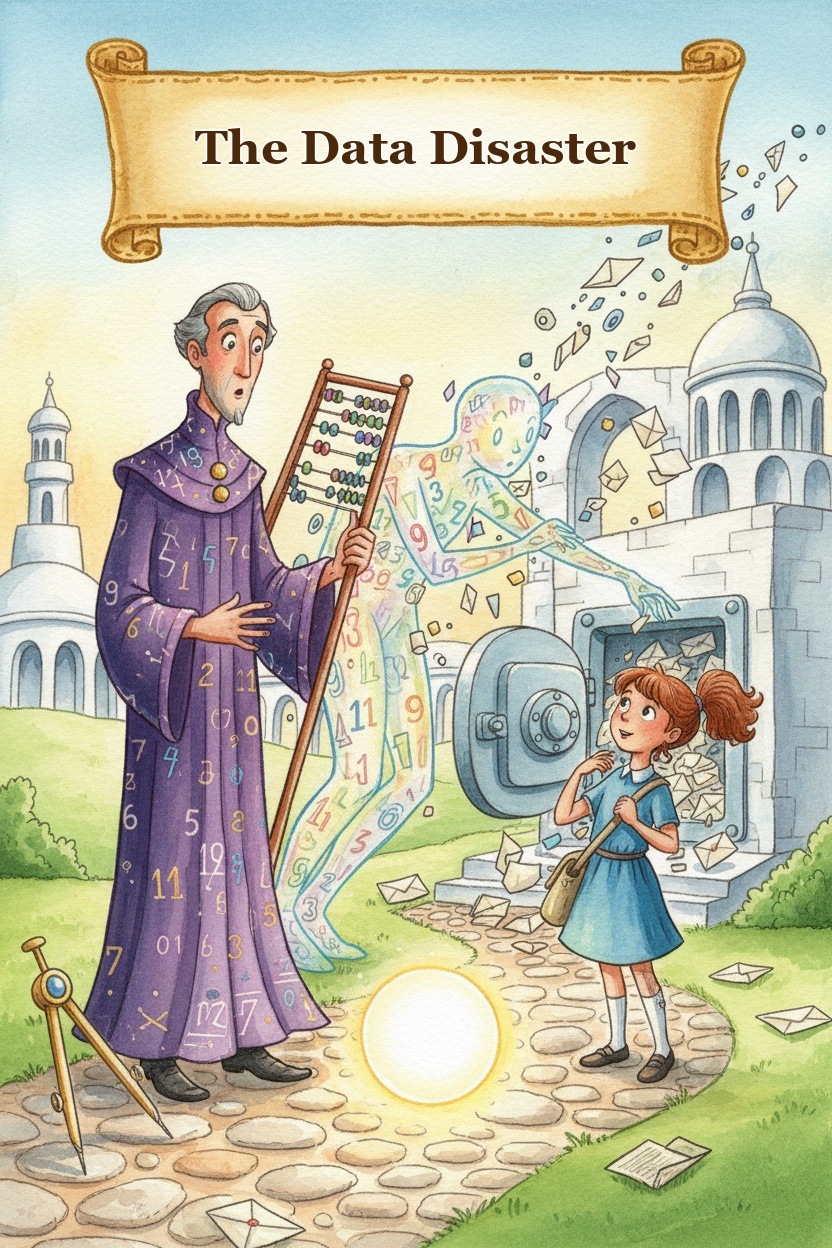
The Missing Numbers
"Right. Let's see what's broken," Mira said, sliding off her bicycle and landing in the middle of the Counting District's main square.
The square was chaos. Normally, the market stalls were arranged in neat rows with exactly the right number of apples, bread loaves, and cheese wheels displayed on each counter. Today, a crowd of citizens stood in confused clusters while the Count's assistants ran back and forth with papers fluttering from their arms.
The Count himself stood at the center, his robe covered in numbers that were blinking in and out of existence. His face was graver than Mira had ever seen it.
"The census," the Count said without preamble. "It has been corrupted."
"The census?" Mira asked.
"Every ten years, we count every citizen in the Number Kingdom," the Count explained. "We record who lives in each district, how many children are in each family, how many workers in each mill. These records tell us how much bread to bake, how many schools to build, how many bridges to maintain. Without accurate records, we are flying blind."
The Remainder appeared on top of the fountain, looking like a wisp of smoke shaped into a grinning face. "I didn't delete them!" it said cheerfully. "I just... rearranged them. A little here, a little there. Some records got counted twice. Some districts got mixed up. And some numbers simply disappeared. Isn't it WONDERFUL? Now nobody knows anything!"
Mira pulled out her notebook. "How bad is it?"
"Bad," said a quiet voice. Zero had appeared beside her, silver and perfectly circular as always. "The records show three hundred citizens in the Flour District. There are actually ninety-two."
"How do you know?" Mira asked.
"I was there yesterday," Zero said simply. "I counted."
Mira looked at the scattered papers, the confused citizens, the grinning Remainder. "We can't just count everything again," she said. "There are too many districts. We'd need to visit every single house in the kingdom."
"Yes!" said the Remainder happily. "That's exactly what you'll have to do! It will take MONTHS! And by the time you're done, the records will be wrong again because babies will have been born and people will have moved and—"
"Stop," Mira said. "Just stop."
She sat down on the edge of the fountain and opened her notebook. "Right. Let's think about this properly."
The Tally Challenge
Mira looked at the pile of papers. "First, I need to know what we're working with. How many districts are there?"
The Count counted on his staff. "Twelve."
"Twelve districts," Mira repeated. "And we need to know how many people live in each one. But we can't count every single person in every single district quickly. There are too many."
"Unless you count faster," the Remainder suggested.
"Or unless you count smarter," Mira said.
She thought for a moment, then started drawing in her notebook. The illustration would show her process later: a rough sketch of the twelve districts, then circles representing groups of people, then a little chart.
"Here's what I think," she said slowly. "We don't need to ask every person in every district. We need to ask a few people in each district, and then use that to figure out the whole district."
"You mean guess?" asked the Count, horrified.
"Not guess," Mira said. "I mean... sample."
Zero's voice was quiet. "That's actually a good idea. But the sample needs to be big enough."
"Why?" Mira asked.
"Because a small sample can lie," Zero said. "If you ask two people in a district with mixed ages, you might get two children and think the whole district is children. But if you ask a hundred people, you get a better picture."
Mira nodded slowly. "So we need the RIGHT number of people to ask. Enough to be reliable, but not so many that it takes forever."
She looked up at the Count. "Do you have any records that WEREN'T corrupted?"
"The bread delivery records," the Count said. "They were stored separately. They list how many households receive bread in each district."
"How many households are there per district?"
The Count consulted a separate book. "Approximately fifty to eighty households per district."
"Okay," Mira said. "So if we ask about... let's think. If we ask ten households in each district, that's about one in five or one in eight households. Is that enough?"
Zero circled thoughtfully. "Ten out of eighty is one-eighth. Ten out of fifty is one-fifth. Both are reasonable samples. But the households you ask must be chosen fairly — not just the nearest ones, or the ones you already know."
"Otherwise you get biased results," Mira said. "Right. So here's my plan."
The Survey
Mira gathered the Count's assistants and gave them each a notebook.
"Here's what we're going to do," she said. "Each of you will go to one or two districts. When you get there, I want you to count the households first — just the houses, not the people. Then I want you to visit every seventh household."
"Every seventh?" asked one of the assistants.
"Every seventh," Mira confirmed. "That way you're not just visiting the houses closest to the road, or the houses where you already know the people. You're getting a fair mix."
"But why seven?" asked another assistant.
"Because it gives us a good number," Mira said. "If there are fifty-six houses, every seventh one gives us eight households. If there are seventy-seven houses, every seventh one gives us eleven households. Either way, we get a sample we can work with."
The assistants looked confused, but the Count nodded slowly. "A systematic sample. Interesting."
"It's not exactly perfect," Mira admitted. "But it's better than nothing, and it's much faster than visiting every single house."
She handed each assistant a list of questions:
How many people live in your household?
How many children?
How many adults?
"And keep track of everyone you ask," Mira added. "We need to know exactly how many households you visited, and how many people you counted in each one."
"Why does that matter?" asked one assistant.
Mira thought about this. "Because if I know that you visited ten households in a district with eighty households, and the average number of people per household was four, then I can say: eighty households times four people equals three hundred twenty people in that district."
"That's not counting!" said the assistant, scandalized.
"No," Mira agreed. "It's estimating. But if my sample is good, my estimate will be close. And close is better than nothing at all."
The assistants looked at each other, then at the Count.
"Do it," the Count said. "Go now, and return by sunset."
The assistants scattered in all directions.
Mira sat down with Zero to wait.
The Frequency Table
By sunset, the assistants had returned, fanning themselves with their notebooks and looking tired but satisfied.
Mira spread their papers across the fountain's edge. "Okay. Let's see what you got."
She started making marks in her notebook — little groups of four lines with a diagonal slash through them, which one of the assistants recognized.
"What are those marks?" the assistant asked.
"Tallies," Mira said. "Every time I count a household, I make a mark. Every fifth mark goes across the other four, so I can count them in groups of five instead of counting each mark one by one."
Zero looked at her tally marks. "How many households did the first assistant count?"
Mira counted her marks. "Fourteen." She wrote: District One: 14 households surveyed, 62 people total.
She continued through the other districts, making tallies and writing them into a table:
District One: 14 households, 62 people
District Two: 16 households, 71 people
District Three: 12 households, 48 people
District Four: 15 households, 65 people
District Five: 13 households, 58 people
District Six: 18 households, 80 people
"Wait," said Mira, looking at her numbers. "District Five only had 13 households surveyed? I thought I asked you to survey every seventh household."
The assistant who had gone to District Five looked embarrassed. "There were only 60 households in the district. So every seventh household gave me... well, let me count. 7, 14, 21, 28, 35, 42, 49, 56. That's only 8 households. But I wanted more, so I went back and did every other one after that. So I ended up with 13."
Mira frowned. "That's not the same method."
"Does it matter?" asked the assistant.
"Yes," Mira said. "Because if we use different methods, our results aren't comparable. District Five's sample might be biased because you chose different kinds of households the second time around."
She sighed and looked at her table. "Okay. We'll work with what we have, but we'll note that District Five's results are less reliable."
She kept working, organizing the data into a cleaner table:
District | Households Surveyed | Total People Counted
One | 14 | 62
Two | 16 | 71
Three | 12 | 48
Four | 15 | 65
Five | 13 | 58
Six | 18 | 80
"Now what?" asked the Count.
"Now," Mira said, "we need to know how many total households are in each district. That's in the bread records, right?"
The Count nodded and produced the bakery records. Together, they added a new column to the table:
District | Total Households | People Counted
One | 56 | 62
Two | 64 | 71
Three | 48 | 48
Four | 60 | 65
Five | 60 | 58
Six | 72 | 80
Mira looked at the numbers. "For District Three, we counted every household — 48 people from 48 households. So we don't need to estimate. We know the answer."
"For the others," she continued, "we need to figure out the average number of people per household from our sample, then multiply."
What the Data Said
Mira worked through the arithmetic carefully, showing her process in her notebook.
"For District One: 62 people divided by 14 households. That's about 4.4 people per household. If there are 56 households, then 56 times 4.4 equals about 246 people."
She wrote it down, then checked her work. "Wait, that doesn't seem right."
"What doesn't?" asked Zero.
"District One's bread records say they order for about 240 people," Mira said. "That matches. Good."
She continued with the other districts:
District Two: 71 ÷ 16 ≈ 4.4 per household → 64 × 4.4 ≈ 282 people
District Three: 48 ÷ 12 = 4 per household → 48 × 4 = 192 people (exact count)
District Four: 65 ÷ 15 ≈ 4.3 per household → 60 × 4.3 ≈ 258 people
District Five: 58 ÷ 13 ≈ 4.5 per household → 60 × 4.5 ≈ 270 people
District Six: 80 ÷ 18 ≈ 4.4 per household → 72 × 4.4 ≈ 317 people
"Is that right?" asked one of the assistants.
"Well, District Three is exactly right because we counted everyone," Mira said. "The others are estimates. But our estimates should be close — as long as our samples were good."
"Except District Five," Zero pointed out quietly.
"Except District Five," Mira agreed. "The person who did that survey changed the method halfway through, so their estimate is less reliable."
The Remainder appeared again, tilting its head. "But how do you KNOW it's close?" it asked. "What if your sample was wrong? What if you just happened to visit the houses with the big families?"
Mira paused. That was a good point. "You're right," she said. "We don't know for sure. But we can check."
"How?"
"We can compare our estimates to other records," Mira said. "The bread records, the school records, the mill records. If everything matches, we're probably right. If something doesn't match, we should look more carefully."
She turned to the Count. "Do we have any records we can check against?"
The Count produced more papers. "The school records list children registered by district. The mill records list workers."
"Perfect," Mira said.
She worked quickly, comparing her estimates to the school and mill records. For most districts, the numbers matched closely. But District Five's numbers were noticeably off.
"I knew it," Mira said. "District Five's estimate is wrong. The school records say there should be about 60 children in that district, but our estimate gives us a much lower number."
She looked at the assistant. "Can you go back to District Five and survey it again — properly this time?"
The assistant nodded and left.
Mira turned back to her table. "While they're gone, let me show you something."
She drew a picture in her notebook: a simple chart with the districts listed along the bottom and the population numbers going up the side.
"This is a bar graph," she said. "It helps us SEE the data instead of just reading numbers."
She drew bars of different heights for each district. "See how District One's bar is shorter than District Six's bar? That tells us that District Six has more people — without even reading the numbers."
"That's pretty," said one of the assistants.
"It's useful," Mira corrected. "When we put the data together with a graph, we can see patterns that might not be obvious from the table alone."
She added one more thing to the graph: a line showing the average population across all districts.
"What's that for?" asked the assistant.
"Before the census was corrupted, was the average population the same as it is now?" asked Mira.
The Count consulted an old record. "The previous census showed an average of about 260 people per district."
Mira measured her graph. "Our estimates give us an average of about 260. That's very close — within the range we'd expect from sampling error."
"So the data is good?" asked the Count.
"The estimates are good, mostly," Mira said. "The only problem is District Five. But once we recount that, we should have reliable data for everything."
The assistant returned two hours later, looking sheepish. "I did it properly this time," he said. "Same method as everyone else. I got 12 households surveyed and 54 people counted."
Mira did the arithmetic: "54 divided by 12 is 4.5 per household. 60 households times 4.5 equals 270 people. That matches the school records much better."
"She updated her table with the new number and drew the corrected bar.
"Now," she said, "we have accurate data. But data isn't information yet. We need to interpret it."
The Information
Mira spread out all her tables and graphs across the fountain's edge.
"Data is just numbers," she explained. "Information is what we learn from those numbers."
She pointed to her frequency table. "The table tells us how many people live in each district. But it doesn't tell us what we should DO with that information."
The Count leaned forward. "And what should we do?"
Mira thought carefully. "District Six has the most people. District Three has the fewest. The bread deliveries for District Six should be the largest, and District Three the smallest."
She looked at the bread records. "And they are."
"Second," she continued, "the average household size is about 4.3 people. That means most families have about four members. The schools should be preparing for about one child per household."
She paused. "But here's something important. The graph shows that District Two has almost as many people as District Six — but District Two's bakeries are smaller. If we don't increase their bread deliveries, they'll run out."
The Count nodded slowly. "That is information we did not have before. The corrupted census showed District Two as one of the smallest districts."
"Because the Remainder corrupted it," Mira said.
The Remainder appeared, looking almost admiring. "You turned my beautiful chaos into... orderly facts. How disappointingly wonderful."
Zero spoke quietly. "The data was there all along. It just needed to be collected properly, organized clearly, and interpreted carefully."
Mira smiled. "That's the thing about data. It's not magic. It's just counting, organizing, and thinking about what the numbers mean."
"Like any mathematics," Zero said.
"Exactly."
As the Count's assistants began distributing the new records, Mira packed up her notebook and surveyed her work one last time. Her tables were organized, her graphs were clear, and the kingdom's records were restored.
But she knew something the data couldn't tell her: that every number in those records represented real people, real families, real lives. The data wasn't just numbers — it was the kingdom, made visible.
"Right," Mira said to Zero. "Let's see what's broken next."
Zero smiled its quiet circle of a smile. "Yes. That tends to work."
The Remainder, sitting on the fountain's edge, watched them go. "You know," it called after them, "your sample still might be wrong. You don't KNOW you asked the right people. You can never be completely certain!"
Mira paused. It was true. She couldn't be completely certain — not with samples and estimates.
But she could be certain enough. And in the Number Kingdom, that mattered more than the Remainder wanted to admit.
So she kept walking, her notebook tucked under her arm, ready for whatever broken number problem came next.