Chef Sparks Kitchen Lab
THE SPICE WHEEL
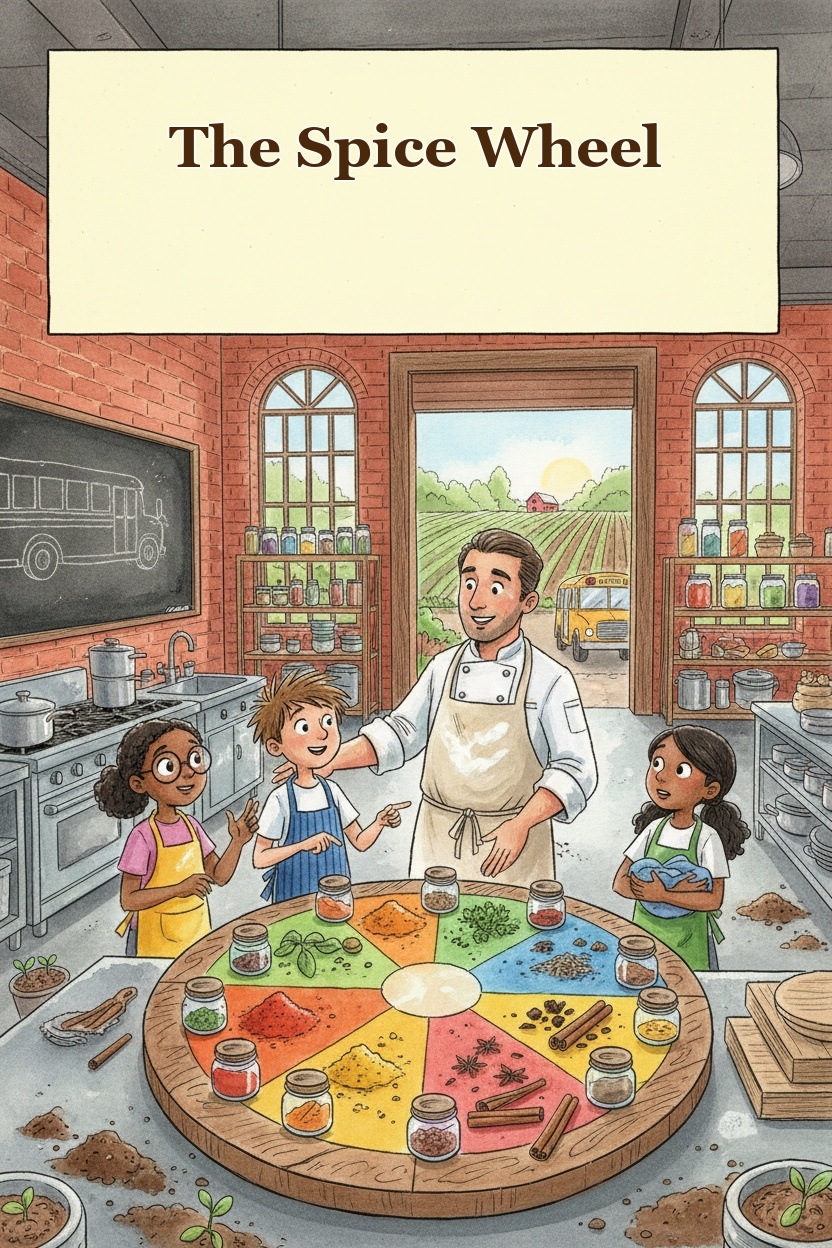
Book 27 in the Series: Chef Spark's Kitchen Lab
The Spice Arrival
The Riverside Fire Station smelled like a market exploded inside it. Not the kind of market with boxes of cereal and long refrigerated aisles, but the kind with burlap sacks of cardamom pods stacked next to bins of dried red chilies and pyramids of turmeric-stained fingers. Iggy had spent the morning setting up, and the Kitchen Lab looked like it had been decorated by a spice tornado.
"I counted thirty-seven jars," Maya said, adjusting her glasses and reading the label on a small clay pot. "And these aren't even labeled."
"They're not supposed to be," Priya said, her voice soft and a little nervous. She was carrying something wrapped in a blue cloth, held against her chest like a treasure. "Ammamma says you should know your spices by smell and touch and sight, not by what a sticker tells you."
"Your grandmother sounds like my kind of cook," Iggy said, emerging from behind the great stainless steel range. He was wearing his usual white chef's coat, but there was a smear of something yellow on his sleeve that might have been turmeric or might have been mustard—only his dry cleaner knew for sure. "Priya, are you ready?"
Priya nodded, but her hands were trembling slightly as she set the blue cloth bundle on the prep table. "Ammamma sent this. She said I should open it when everyone was here."
Tommy was already sniffing the air like a bloodhound. "What is that smell? It's like... warm and kind of sweet and also like someone's baking bread but also kind of spicy?"
"That's the fenugreek," Priya said. "And the cumin. And maybe the cardamom. Ammamma's house always smells like this. She says it's the smell of being loved."
"Your grandmother says a lot of beautiful things," Maya said.
"She's been cooking for sixty years," Priya said. "She has a lot of time to think about things while the onions cook."
Iggy clapped his hands once, and the class gathered around the horseshoe of prep tables. On the chalkboard behind him, he had drawn a large circle divided into six sections, like a pie, and each section had a word written in it. But the chalk marks were smudged, like he'd been erasing and redrawing them all morning.
"Before we begin," Iggy announced, "we have a guest. Someone who knows more about the history of food than anyone I've ever met. Someone who once told me that the story of a spice is the story of the whole world—the wars, the trade routes, the ships, the dreams."
"Did he really say that, or are you saying it?" Maya asked.
"He said something very close to that," Iggy said, "and I've been polishing it for years."
The door to the street opened, and a woman walked in. She was small and elegant, wearing a sari the color of saffron, and she carried a leather satchel that looked ancient and well-loved. Her glasses were round and gold-rimmed, and when she smiled, the whole kitchen seemed to get a little warmer.
"Welcome, everyone," she said. "I'm Dr. Anjali Patel. I study the history of food—how dishes travel, how ingredients move between cultures, how a recipe that starts in one kitchen ends up in kitchens all over the world."
"Dr. Patel is here because this book—this lesson—is about understanding where one of the world's most beloved food traditions truly comes from," Iggy said. "And I need her help because, honestly, I know I'm going to get something wrong if I try to explain it myself."
"An honest chef," Dr. Patel said approvingly. "That's rarer than you'd think."
The Six Tastes
Priya unwrapped the blue cloth. Inside was a battered tin box, the kind that might hold sewing supplies or old photographs. But when she opened it, the room filled with the richest, most complex smell any of them had ever encountered.
Inside the tin were smaller tins, each one dented and worn from decades of use. Priya opened them one by one, setting them on the table in a wide circle.
"This is Ammamma's spice box," she said. "She's had it since she got married. She says every kitchen needs a spice box because spices are the alphabet of cooking—you learn the letters, and then you learn to make words."
"The alphabet of cooking," Iggy repeated, writing it on the chalkboard. "I'm going to use that. With credit."
Dr. Patel leaned over the spice box, inhaling deeply. Her eyes closed for a moment. "Your grandmother has good cardamom," she said. "You can tell by the color of the pods. Green, tight, fragrant. Your grandmother knows her spices."
"She knows everything about cooking," Priya said. "But she says she doesn't know the science. She just knows what works."
"That's the beautiful thing about food traditions," Dr. Patel said. "They're accumulated knowledge. Thousands of years of people testing, tasting, adjusting, improving. Your grandmother's recipe isn't just her recipe—it's the recipe her grandmother's grandmother taught her. And the reason certain spices appear together over and over again isn't an accident. It's because they work together chemically."
"Chemically?" Dev asked, perking up for the first time since class started.
"Let me show you." Dr. Patel opened her satchel and pulled out a large poster. She unrolled it to reveal a wheel—a big circle divided into six colored sections.
"This is the spice wheel," she said. "But it's more than a spice wheel. It's a concept from Ayurveda, which is an ancient system of medicine and wellness that developed in India thousands of years ago. In Ayurveda, every food has a taste, and there are six primary tastes: sweet, sour, salty, bitter, pungent, and astringent."
"Six?" Tommy counted on his fingers. "I only knew about the five."
"Many food traditions in India recognize these six," Dr. Patel said. "And the idea is that a well-balanced meal should include all of them. Not all in equal amounts—but all present. Because each taste affects the body differently."
Iggy pointed to the wheel. "So when Priya's grandmother is cooking, she's not just making food taste good. She's balancing something."
"When I cook with Ammamma," Priya said slowly, "she always adds certain things together. She says the dal needs the tarka—the spice bloom. She says the mustard seeds need to pop."
"The mustard seeds," Dr. Patel said, nodding. "Do you know what happens when mustard seeds hit hot oil?"
"They pop," Tommy said.
"They pop," Dr. Patel agreed, "because the heat causes the moisture inside the seed to turn to steam very quickly, and the steam expands and bursts the seed coat. But that popping does something else. It releases the compounds inside the seed—the ones that make it taste pungent. And then those compounds mix with the oil, and the oil carries those flavors throughout the entire dish."
"So the popping isn't just a show," Maya said.
"The popping is the science," Dr. Patel said. "It's the delivery system."
Iggy was pacing now, his enthusiasm building. "This is the thing I love about cooking. The ground rules of flavor are chemical. Certain compounds dissolve in fat. Others dissolve in water. When you cook spices in oil, you're extracting the fat-soluble compounds. When you add water—like when you add tomatoes or water to your dal—you're extracting the water-soluble compounds. You get different flavors from the same spices depending on how you cook them."
"So the same spice can taste different?" Sam asked.
"The same spice can taste very different," Dr. Patel confirmed. "That's why the tarka is done at the end of cooking the dal. The spices bloom in hot oil and release their flavors into the fat. Then that fragrant oil gets stirred into the dal, and suddenly the whole dish changes. The spices have done two things—flavored the oil and flavored the dal—and the combination is more complex than either one alone."
Dev had been scribbling in his notebook. "So the reason certain spices appear together over and over—like cumin and coriander, or mustard seeds and curry leaves—is because their chemical compounds complement each other?"
"Exactly," Dr. Patel said. "Try this. Who has a pencil?"
Dev handed her one. Dr. Patel tapped it against the table a few times, then made a small, deliberate gesture that knocked a jar of turmeric off the edge of the counter. It clattered to the floor and rolled under the range.
Everyone looked at Iggy.
Iggy looked at the floor where the turmeric had vanished.
"Nobody saw anything," he said. "Continue."
Thinking Like a Thali
Dr. Patel carefully retrieved the turmeric jar, set it back on the counter, and continued as if nothing had happened. The students exchanged looks. The Spark Effect had claimed another victim.
"Let me tell you something important," Dr. Patel said, setting the poster aside. "You've probably heard the word 'curry' used to describe Indian food. Like all Indian food is curry. Like there's one dish called curry."
Tommy nodded. "My mom makes curry sometimes. It's really good."
"I'm sure it is," Dr. Patel said. "But here's what you need to understand. The word 'curry' as a catch-all term for Indian food is a simplification that came from British colonial rule. When British people encountered Indian cuisine, they were overwhelmed by its diversity—every region has its own set of dishes, its own spices, its own cooking methods. But it was easier to lump it all together under one name."
"So there's no actual dish called curry?" Sam asked.
"There are dishes called curry," Dr. Patel said. "But they're specific dishes from specific regions. Like the curries of South India, which are different from the curries of Bengal, which are different from the dishes of Punjab or Gujarat or Kerala. Indian cuisine is so diverse that the comparison often used is Europe—you wouldn't say 'European food' and expect that to describe everything from Italian pasta to Swedish meatballs, right?"
The students nodded, beginning to understand.
"That's what we're dealing with here. An entire subcontinent—billions of people, thousands of distinct regional traditions, millions of recipes passed down through families. And all of that variety was reduced to one word: 'curry.' It's like someone calling all food from Mexico 'salsa.'"
"Or all food from Italy 'pizza,'" Tommy said.
"Exactly," Dr. Patel said. "So when we cook today, we're not making 'curry.' We're making a very specific dish from a very specific tradition. Priya, can you tell us what we're making?"
Priya took a deep breath. "We're making Ammamma's dal with tarka," she said. "The recipe she learned from her mother, who learned it from her mother. The recipe that always tastes like home."
"What's dal?" Maya asked.
"Dal is a word for both lentils and the dish made from them," Dr. Patel said. "In India, lentils are a protein source that's been central to diets for thousands of years. There are so many varieties—red lentils, yellow lentils, black lentils, split pigeon peas, mung beans. Each one has a different cooking time, a different texture, a different flavor."
"And the tarka?" Iggy asked.
"The tarka is the tempering," Priya said. "You heat oil, and you add spices, and the spices burst and bloom, and then you pour the whole thing over the dal. Ammamma says the tarka wakes up the lentils."
"It wakes them up," Iggy repeated, savoring the phrase. "That's brilliant. Because it does. The lentils have been simmering away, kind of quiet, and then the tarka hits them, and suddenly—"
"Suddenly the whole dish is alive," Priya finished.
Iggy looked at her with something like wonder. "Priya, your grandmother is a food scientist. She just doesn't know the word."
The Mustard Seeds
The cooking began. Iggy organized the class into a production line, the way he always did: Sam measured the spices, Lucia was in charge of arranging them aesthetically on the prep table, Maya read the recipe card out loud to make sure everything was correct, and Dev was in charge of the lentils—rinsing them, checking for stones, making sure they were clean before they hit the pot.
The dal itself was simple. Red lentils, water, turmeric, and a pinch of salt, simmering together until the lentils broke down and thickened into a golden, soothing stew. It smelled gentle and comforting, the kind of smell that wrapped around you like a blanket.
But the tarka was the show.
"Okay," Iggy said, standing in front of the stove. "This is the moment. This is the science and the art and the history all boiling down together. Who wants to do the tarka?"
"I do," Priya said. Her voice was steady, but Iggy noticed her hands were trembling again.
"Then come up here, chef."
Priya took her place at the stove. On the counter beside her, Iggy had arranged the ingredients: ghee (clarified butter, which Priya had explained was different from regular butter because it doesn't burn at high temperatures), mustard seeds, cumin seeds, dried red chilies, and fresh curry leaves.
"Can someone remind me why we use ghee?" Iggy asked.
"Because the milk solids in regular butter burn at high temperatures," Maya said. "But ghee is pure butterfat. It wasn't really smoking point—it can get much hotter without burning."
"And what does that mean for our spices?"
"They can bloom faster and harder without tasting burnt," Tommy said.
"Exactly." Iggy turned to Priya. "Ready?"
For a moment, Priya didn't move. She stood there, looking at the pan, at the ghee just beginning to shimmer. And then she closed her eyes.
Iggy understood. He stepped back, giving her space.
Priya opened her eyes and dropped the mustard seeds into the hot ghee.
For half a second, nothing happened. The seeds sat in the shimmering butter, just sitting there, and Priya thought, did I do it right, is the heat high enough, is something wrong—
And then they started to pop.
It was like miniature fireworks. The mustard seeds danced and jumped and burst, sending little fragments of seed scattered through the shimmering ghee. And then Priya added the cumin seeds, which crackled and perfumed the air with their warm, toasty scent. Then the dried red chilies, which blistered and turned glossy. Then the curry leaves, which sizzled and curled and released the most extraordinary smell—citrusy and earthy and something almost like anise.
The kitchen filled with the smell of home.
And Priya, standing there at the stove with her hand on the handle of the pan, watching the mustard seeds pop in the hot oil, smelling the curry leaves, suddenly started to cry.
Not big tears. Not dramatic tears. Just a slight glisten in her eyes that she tried, briefly, to hide.
Maya saw it. She didn't say anything. She just moved quietly to stand beside Priya and wait.
"I'm okay," Priya said, her voice barely a whisper. "I just—this is the smell. This is the smell of Ammamma's kitchen. When I was little, I used to sit on the floor while she cooked, and this was the smell. This was the sound. The popping of the mustard seeds. Every single time."
"We can pause if you need to," Iggy said quietly.
"No," Priya shook her head, wiping her eyes with her sleeve. "No, this is—this is what I wanted. I wanted you all to know what it smells like. I wanted you all to know what it sounds like. When I said the tarka wakes up the dal, this is what I meant. It wakes up the whole kitchen. It wakes up the memories."
She poured the sizzling tarka over the pot of dal. The ghee hit the golden lentils, and a wave of steam rose up, carrying all those flavors—the mustard seeds, the cumin, the chilies, the curry leaves—up and out and into the kitchen, where everyone took a breath at the same time.
"Now it's dal," Priya said. "Before, it was just a bunch of lentils. Now it's dal."
"Because the tarka woke it up," Tommy said.
"Because the tarka woke it up," Priya agreed.
The Spice Wheel
They ate together, sitting at the prep tables, the pot of dal in the center, bowls passed around, no one talking very much because everyone was too busy tasting.
Sam broke the silence first. "This is the best thing I've ever tasted."
"You said that last week," Lucia reminded him.
"Well, now I mean it."
Tommy was making the hum—the two-note sound that indicated deep approval. He had already had three bowls.
Maya, who was careful about everything, had been eating slowly, paying attention. Now she set down her spoon. "The six tastes," she said. "Dr. Patel, can you help me taste them?"
"An excellent exercise," Dr. Patel said, smiling. "Look at your bowl of dal. What tastes are there?"
Maya looked at her dal. "Sweet?" she tried.
"Sweet is often the base of the dal—the natural sweetness of the lentils and the ghee. And also," Dr. Patel said, "the sweetness that comes from the cumin toasting in oil. Toasted cumin has a nutty, sweet quality. What else?"
"Salty," Tommy said, pointing at his bowl. "I can taste the salt."
"Meat and savory—I mean, it's not meat, but there's a savoriness."
"That's almost the sixth taste, which we call umami in Japanese cuisine," Iggy said. "The lentils themselves provide a deep savoriness. But what about the others?"
"Sour," Priya said. "Ammamma adds a little bit of tamarind to her dal. It makes the flavors bright."
"Bitter?" Maya frowned. "I don't taste anything bitter."
"The curry leaves," Dr. Patel said. "They have a slightly bitter edge, especially after being fried in the ghee. It's subtle, but it's there, pulling the other flavors into balance."
"Pungent," Dev said. "The mustard seeds and the chilies."
"Pungent," Dr. Patel confirmed. "And the last one is astringent—the kind of drying, tightening sensation that some foods leave in your mouth. The red lentils have a slight astringent quality. So you see: in one simple dish, all six tastes are present. That's the Ayurvedic concept. That's the spice wheel in action."
"I never think about all the different tastes when I'm eating," Tommy admitted.
"That's how it's supposed to be," Dr. Patel said. "A balanced meal doesn't announce itself as balanced. It just tastes satisfying and leaves you feeling good. That's the genius of these traditions—they were developed over centuries. No one sat down and said, 'I'm going to create a food system that provides all six tastes.' They just kept cooking, kept tasting, kept adjusting. And the recipes that worked became the ones that were passed down."
Iggy nodded, and it was unsettling, even more than before, how his whole attention was elsewhere for a second. Then he refocused. "And the global influence?" he prompted.
"The global influence," Dr. Patel said, "is everywhere. Black pepper from India used to be worth more than gold in Europe. Spices drove the age of exploration—people risked their lives to find faster routes to India because pepper and cardamom were so valuable. And then they brought those spices home, and they changed what food tasted like for the whole world."
"So every time I use pepper," Tommy said, "I'm using something from India?"
"Or from somewhere else where people adapted it," Dr. Patel said. "Pepper originally came from India, and now it's grown in Southeast Asia, South America, Africa. Plants and recipes spread. They change. They adapt. Indian food has influenced cuisines all over the world—through the Caribbean, through Africa, through England, through America."
"So it's kind of like the ultimate cookbook," Tommy said. "Everyone's been adding recipes for hundreds of years."
"Thousands," Dr. Patel corrected gently. "People in India have been cooking some version of dal for over four thousand years."
The kitchen went quiet.
"Four thousand years," Dev repeated.
"Four thousand years." Dr. Patel pointed at the pot of dal. "And you cooked it today. The same technique, the same flavors, the same balance of six tastes. Four thousand years later. You've connected to something really old."
Priya looked at the pot of dal. The smell was still in the air—fragrant and heady and full of memory and history.
"I wish Ammamma was here," she said quietly.
"She is," Iggy said. "In a way. She's in the recipe. She's in the smell. She's in the way you knew exactly when the mustard seeds were ready."
Priya smiled, wiping her eyes again. "She would have liked you, Chef Spark."
"I'm sure I would have liked her," Iggy said. "Anyone who has spent sixty years understanding the science of mustard seeds is my kind of cook."
Recipe: Ammamma's Dal with Tarka
What you need:
For the dal:
-
1 cup red lentils (masoor dal)
-
3 cups water
-
½ teaspoon turmeric powder
-
Salt to taste
-
1 small ball of tamarind (or 1 teaspoon tamarind paste) — optional, but Priya's Ammamma always added it
For the tarka:
-
2 tablespoons ghee (or vegetable oil)
-
1 teaspoon mustard seeds
-
1 teaspoon cumin seeds
-
2 dried red chilies
-
10 fresh curry leaves
What to do:
-
Rinse the lentils in a fine-mesh strainer until the water runs clear. This removes the dust and any tiny stones.
-
Put lentils, water, turmeric, and salt in a pot. Bring to a boil, then reduce to a simmer. Cook for 20-25 minutes, stirring occasionally, until the lentils are soft and starting to dissolve.
-
If using tamarind, add it during the last 5 minutes of cooking.
-
While the dal simmers, make the tarka. Heat ghee in a small frying pan over medium-high heat. The ghee should be shimmering but not smoking.
-
Drop in the mustard seeds. They will pop and jump — this is good! Wait until the popping slows down, then add the cumin seeds, chilies, and curry leaves.
-
The spices will sizzle and become fragrant very quickly — about 30 seconds.
-
Immediately pour the whole thing over the cooked dal. It will sizzle and bubble — this is the sound of flavor waking up the lentils.
-
Stir well, taste, and add more salt if needed.
Chef Iggy's Kitchen Lab Note: The tarka isn't just adding flavor — it's chemistry. The spices release their flavors into the hot ghee, and the ghee carries those flavors into the entire pot of dal. When the mustard seeds pop, you can actually see the science — the heat turns the water inside the seeds to steam, and the steam blasts out of the seed, releasing the chemicals that make it taste pungent. That's why your grandma's recipes work. That's why any tradition works: it's thousands of years of people testing and tasting and getting it right. When you cook, you're not just making food. You're being part of that chain. And it's a delicious chain to be part of. — Iggy
Kitchen Lab Notes
Today you learned:
-
Indian cuisine is wildly diverse — it's more like the concept of "European food" than one single style. The word "curry" is a simplification that misrepresents thousands of distinct regional traditions.
-
The six tastes of Ayurvedic cooking: sweet, sour, salty, bitter, pungent, and astringent. A balanced dish often includes all six.
-
Spices are both flavor and medicine — different combinations appear over and over because their chemical compounds work together.
-
The tarka technique uses hot oil to bloom spices, releasing their flavors so they spread through an entire dish.
-
Indian food has shaped the world — spices were once worth more than gold and drove exploration, trade, and even wars.
Question to think about: What other food traditions might use "blooming" techniques — flavoring oil — to carry taste throughout a dish? Think about the chili oil in Chinese cooking, the soffritto in Italian food, the cooked spices in Mexican cuisine. Where else might you find this same chemistry at work?
When the class was over, and the students had drifted out into the afternoon, Iggy stood alone in the Kitchen Lab. The pot of dal was nearly empty. His students had eaten almost everything, which was the highest compliment they could give.
The kitchen still smelled of mustard seeds and curry leaves.
"Four thousand years," he said to no one, and then he went to finish his own bowl of dal before it got cold.
From her seat by the doorway, a small blue cloth bundle caught his eye—Priya had left behind Ammamma's spice box, and the tins were shining in the late afternoon light, gleaming like tiny towers of brass, waiting to be carried into the next kitchen, into the next memory, their alphabet of flavors waiting for the next cook to learn its words.
END OF BOOK 27: THE SPICE WHEEL