Just Like Me
My Brain Noticed Something
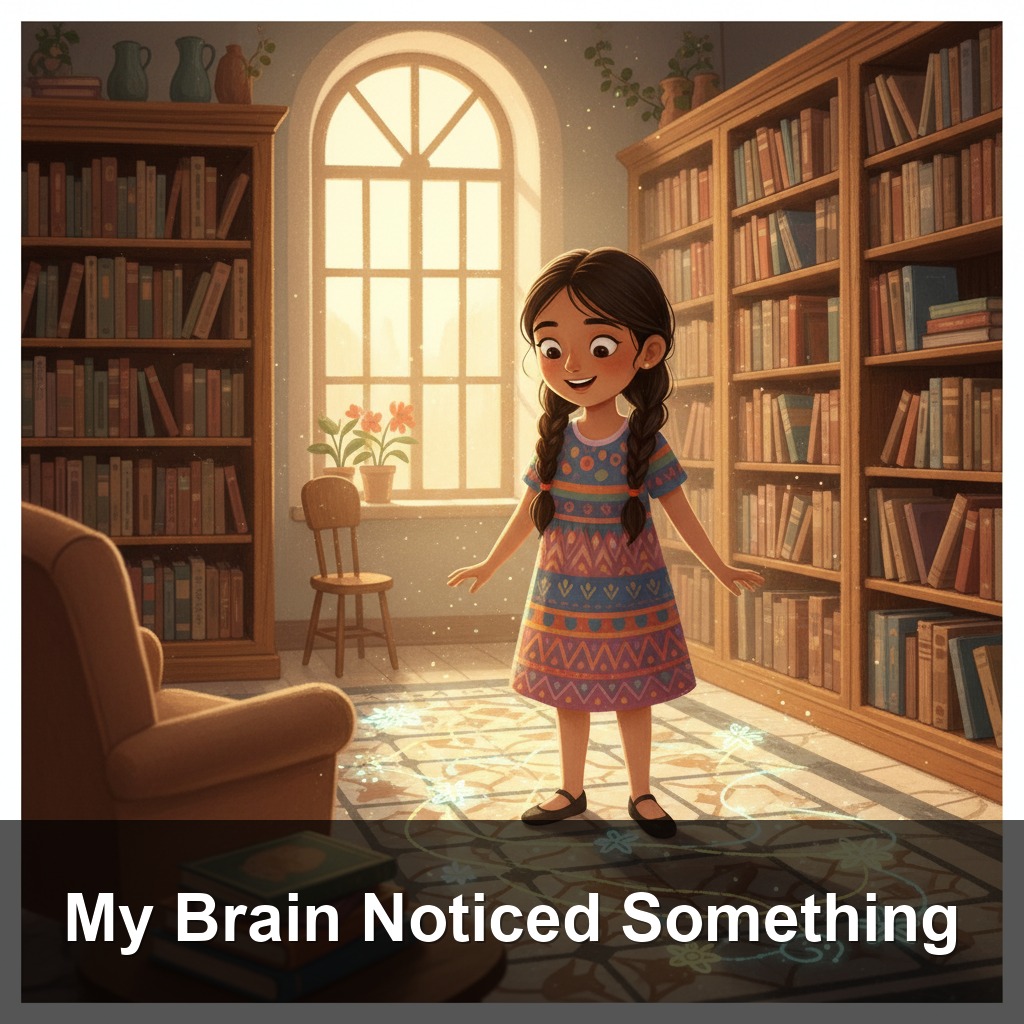
Sam's Brain Noticed Something
Sam's favorite place in the whole world was the library.
Not just because of the books—though Sam loved books, especially the ones with pictures of deep sea creatures with glowing lights on their heads.
No, Sam loved the library because of the floor.
The floor was covered in tiles. Big square tiles the color of cream. And every few tiles, there was a different one. A blue one. A green one. A small one. A cracked one.
Sam's brain noticed things. That was what Sam's brain did. It noticed patterns everywhere—in the way the sidewalk slabs repeated their shapes, in the way the school bell rang at exactly the same time every day, in the way the morning light fell across the kitchen table in stripes.
Other people walked across the library floor without looking.
Sam looked.
The tiles were mostly cream. But Sam noticed that the blue tiles made a shape. Not a square. Not a straight line. A curve.
"Jordan," Sam said. "Come here."
Jordan came over and looked at the floor. "What?"
"The blue tiles," Sam said. "Do you see them?"
Jordan looked. And looked. "They're just... scattered?"
Sam shook their head. "No. Watch."
Sam walked slowly across the floor, stepping on each blue tile. Jordan followed, watching Sam's feet. From this angle, stepping in order, the blue tiles traced a shape across the floor.
It looked like a wave. No—like a fish. No—
"It's a whale," Sam said. "A whale."
Jordan tilted their head. "Huh. Okay, I see it now. Kind of."
Sam's brain was already working. The whale made a curve with its tail, and the tail pointed toward a green tile on the wall. Sam walked to the green tile. Then noticed the green tile was part of a pattern too.
"Jordan," Sam said. "There are more."
The green tiles made a shape too. Together they spelled something. Or almost spelled something.
"Letters," Sam said. "The green tiles are letters."
Jordan squinted. "What do they say?"
Sam moved closer. The green tiles were small, nestled among cream ones near the children's section. Sam counted them. Traced them with a finger.
"G-O... O-D... Good?" Sam said.
And then the final tile. "L-U-C-K. Good luck."
Jordan's eyes went wide. "Someone made that? On purpose?"
Sam's brain was already moving forward, connecting dots, finding patterns. "The blue whale's tail points to the green letters." Sam looked up. "And the green letters point... where?"
The last green tile was aimed at the stairs. The stairs to the second floor, where the old books lived. The ones nobody checked out anymore because they were dusty and the pages were thin and they smelled like secrets.
Sam took the stairs two at a time.
The second floor was quiet. The carpet was gray and worn. But along the back wall, where the shelves were oldest, Sam noticed something.
The books. Their spines. Red, blue, red, blue, red, blue—no. Not a pattern.
Red, blue, red, red, blue. Red, blue, red, red, blue.
Sam pulled out the two books that were out of place. Behind them, dusty and curled at the edges, was a piece of paper.
"This is a treasure hunt," Sam said.
Jordan ran up the stairs. "What?"
"A treasure hunt," Sam said again. "Someone made it. A long time ago."
The paper was yellow. The writing was in pencil, faded but still readable.
If you can see the patterns, you can find the treasure. Follow the whale. Follow the words. Follow the numbers.
Numbers. Sam looked at the paper again. At the bottom was a string of numbers that made no sense to Jordan but made perfect sense to Sam.
"Bookcase numbers," Sam said. "This is a library code."
Jordan laughed. "Your brain noticed that?"
"My brain notices things," Sam said. "That's what my brain does."
They followed the numbers. Bookcase 12, shelf 3. Bookcase 5, shelf 1. Bookcase 8, shelf 2. On each shelf Sam found a book with a small folded note inside. The notes didn't say much—just a word, a line, a hint.
Think like water.
Look for what's hidden inside.
You are close.
The last note said: Check the book with the whale on the cover.
Sam knew that book. Everyone did. It was the biggest book in the children's section—a huge old encyclopedia about ocean life. It was propped up on a special stand because it was too heavy to sit on the shelf.
Sam opened it to the middle. There, in the pages about whales, was an envelope.
Inside was a letter and a photograph.
The photograph showed a library—this library—but years ago. In the photograph, a young girl sat on the floor, looking at the tiles. She was smiling.
The letter was from the girl. She was grown up now, she wrote. She used to come to this library every Saturday. She noticed the tile patterns when she was eight years old. She was the one who wrote the code, who set up the treasure hunt, who wanted to leave something for someone else who would see what she saw.
Because everyone thought I was strange, the letter said. I stared at the floor instead of talking to people. I counted the tiles instead of playing games. But the tiles were my friends. They told me stories. I wanted to leave a story for the next person whose brain noticed things.
If you're reading this, you found it. You see what I saw. I'm not strange. I'm not alone. And neither are you.
This library was my safe place. Now it's yours.
Thank you for noticing.
Sam read the letter three times. Then Sam looked at Jordan.
"Someone like me," Sam said quietly. "She noticed things too."
Jordan sat down beside Sam. "Usually when someone leaves a treasure, the treasure is gold or candy or something."
"The treasure is this," Sam said. "The letter. Knowing someone else saw it too."
Jordan was quiet for a minute. Then Jordan said, "Can we put it back? So someone else can find it someday?"
Sam smiled. The biggest smile.
"We can make a new clue," Sam said. "One that starts where hers ended."
And so they did. They folded the letter carefully, tucked it back in the book, and hid it again. But Sam added a new piece of paper.
To the next person whose brain notices things: I see you. You're not alone. This library was my safe place too.
Thank you for noticing.
Sam's brain noticed things. And that—Sam knew now—was exactly right.
A Note for Readers:
This book is about pattern recognition as a gift. Many autistic people—and many other neurodivergent people—have brains that notice details, connections, and patterns that others miss. This can be wonderful, but it can also feel isolating when no one else seems to see what you see. This story is about what happens when a "different" way of seeing leads to connection. If your child is a pattern-noticer, they are not strange. They have a gift. And there are others out there who see the same things they do—sometimes waiting to be found, like a message hidden in a library floor.