Inside Out Academy
THE FULL ROUTE
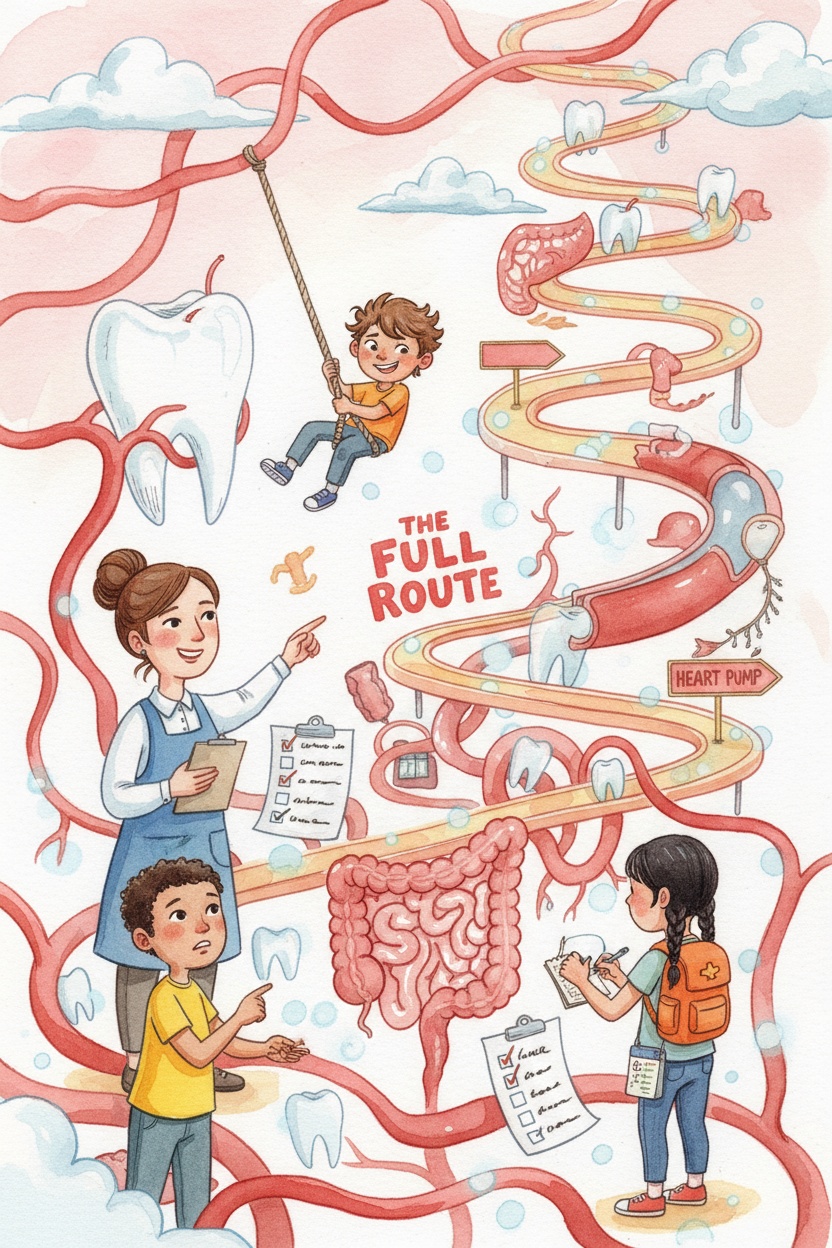
MS. VANCE'S CURRENT CHECKLIST
Location: Inside the right atrium, approaching the tricuspid valve
Students accounted for: All 22, plus Ms. Vance
Status: Leo is holding a rope. This is fine. This is fine.
THE ARGUMENT
The class stood at the edge of the right atrium, looking out at the enormous chamber before them. The walls pulsed with a rhythm that shook the floor they stood on. Every few seconds, the entire space contracted around them—a wave of muscle that pressed through the chamber and pushed blood past them toward the valve ahead.
"We're doing it again," Ms. Vance said. "Everyone, eyes on me."
Twenty-two fifth-graders turned. Most of them. Leo was trying to tie the rope to a structural ridge in the heart wall.
"We have two routes to document," Ms. Vance continued. "The pulmonary circulation—from heart to lungs and back. And the systemic circulation—from heart to body and back. Both are essential. Both must be mapped."
"So we go together," Marcus said. "One group, both routes, in order."
"That would take twice as long," Sadie said. "The pulmonary route is short. Heart to lungs, lungs to heart. Then the systemic route is the long one—heart to body, body to heart. If we split up, we can document both at the same time."
Ms. Vance's clipboard hovered in the air. She looked at it. She looked at the class.
"We don't split up," she said. "That's a rule."
"There's no rule about that," Leo said.
"There's an unwritten rule," Ms. Vance said.
"There's a written rule!" Fatima said, holding up the edge of the wrapper they'd been using as a map. "I wrote it. 'No splitting up.' I wrote it in Book Three."
"That was about the skin cell," Marcus said.
"It's a general principle!" Ms. Vance said.
"The problem," Sadie said carefully, "is that the two routes are connected. We're standing right now at the place where both routes begin. The right ventricle pumps blood to the lungs. The left ventricle pumps blood to the body. If we want to understand the full loop, we need to see both."
Ms. Vance looked at the checklist. She looked at the class. She looked at the checklist again.
"We split," she said. "But we split carefully."
The class erupted. Leo was already running toward the rope.
"Groups of eleven," Ms. Vance said, raising her voice. "Group One: pulmonary circulation route. Led by Sadie. You'll go through the right ventricle, into the pulmonary artery, through the lungs, and back through the pulmonary veins to the left atrium. Group Two: systemic route. Led by me. We'll go through the left ventricle, out through the aorta, follow the circulation through the body, and return through the vena cava to the right atrium."
"Sadie leads a group?" Marcus said. "She's the navigator?"
"She knows the route," Ms. Vance said. "She's been studying it."
Sadie was already writing notes on her arm with a pen she'd found somewhere. "Okay so technically the pulmonary route is the only route where arteries carry deoxygenated blood," she said. "Everyone in my group needs to remember that."
"Arteries carry oxygenated blood," Marcus said. "That's the rule."
"Not in the pulmonary circuit," Sadie said. "In the pulmonary circuit, the arteries are carrying blood to the lungs to get oxygen. So they're carrying deoxygenated blood. And the pulmonary veins are carrying oxygenated blood back."
"That's backwards," Marcus said.
"That's the point," Sadie said. "It's the one exception."
Ms. Vance raised her hand. "This is why we're splitting up. Because the circulatory system is not one loop—it's two loops, working together. The right side of the heart handles deoxygenated blood. The left side handles oxygenated blood. They never mix."
"That's the key," Fatima said quietly. "They're two separate pumps, side by side."
"Exactly," Ms. Vance said. "Each group will document what they see. When we meet back in the left atrium, we'll compare notes."
Leo had already tied the rope to something and was swinging toward the tricuspid valve.
"Leo!" Ms. Vance shouted. "Which group are you in?"
He paused mid-swing. "The one that goes first!"
"That's not a group," Marcus said.
"It's a philosophy," Leo said.
THE PULMONARY ROUTE
Sadie's group—eleven students including Leo, who had decided at the last moment that the pulmonary route was the shorter one and therefore "the smart one"—moved through the tricuspid valve in a tight cluster, holding onto each other's backpacks and shirtsleeves.
The valve closed behind them with a sound like a door slamming underwater. They were in the right ventricle now, a chamber so powerful that the floor itself seemed to move. Every beat of the heart pushed them upward, toward the exit.
"The pulmonary artery is right there," Sadie said, pointing. "When the ventricle contracts, blood gets pushed through that valve into the artery. That's the only way out."
"It's like a subway," Leo said.
"It's exactly like a subway," Sadie said. "Except the subway is full of blood and you're in it."
They pushed forward through the pulmonary valve. The vessel ahead was wide—enormous, really—and they were immediately swept into a current that carried them forward whether they wanted to move or not.
"This is the pulmonary artery!" Sadie shouted over the rush. "It splits into two branches—one going left, one going right. Each branch goes to one lung!"
"Which one do we take?" Leo asked.
"Doesn't matter," Sadie said. "The lungs are the same on both sides. Mostly. The right lung has three lobes, the left has two."
"Why?" Leo asked.
"Because the heart takes up space on the left side," Sadie said. "The left lung made room."
They took the right branch. The vessel narrowed, then split again into smaller and smaller passages. The current slowed. The walls around them thinned, became translucent.
"We're getting close to the capillary beds," Sadie said. "This is where the exchange happens."
The passage narrowed until they had to crawl. The walls around them were so thin they could see through them—on the other side, a lattice of tiny air sacs, each one a bubble of almost impossible delicacy.
"The alveoli," Sadie whispered.
They emerged into a capillary that wrapped around one of the air sacs like a thread around a balloon. The wall between the blood and the air was so thin that Leo could see faint shapes moving on the other side—gases, diffusing across the membrane.
"Oxygen from the air moves into the blood," Sadie said. "Carbon dioxide moves out. The blood is switching—deoxygenated in, oxygenated out."
"But we're in the blood," Leo said.
"Yes."
"So we're getting oxygenated too?"
"Yes."
Leo took a deep breath and immediately started coughing as the oxygen flooded into his bloodstream and, presumably, into his entire body.
"That's what happens when you breathe!" Sadie said. "Everyone's blood does this. Every time you breathe in, this exchange happens in millions of alveoli at once."
"Millions?" someone said.
"About 480 million," Sadie said. "Give or take."
The class was quiet for a moment, crouched inside a single capillary, watching the oxygen pass through the wall beside them.
"Okay," Leo said. "That's the most beautiful thing I've ever seen."
"The exchange is only possible because the walls are this thin," Sadie said. "That's the whole trick. The capillary walls are one cell thick. Oxygen travels through them by diffusion—from high concentration to low concentration, no energy needed."
"So the blood gets oxygen for free," Leo said.
"Everything in the body is free if you don't count the food and sleep," Sadie said.
They followed the capillary as it curved around the alveolus, then joined with other capillaries, growing larger and larger until they were back in a proper vessel—this time moving in the direction of the heart.
"This is a pulmonary vein," Sadie said. "And look—_" She held up her arm, where she'd drawn a small diagram. "We're in the one place in the entire body where veins carry oxygenated blood. Because this blood has been to the lungs. It's fresh. It's ready."
"Ready for what?" Leo asked.
"Ready to go to the body," Sadie said. "The left side of the heart is going to pump this oxygenated blood out through the aorta, and it's going to travel everywhere—all the way to your toes. And then it's going to come back, through the veins, deoxygenated again, and the whole process starts over."
"So the pulmonary route is like—charging the battery?"
"Exactly," Sadie said. "It's the charging station. The systemic route is the battery being used."
They emerged into the left atrium—a chamber full of oxygenated blood, glowing faintly in the light of their lamp with a color that seemed somehow brighter, richer.
Sadie checked her notes. "We're here. Now we wait for Group Two."
THE SYSTEMIC ROUTE
Ms. Vance's group had a different experience.
They'd entered through the mitral valve from the left atrium into the left ventricle, and Marcus had immediately understood something important.
"The left ventricle is thicker," he said. "Look at the walls."
"Because it has to pump blood to the entire body," Ms. Vance said. "The right ventricle only pumps to the lungs—which are close by. The left ventricle has to push blood all the way to your feet and back."
"So it's stronger," Marcus said.
"About six times stronger," Ms. Vance said. "Muscle thickness matters. The left ventricle is the most muscular chamber in the heart."
They pushed through the aortic valve and into the aorta itself—a vessel so wide that the entire group could spread out and walk side by side down the center of it.
"This is the largest artery in the body," Ms. Vance said. "It's about the width of a garden hose in a grown adult. At our scale, it's..." She paused. "It's a highway."
They walked. Branches split off to the left and right—carotid arteries heading up to the brain, coronary arteries feeding the heart itself, mesenteric arteries heading to the digestive system.
"Every branch is a destination," Ms. Vance said. "Arteries branch smaller and smaller, until they become arterioles, and then capillaries—threads so small that blood cells pass through in single file."
"How do we get to see one?" Marcus asked.
We're going to follow a branch down," Ms. Vance said. "To the capillaries, where the real work happens."
They took a branch that led toward the arm—the subclavian artery, Ms. Vance identified it. Then narrower: the axillary, the brachial. The vessel walls were still thick, still muscular.
"Arteries have thick walls because they carry blood under high pressure," Ms. Vance said. "The heart is pushing on this blood with every beat. The artery walls have to hold that pressure."
"Like a fire hose," Marcus said.
"Exactly like a fire hose."
They branched again—now moving through an arteriole, the walls thinner but still muscular. Ms. Vance pointed out the smooth muscle in the walls, the way it could contract to narrow the vessel or relax to widen it.
"Your body controls blood flow by changing the size of these vessels," she said. "When you're cold, it narrows the vessels in your skin to keep heat inside. When you're hot, it widens them to release heat. When you're running, it widens the vessels in your muscles so they get more blood."
The arteriole narrowed. The group had to squeeze through single file. The walls around them became translucent, thin, almost delicate.
"Welcome to the capillaries," Ms. Vance said.
They emerged into a space so small that they had to press against the walls to fit. Around them, red blood cells—enormous, flattened, flexible—squeezed through the capillary in single file, bending and deforming to slide through the tight spaces.
"Capillary walls are one cell thick," Ms. Vance said. "That's the secret. Everything that needs to exchange—oxygen, carbon dioxide, nutrients, waste—has to pass through these walls. If the walls were thicker, the exchange couldn't happen fast enough."
Marcus reached out and touched the wall. It was warm, alive, breathing somehow.
"Look at the red blood cells," he said.
They were passing through the capillary beside the class—each one a disc shape, slightly flattened in the center, carrying its cargo of oxygen. As they passed, Marcus could see the oxygen molecules clustered around them, attached to the hemoglobin inside.
"They release oxygen here," Ms. Vance said. "Into the tissues. The tissues need it for energy. Then they pick up carbon dioxide—the waste product—and carry it back to the heart."
"So this is where the exchange happens," Marcus said. "Not in the arteries. Not in the veins. Here."
"The capillaries are where the actual work of the circulatory system happens," Ms. Vance said. "Everything else—the heart, the arteries, the veins—is just plumbing. This is the delivery point."
"Capillaries are everywhere," Fatima said. She'd been quiet, watching. "Every tissue in the body has them. That's how the blood reaches everything."
"Every tissue except—" Marcus started.
"Cartilage doesn't have them," Fatima said. "And the lens of the eye. They get nutrients through diffusion instead."
Ms. Vance smiled. "You've been paying attention."
The group observed for a while longer—watching the red blood cells squeeze through the capillary, watching the exchange happen at the cellular level, watching the walls flex and breathe with the pressure of the blood.
Then it was time to go back.
"Veins," Marcus said, as they moved into a vessel where the walls were thinner, the pressure lower. "How do we know it's a vein?"
"The pressure is lower," Ms. Vance said. "And the walls are thinner. Veins don't need thick walls because the blood isn't under high pressure anymore. The heart's pumping force has been spent."
"How does the blood get back to the heart?" Marcus asked.
"That's the question," Ms. Vance said. "And the answer is: it's not the heart. The veins have valves."
She pointed. Inside the vein, at intervals along the walls, were small flaps—valves that opened in one direction only.
"The muscles of your body squeeze the veins when you move," Ms. Vance said. "Each squeeze pushes the blood forward, and the valves stop it from flowing backward. That's how blood gets back to the heart when you're standing up—your leg muscles are helping pump it."
"So moving is part of the system?" Marcus said.
"Movement is essential to the system," Ms. Vance said. "That's why exercise matters. Your muscles are helping your heart circulate blood."
The group followed the vein upward, moving with the current as it flowed back toward the chest, through the subclavian vein, into the vena cava—a massive vessel that carried all the deoxygenated blood from the body back to the right atrium.
"Notice," Ms. Vance said, "that this blood is deoxygenated now. The oxygen was delivered to the tissues. The blood is carrying carbon dioxide back to the lungs to be exhaled."
"So the whole loop is—" Marcus started.
"Two loops," Ms. Vance said. "Pulmonary: heart to lungs and back. Systemic: heart to body and back. They're connected, but they're separate. The right side of the heart handles the deoxygenated blood. The left side handles the oxygenated. They never mix."
"Because if they mixed—"
"The oxygenated blood would be diluted," Ms. Vance said. "And the whole system would be less efficient."
They arrived back at the heart—a small group of students, muddy, tired, and completely awed.
THE COMPARISON
They met Sadie's group in the left atrium, where the oxygenated blood flowed in through the pulmonary veins and out through the mitral valve, bright and clean and ready.
"Well?" Ms. Vance said.
"The pulmonary route is short," Sadie said. "Roughly heart to lungs and back. The whole exchange happens in the capillaries around the alveoli. Oxygen in, carbon dioxide out."
"We saw capillaries too," Marcus said. "They're everywhere. The exchange happens in every tissue."
"Is it the same?" Leo asked.
"The same mechanism—diffusion across a thin wall," Sadie said. "But in the lungs, oxygen moves into the blood. In the tissues, oxygen moves out."
"So the lung capillaries are charging the blood—" Leo started.
"—and the body capillaries are using the charge," Marcus finished.
"It's two sides of the same system," Fatima said. "The heart is in the middle, keeping them separate."
Ms. Vance looked at her checklist. She made some notes. Then she made some more notes.
"The class has split in half," she said, "and I will admit—the results are better than I expected. We have complete documentation of both routes. We can compare them. We can understand the whole system."
"Because we saw both," Leo said. "The short route and the long route."
"Because you saw both," Ms. Vance said. "The pulmonary circuit is what allows you to breathe. The systemic circuit is what allows your body to use the oxygen you breathe. You need both."
"Two loops," Marcus said. "One heart."
"One heart, four chambers," Sadie said. "Two on the right for deoxygenated blood. Two on the left for oxygenated. Never mixing, always working together."
Leo, who had been quiet for an unusually long time, spoke up.
"So Mr. Gomez's heart is doing this right now. Right this moment."
"Every moment," Ms. Vance said. "From before you were born. Every beat, both circuits, working."
"That's—" Leo stopped. "That's a lot of beats."
"About 100,000 per day," Sadie said. "Give or take."
"About 2.5 billion times in a lifetime," Marcus added.
The class stood in the left atrium, listening to the heartbeat—the enormous, rhythmic, impossible sound of the organ that had been working for every single moment of Mr. Gomez's life, pushing blood through two separate circuits, delivering oxygen and collecting waste, keeping him alive without him having to think about it even once.
"Okay," Leo said. "Okay. That's better than the stomach."
"I don't know," Sadie said. "The stomach was also pretty impressive."
"The stomach tried to digest me," Leo said. "The heart is just trying to keep everyone alive."
"Including us," Fatima said.
"Including us," Ms. Vance agreed. "We are riding on a red blood cell's commute, in the middle of a system that never stops."
She looked at her checklist. She made one final note.
"Next stop: the lungs," she said. "We have seen the circulation. Now we'll see what happens at the other end of the line—where the oxygen comes from in the first place."
"The breathing rooms," Leo said.
"The breathing rooms," Ms. Vance confirmed.
And somewhere outside, Mr. Gomez felt a faint fluttering in his chest, smiled, and went back to reading his newspaper.
MR. GOMEZ'S EXTERNAL LOG — DAY TWO
I felt something today. A little pressure in my chest, like something was moving from one side to the other. Then a second pressure. I sat down for a minute to make sure I wasn't having a heart attack. I wasn't. It just felt like there were two things in there, doing a very careful job.
I had a sandwich for lunch. A turkey sandwich. I hope they liked it. I don't know what it looks like from the inside. I'm not sure I want to know.
The principal called again. I said I had a stomach bug. He asked why I was eating a turkey sandwich if I had a stomach bug. I said I was testing it. He said "Please advise." I told him to advise his way out of my sick leave.
My knee is fine today. No complaints.
—Mr. Gomez