The Logic League
Everyones Work
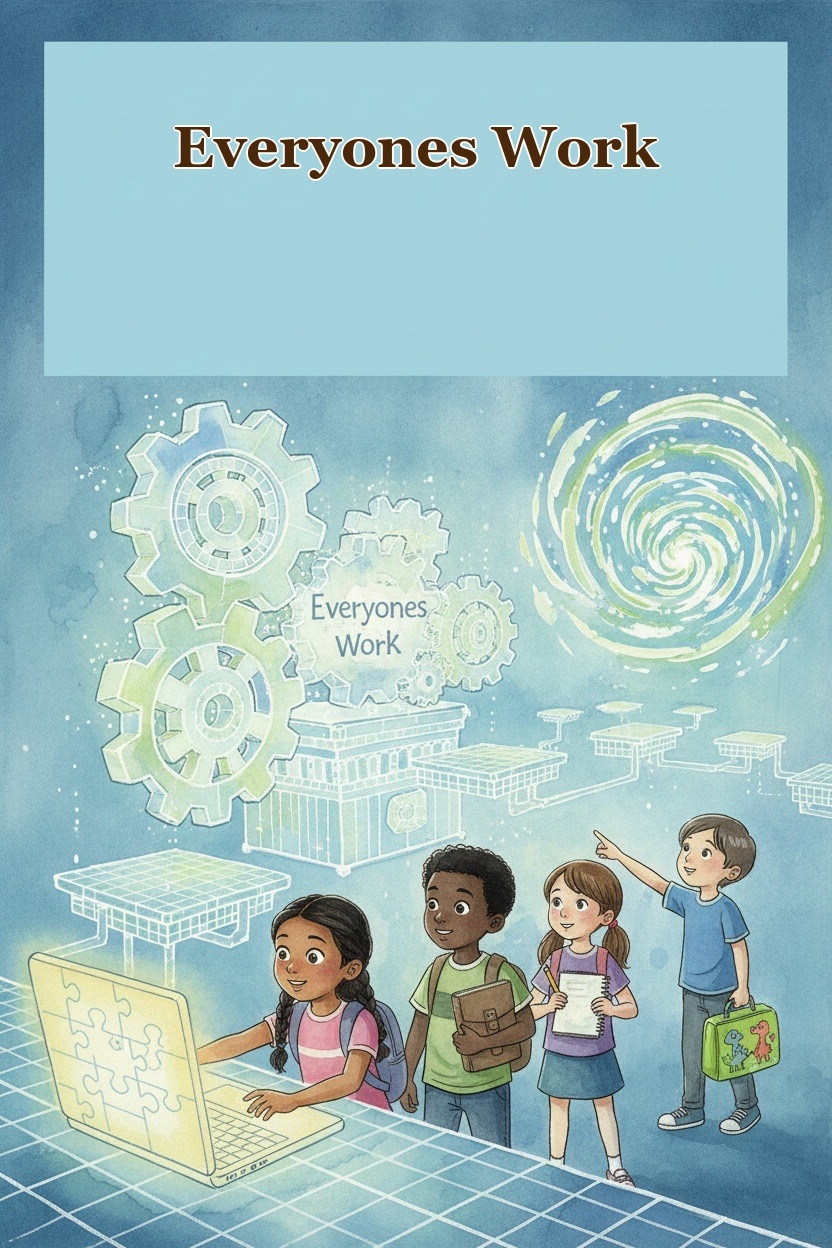
The Workshop That Wasn't Empty
The lost-and-found laptop glowed warm on the dusty shelf, and Priya's fingers had barely touched the keyboard before the familiar green text spilled across the screen. The doorway rippled open, and the four kids stepped through into the Outer Grid's silver-and-red landscape.
But something was different.
The usual hum of the Grid—that constant, quiet thrum of processes running—was louder here. Brighter. Almost... busy.
"Whoa," Sam said, stopping so fast that Kwame bumped into them. "Look."
The path ahead curved toward what looked like a massive workshop, its walls made of glowing glass panels. Through them, the kids could see dozens of figures moving—small, blocky shapes that worked at benches, typed on floating keyboards, and called out to each other across the vast room.
"I thought we were the only people here," Lily said, squinting. "I mean, the only people people."
"Apparently not," Kwame said slowly. "The Grid must have other visitors. Other... builders."
Priya was already walking toward the entrance, her pace quickening. "Come on. We need to see what they're doing."
The door slid open without resistance, and the kids stepped into the strangest room they'd ever seen in the Grid.
Workbenches stretched in every direction, each one covered in lines of code that floated in the air like holographic blueprints. But the code wasn't static—it was moving. New lines appeared at the bottom of each block, scrolling upward as if being written by invisible hands.
And everywhere, the blocky figures worked.
One figure at a nearby bench was carefully reviewing a long section of code, highlighting lines and making tiny adjustments. Another was building something from scratch, starting with a single function and expanding it outward. A third was copying a section of code from a shared wall and pasting it into their own project, nodding approvingly.
"Is anyone going to tell us what's going on?" Sam asked, spinning around to take it all in.
A voice answered from behind them. "They're too busy improving things to introduce themselves."
The kids turned. A tall figure stood there—not blocky like the workers, but smooth and curved, with kind eyes that seemed to hold the entire Grid in them. The figure wore a cloak that shimmered with moving code, constantly shifting like water.
"Who are you?" Priya asked.
"I'm called the Maintainer," the figure said. "I keep the Grid running. But I don't do it alone." They gestured at the workshop. "Everyone here contributes. Everyone builds on everyone else's work."
Kwame's brow furrowed. "You mean... all these people write code together?"
"Not together exactly," the Maintainer said. "But they share. They build on each other's foundations. Watch."
The Maintainer gestured toward a young figure at a nearby bench. The figure was working on a simple function—something that sorted a list of glowing orbs by size. But they were stuck, clearly frustrated, trying to figure out why the largest orb kept ending up in the middle.
"I can't fix this," the figure muttered. "I've tried everything."
The Maintainer pointed, and a small window opened above the figure's workbench, showing a community board filled with shared code. The figure scrolled through it, and a message caught their eye:
From: Jax the Builder
"I had this problem last cycle! The issue is in your comparison step. You're comparing size as text instead of number. Here's a fixed version:"
A block of code appeared, clearly labeled with Jax's name and a note about how it could be reused. The frustrated figure copied it, adapted it slightly, and ran it again.
The orbs sorted perfectly.
"Yes!" the figure cheered. "Thank you, Jax!"
Priya's eyes went wide. "They just used someone else's work."
"With permission, with credit, and with improvement," the Maintainer said. "That's how the Grid grows. No one person could write all of this." They swept their arm across the vast workshop. "But together? We can build anything."
The Broken Bridge
The workshop was fascinating, but the kids hadn't come to the Outer Grid just to watch. Their mission this time was to reach the Signal Spire, a tall structure in the distance where they'd been told they could access a map of the Outer Grid's hidden paths.
They left the workshop and followed a silver path toward the Spire. But they hadn't gone far before they hit a problem.
The path ahead crossed a wide chasm, and the bridge that should have crossed it was broken—literally. Half-built. The first section was complete, a solid walkway about ten steps long. But the second section was missing entirely, leaving a gap of at least twenty steps to the other side.
"Great," Lily said, peering over the edge. "We can't jump that."
Sam walked up to the first section and examined it. There was a small screen built into the railing, showing code that seemed to control the bridge. "Maybe we can finish it?"
Priya was already reading the code. "Look at this. The bridge is meant to be built in sections. Each section is a program that extends the bridge by ten steps. Someone built the first section..." She scrolled down. "But nobody built the second one."
"Can we build it?" Kwame asked.
Priya stared at the code. The first section was complex—there were variables for width, height, and material strength. There were loops for laying down the floor planks and conditions for checking that each plank was secure before adding the next.
She'd learned a lot over thirty-three adventures, but this was a lot.
"It would take me hours," she admitted.
From behind them, a voice said, "Maybe you don't have to build it from scratch."
They turned. A small, round figure stood there, watching them with friendly eyes. They'd seen this figure in the workshop, working at one of the benches.
"I'm Bree," the figure said. "I saw you leave. I figured you were heading to the Spire." They nodded at the bridge. "This thing's been broken for a while. The original builder, Niko, moved on to another project and never came back."
"So we're stuck," Sam said.
"Not necessarily." Bree walked up to the screen and tapped it. A menu appeared—the community board. "Niko published their bridge code. It's open for anyone to use. I can access it right now."
Bree scrolled through the code, found the first section, and highlighted it. "This section works fine. We just need to build a second section that connects to it. And Niko's code already has the structure—we just need to extend it."
Kwame leaned in, studying the code. "It's like taking a story and writing the next chapter. The characters are already there. You just have to continue the plot."
"Exactly!" Bree said, beaming. "That's how open sharing works. You build on what's already there. You don't have to start from nothing."
Bree opened a new window and started writing—copying the first section's structure, modifying it slightly, and adding new code that would connect the second section to the first. But as they worked, they hit a problem.
"This connection point," they said, frowning. "It needs to match exactly, or the two sections won't lock together. But Niko's code uses a different connector type than this bridge needs."
Priya examined the code. Bree was right. The first section had been built for a different kind of bridge, with a different locking mechanism. Trying to connect the second section would fail.
"Maybe we can change the connector type in the first section?" Lily suggested.
"If we modify Niko's code, we break the original bridge," Bree said. "That means everything built on it would break too."
Sam was quiet for a moment, staring at the screen. Then they said, "But what if you write a new connector that translates between the two types? Like... you make something that fits both."
Everyone turned to look at Sam.
"What?" Sam shrugged. "When we played that game at school, the adapter let us plug the old controller into the new console. They're different, but the adapter makes them work together."
Bree stared at Sam, then back at the code. "A bridge adapter. A small program that sits between the two sections and translates the connection. That's... that's a really good idea."
For the next few minutes, Bree and the kids worked together. Priya spotted the pattern in the locking mechanism that would need to be translated. Lily debugged the adapter code, fixing two errors that would have caused it to fail. Kwame kept track of what they were changing, writing notes about each modification. And Sam kept asking questions—
"Why does this line come before that one?"
"What happens if the material weight changes?"
"Does the adapter need to know both types of connections?"
—that helped them catch problems before they became errors.
Finally, the code was complete. Bree ran it, and the bridge began to extend. Section by section, it grew across the chasm, the adapter translating between the old and new connection types, until—
CLICK.
The bridge locked into place.
"Yes!" Sam shouted, jumping up and down.
"Wait," Lily said, scanning the screen. "Before we cross, we need to give credit. Bree, you used Niko's code. And we used your code. Everyone needs to be credited."
Bree smiled. "That's the best part. The Grid keeps track automatically. Watch."
A small window appeared above the bridge:
BRIDGE SECTION 1: Built by Niko (original)
BRIDGE SECTION 2: Built by Bree, based on Niko's work
ADAPTER: Built by Bree, Priya, Kwame, Lily, and Sam
Special thanks to Jax for the sorting fix
"Everyone who contributed has their name on it," Bree said. "That's how we make sure people feel good about sharing. And it means if anyone wants to learn how the bridge works, they can read the history and see who built what."
Kwame pulled out his journal and wrote:
"Sharing work in the Grid is like a story that keeps growing. The first writer plants a seed. Another writer waters it. A third adds a new branch. The tree that grows is taller than any one person could grow alone—and every root, every limb, every leaf remembers who helped it reach the sun."
The Spire and the Shared Future
The Signal Spire was even taller up close. As they approached its base, the kids saw that the entire structure was made of code—giant floating blocks of it, stacked and connected, forming a spire that reached toward the Grid's glowing sky.
The Maintainer appeared beside them, as if they'd been there all along. "This spire is the heart of our sharing system. Every piece of code in the Grid is stored here, organized by who built it and what it does. When someone shares their work, it becomes part of the Spire. When someone uses that work, the Spire records it."
"So it's like a library," Sam said.
"Better than a library," Priya said, reading the floating blocks. "A library has books you can read. Here, you can take the code, change it, improve it, and put it back for the next person."
"Exactly," the Maintainer said. "And because everyone builds on everyone else's work, the Grid improves faster than any one person could make it. One person might spend a whole cycle building a bridge. But a hundred people, sharing and building on each other's work? They can build a city."
Kwame looked up at the Spire, his voice quiet. "And everyone who contributed is remembered."
The Maintainer nodded. "In the Spire, nothing is forgotten. Every name is recorded. Every contribution is part of the story."
Sam raised a hand. "But wait. If anyone can use the code, isn't there a risk that someone might break things? Like, take a good piece of code and make it worse?"
"Ah," the Maintainer said, nodding. "That's why we're careful. Sharing doesn't mean we don't check the work. When you use someone's code, you test it. When you improve it, you show your work. And if you break something—" They smiled. "Well, that's what version control is for."
Lily gasped. "Version control! That's what we learned about in our last adventure! You can always go back to an earlier version if something goes wrong."
"Exactly," the Maintainer said. "Sharing is safe because we keep history. We can always undo. And when someone fixes a problem, the whole community benefits. One person's bugfix becomes everyone's improvement."
The kids looked at the Spire, at the workshop full of builders, at the bridge they'd helped complete—now connecting two sides that had been separated.
"That's how we've been able to do everything we've done," Priya said slowly, realization dawning. "Every puzzle we've solved, every rule we've learned... it's all built on the work of people who came before us."
"And everything you've learned here today," the Maintainer said, "is part of the Spire now. Someone will come after you and read about how you built that bridge. They'll learn from your work. Maybe they'll even improve it."
The laptop's glow began to pulse—the familiar signal that their time in the Grid was ending.
"Wait," Sam said, turning to Bree. "Will you remember us?"
Bree laughed. "Of course. Your names are on the bridge. They'll be there long after all of us are gone." They paused. "That's the amazing thing about sharing your work. You live on in what you build."
The kids said goodbye to Bree, thanked the Maintainer, and took one last look at the workshop—the glowing walls, the busy builders, the shared code floating in the air.
Then they stepped through the door back to the lost-and-found closet, where the laptop hummed quietly before going dark.
Priya looked at the closed laptop, thinking about everything they'd seen. "You know what?" she said. "When we get back to school, I want to show Tommy how to build that obstacle course game. I've been working on it, and I bet he'd have good ideas for it."
Kwame grinned. "And I want to ask Ms. Chen if I can share my math tricks with the second-graders."
"What?" Lily said. "Those tricks were your secret!"
"Secrets are okay for treasure," Kwame said. "But if I share them, other people can make them better. And then everyone wins."
Sam was quiet for a moment, then nodded. "I'm going to show Dad that code I wrote. He said it had a bug, but I couldn't find it. Maybe we can fix it together."
"How to resolve it?" a gentle voice said from the doorway. Mr. Kofi, the librarian, was standing there with a stack of books. "That's the spirit."
He set the books on a desk and looked at the laptop for a long moment. Then he smiled.
"Great things happen when people share, don't they?"
The kids exchanged looks. Mr. Kofi knew. He always seemed to know.
"It's like a story," Kwame said slowly, speaking words that settled around them like warm blankets. "When you share it, it grows. It becomes part of other people's stories. And the story gets bigger and better than any one person could make it."
Mr. Kofi nodded. "That's the most important lesson any of you will ever learn," he said. "Not just about code—about everything."
And as the kids left the library, talking about what they'd seen in the Grid and what they wanted to share with the world, they understood something deep and true:
The Grid wasn't just a place of rules and logic. It was a place of community—where everyone's work, everyone's ideas, everyone's stories grew together, like a garden planted not by one hand but by the whole world.
And that was the most beautiful code of all.