Lighthouse Cats
The Rogue Current
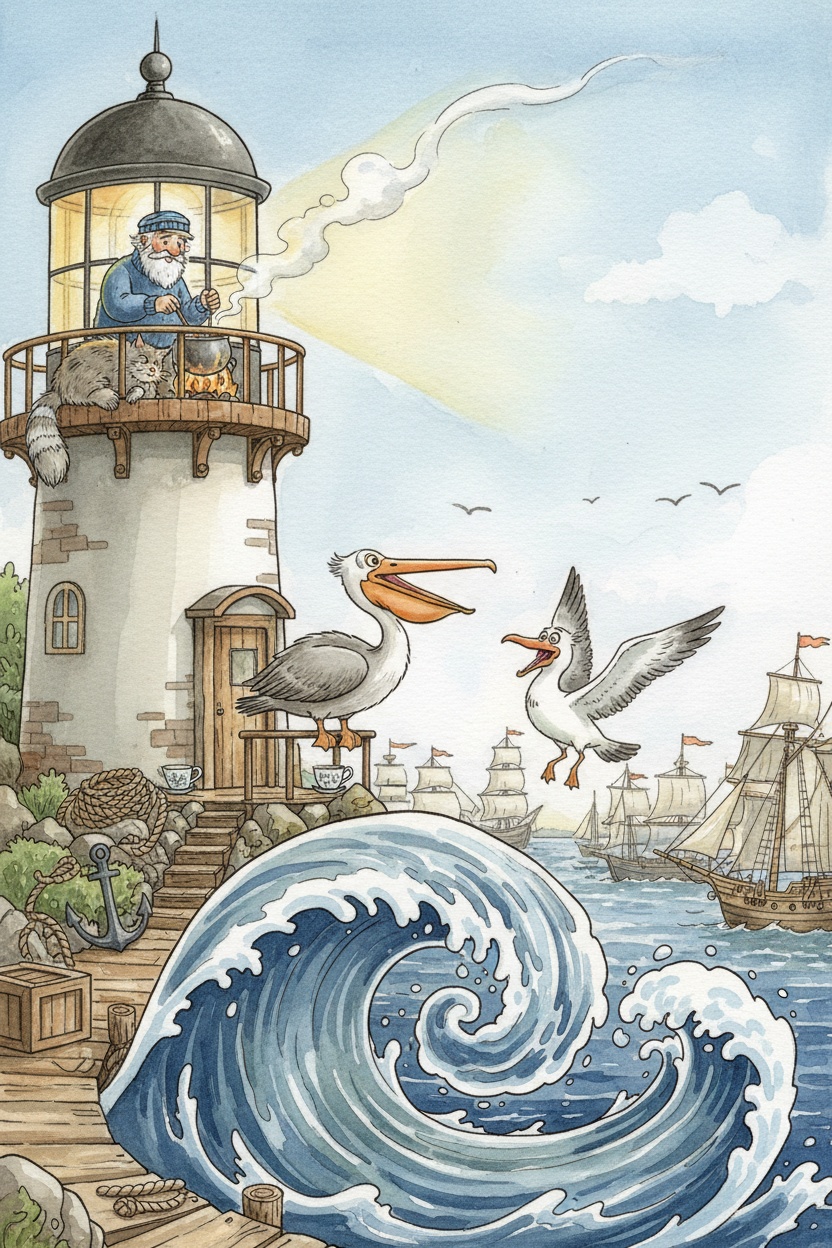
The morning began like any other at Pelican Point. The sea was a smooth sheet of silver, the sun was yawning over the horizon, and Captain Whiskers sat in her window, watching the world with quiet authority.
Morris the Seagull landed on the sill with a dramatic flutter. “Whiskers! The Golden Gull is coming in, and she looks WRONG. Her bow is pointing at the harbour, but her sails are pushing her toward the rocks! She’s going to crash! This is the WORST thing that has EVER happened at this lighthouse!”
Captain Whiskers blinked once. She looked at the ship. The Golden Gull was indeed angled strangely—not wildly, but definitely not correctly. The captain on board was tugging at the wheel, looking baffled.
“Hmm,” said Whiskers.
She trotted down the spiral stairs, her paws silent on the stone. Angus was asleep in his rocking chair, his chowder cooling on the stove. Whiskers did not wake him. She never did.
At the dock, the Golden Gull was already tying up. Her captain, a round woman named Salty Meg, was scratching her head. “Twelve degrees off,” she muttered. “Every compass says I’m heading straight, but the boat says otherwise. We nearly kissed the rocks.”
Whiskers studied the water. It looked normal—no waves, no whirlpools. But she noticed something. The drifting bits of seaweed were all moving the same way. Not with the tide. Just… off.
She walked to the end of the dock and watched a leaf float past. It moved at a perfect angle, as if pushed by an invisible hand. Whiskers sat down, tail curled around her paws. She watched for a full minute.
“Twelve degrees,” she said quietly. “Not the tide. Not the wind. The water itself is leaning.”
She hurried back to the lighthouse, up to Angus’s study, where the maps were kept. She unrolled the coastal chart—a big, beautiful drawing of the Point and all the waters around it. With one neat claw, she drew a long, curving line, like a river that no one could see.
“There,” she said. “A rogue current. It’s invisible, but it’s there. And it’s pushing everyone sideways.”
She borrowed Angus’s red pencil and marked the current’s path with a dotted line and a small warning symbol: a little wave with a twelve next to it.
Down at the harbour board—the big cork noticeboard where sailors pinned messages—Whiskers wrote in her neat, precise paw-writing:
ATTENTION ALL SHIPS: An invisible current runs past the Point. It will push you 12 degrees north. Correct your heading by 12 degrees south. — C. Whiskers, Harbour Master (unofficial)
She posted it with a drawing pin. Then she climbed up to the widow’s walk and looked out. The Blue Heron was coming around the headland. Whiskers saw her drift, just a little, toward the rocks.
“Morris,” she said. “Tell Captain Banks to steer twelve degrees south.”
Morris puffed out his chest. “TWELVE DEGREES SOUTH!” he screamed, flying out over the water. “THE CAPTAIN SAYS TWELVE DEGREES SOUTH! DO NOT ASK QUESTIONS! JUST DO IT!”
Captain Banks waved. The Blue Heron adjusted. She glided into the harbour perfectly straight, her ropes landing exactly where they should.
One by one, the ships came. The Sea Squirrel. The Mackerel’s Dream. The Dancing Lobster. Whiskers watched them all, and whenever a bow began to lean, she gave Morris the word, and Morris screamed it across the waves.
But the current wasn’t done.
The fishing trawler Tiny Tina came in from the east, and she had not seen the notice board. She was heading straight for the rocks, and she didn’t know it. Her skipper, Old Pete, was singing a shanty with his hat over his eyes.
“Morris,” said Whiskers. “This one needs more than a scream.”
Morris looked at her. “More? THERE IS NO MORE. I AM AT FULL VOLUME.”
Whiskers was already moving. She ran down to the dock, where Penny the Pelican was clumsily rearranging a pile of rope.
“Penny,” said Whiskers. “The Tiny Tina is about to hit the rocks. I need you to fly over and drop something on her deck. Something that will get attention.”
Penny looked around. Her eyes landed on Angus’s spare tin of chowder—the one he kept by the door. She scooped it up in her bill.
“Perfect,” said Whiskers.
Penny launched herself into the air, wings wobbling, the tin clamped in her beak. She flew straight and true, and as she passed over the Tiny Tina, she let go.
The tin dropped with a CLANG on the deck.
Old Pete jumped. His hat flew off. “WHAT IN THE—?”
Penny circled back and shouted—as loudly as a pelican could— “TWELVE DEGREES SOUTH, PETE! YOU’RE DRIFTING!”
Old Pete looked at his compass. He looked at the rocks. He spun the wheel.
The Tiny Tina swung just in time, missing the rocks by a whisker.
“Thank you, Penny,” said Whiskers, when the pelican landed back on the dock. “That was very good first-mating.”
Penny glowed. She had never been called that before.
By evening, every ship for miles had been warned. Whiskers marked the last correction on the chart, then sat in her window, watching the harbour settle into its quiet hum. The rogue current was still there, invisible and steady. But now everyone knew about it. And knowing about a thing—well, that was half the battle.
Angus woke up. “Funny,” he said. “I felt like the room was leaning all day. But it’s straight as a die now.”
Whiskers blinked at him neutrally.
On the harbour board, her notice fluttered in the breeze:
ATTENTION ALL SHIPS: An invisible current runs past the Point. It will push you 12 degrees north. Correct your heading by 12 degrees south. — C. Whiskers, Harbour Master (unofficial)
And underneath, in small, careful letters, someone had added:
Especially the fishing trawlers. — P. the Pelican, First Mate (official)