Lighthouse Cats
The Singing Siren
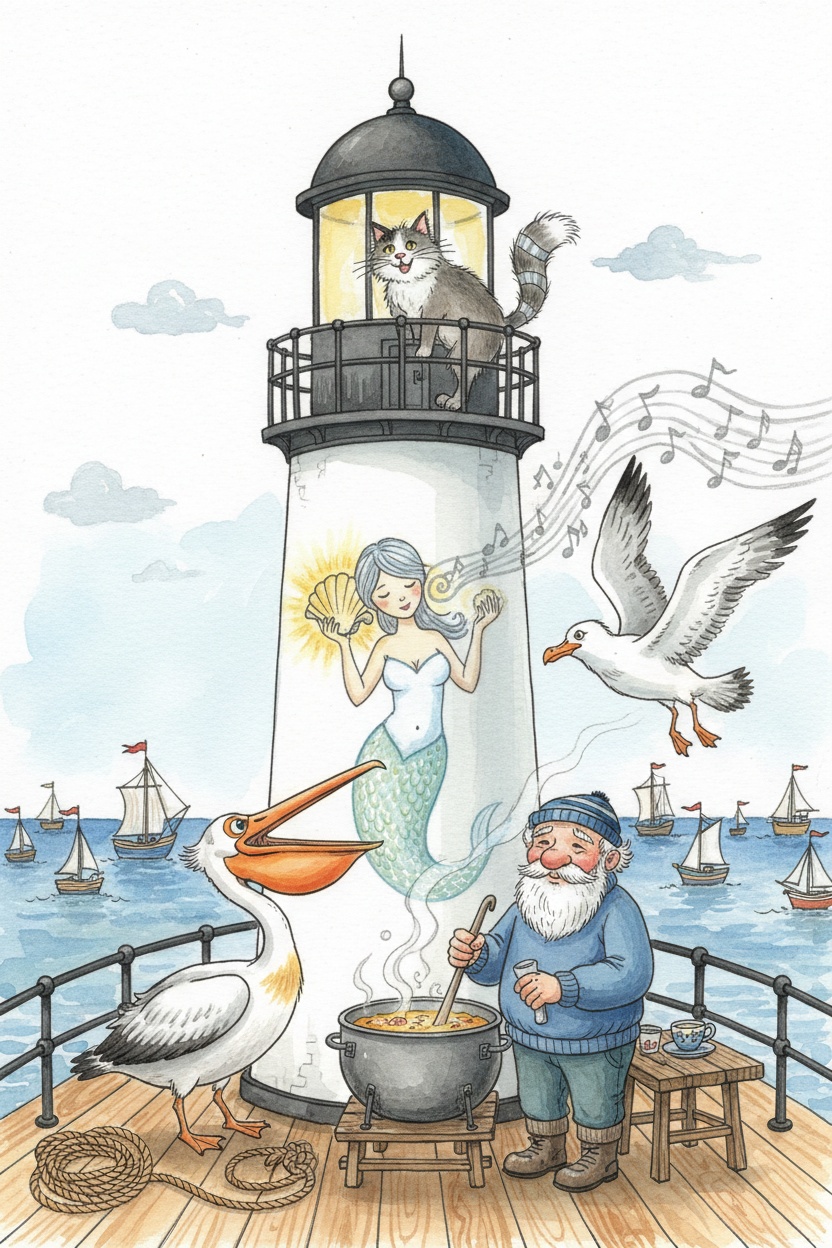
The morning was calm at Pelican Point, which meant one thing to Morris the Seagull: absolutely nothing was happening, and he was terribly bored.
He perched on the widow’s walk, watching the horizon with one eye and the lighthouse kitchen window with the other. Captain Whiskers sat on the sill, washing one perfect silver-striped paw. Old Angus was inside, stirring his chowder and humming something that sounded like a sea shanty but wasn’t.
“A quiet day,” Morris announced to no one in particular. “A deadly quiet day. The quietest day in the HISTORY of quiet days. I can’t stand it.”
“Quiet is good,” said Penny the Pelican, wobbling onto the walk beside him. “Quiet means everyone is safe.”
“Safety is boring,” Morris declared.
And then, as if the sea itself had heard him and decided to teach him a lesson, a ship appeared around the headland.
It was a cargo ship called the Barnacle Belle, and it was veering dangerously close to the rocks.
“WHISKERS!” Morris shrieked. “A SHIP! It’s going to crash! The WHOLE SHIP is going to crash, and then the hull will be GONE, and the cargo will be GONE, and probably the OCEAN will be GONE too!”
Captain Whiskers did not hurry. She never hurried. She stood, stretched, and padded to the edge of the walk to look.
The Barnacle Belle was not crashing. It was drifting. Slowly, dreamily, it curved toward the Point like a sleepy whale. And from somewhere onboard came a sound.
Singing.
It was the most beautiful singing Captain Whiskers had ever heard. High and sweet, it floated across the water like honey poured into moonlight. Penny’s eyes went glassy. Morris’s beak fell open.
“Oh,” he whispered. “Oh, that’s lovely. I could listen to that forever.”
“That’s the problem,” said Captain Whiskers.
She sprang down the lighthouse stairs in three graceful leaps and across the rocks to the harbour. The hermit crabs — the Committee — scuttled out of her way, waving their claws in agitation.
“Boat!” called Captain Whiskers.
The harbour rowboat was small, but it was fast. She untied it with her teeth, dropped into the seat, and took the oars in her paws. Penny landed beside her with a thump.
“I’m coming too!” said Penny. “I’m your first mate!”
“Then row,” said Captain Whiskers.
They rowed. The singing grew louder as they approached the Barnacle Belle. At the wheel stood the captain, a large man with a red beard, his eyes half-closed, his head swaying gently side to side. Beside him, the first mate had fallen asleep on a coil of rope. The helmsman had slumped over the wheel, snoring softly.
The whole crew was asleep on their feet. The ship was heading straight for the rocks.
“They’re dreaming,” said Penny. “They’re dreaming of beautiful things.”
“They’ll dream right onto the reef,” said Captain Whiskers.
She climbed the ladder to the deck — paw over paw, quick and silent — and found the source of the singing. A mermaid sat on a coil of rope near the bow, her voice rising and falling like a lullaby. She was young and silver-tailed, and she looked terribly sorry.
“I can’t stop,” she whispered between verses. “The song started and now I can’t stop singing it. I’ve sung the rocks to sleep. I’ve sung the gulls to sleep. I’ve sung myself nearly to sleep.”
Captain Whiskers studied her.
“How long have you been singing?”
“Two days,” said the mermaid. “It’s a song my grandmother taught me. It worked fine in the reef, but out here it keeps putting everyone to sleep. I’m so sorry. I don’t want to sink anyone.”
And she kept singing, because she couldn’t stop.
Captain Whiskers sat very still, thinking.
Then she spotted the cargo on the deck: great crates of cork, bound for the mainland. And in the galley, a box of candles.
“Penny,” she called. “Fetch the candle box. And your bill.”
Penny returned with the candles. Captain Whiskers took one, melted the wax over the ship’s lantern, and pressed it into a small lump. Then she took a piece of cork from the crate and shaped it with her claws into two neat little plugs.
“Earplugs,” she said. “Wax and cork. Sound can’t get through.”
She woke the captain first. He blinked, startled, and she pressed the earplugs into his hands.
“Put them in,” she said.
He did. Instantly, his eyes cleared. “The singing!” he cried. “It’s stopped!”
“It hasn’t stopped,” said Captain Whiskers. “You just can’t hear it.”
Penny carried the wax and cork to every crew member, and soon the whole ship was alert and awake. The captain spun the wheel hard, and the Barnacle Belle curved away from the rocks with metres to spare.
The mermaid watched, still singing, a tear rolling down her cheek.
“Thank you,” she mouthed.
“Keep singing,” said Captain Whiskers. “Just stay away from busy shipping lanes. Everyone’s awake now.”
And as the Barnacle Belle sailed safely onward, her crew waving and cheering, Captain Whiskers and Penny rowed back to the lighthouse.
Morris met them at the dock, looking deeply disappointed.
“So the ship didn’t crash,” he said.
“No,” said Captain Whiskers.
“And no one was lost at sea?”
“No.”
Morris sighed a huge, theatrical sigh. “This is the WORST thing that has EVER happened at this lighthouse.”
But as they climbed the stairs, Captain Whiskers looked back at the sea. The mermaid’s song floated faintly across the water, beautiful and harmless now.
She added a small piece of silver driftwood to her wall of tokens. On it, she had scratched the shape of a mermaid’s tail.
Old Angus looked up from his chowder. “Funny,” he said. “I could have sworn I heard singing.”
Captain Whiskers blinked at him, utterly neutral.
“The wind,” she said.
And she settled on her windowsill, her watch complete, the ship safe, the song fading into the evening air.