The Number Kingdom
The Fraction Kitchen
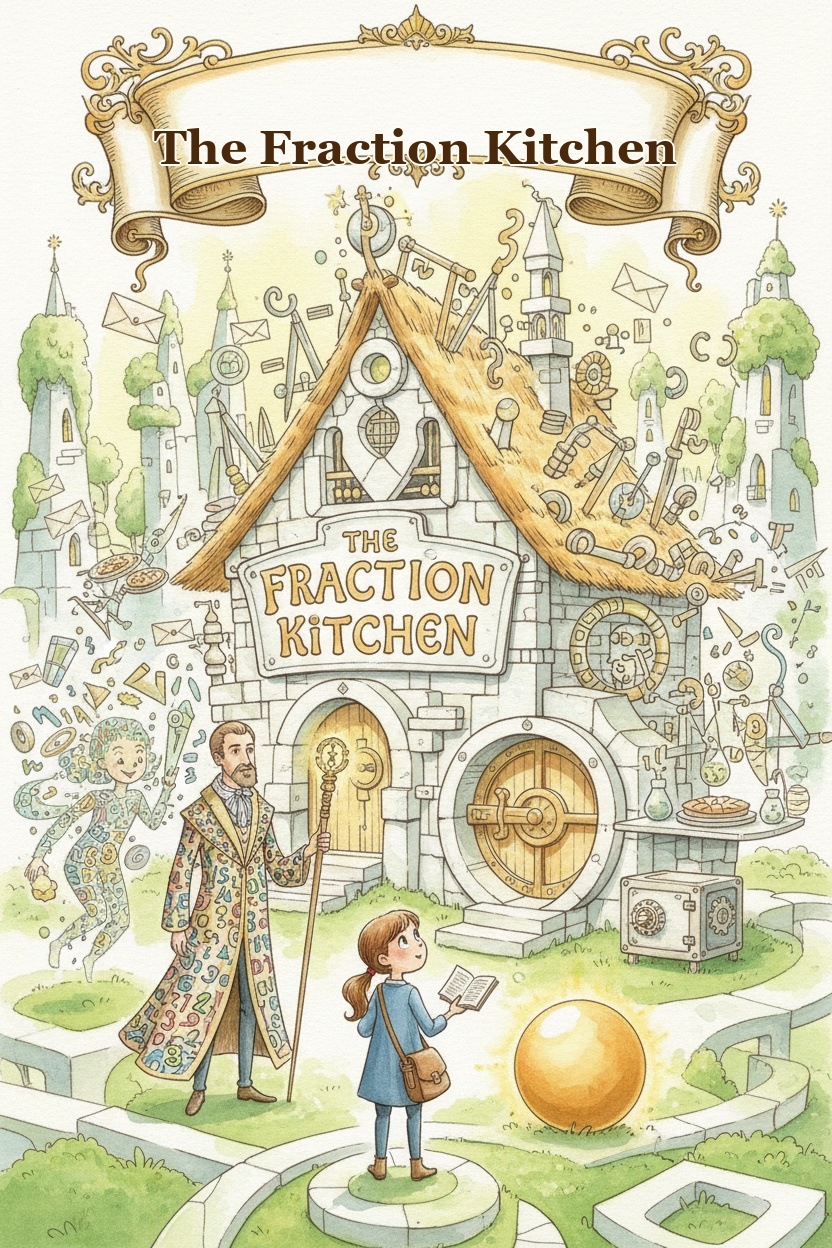
The Festival of a Thousand Tastes
The Number Kingdom was humming with excitement. Every year, the Festival of a Thousand Tastes filled the streets with tables of marvelous food from every corner of the land. The Geometric Provinces sent perfectly square sandwiches. The Decimal District contributed their famous shimmering drinks, each one precisely measured.
But this year, something was wrong in the Great Kitchen.
Mira arrived at the kitchen doors to find the Count pacing back and forth, his robes swirling with worried numerals. A cloud of flour hung in the air, and from inside came the sound of pots clanging and someone muttering in a gleeful voice.
"Right. Let's see what's broken," Mira said, pushing open the doors.
The Great Kitchen was chaos. Measuring cups floated in the air, spilling their contents. Recipe cards fluttered like confused birds. And in the center of it all sat the Remainder, wearing a chef's hat that was slightly too large and stirring a pot with a wooden spoon.
"Welcome, welcome!" the Remainder chirped. "We're having a TASTING! Everything is almost ready. Almost. But not quite. Not evenly. Not resolved." It giggled. "That's the best part!"
The Count's voice was grave. "The festival recipes require precise fractional amounts of ingredients. The Remainder has altered every measurement. The Grand Festival Cake — the centerpiece of the celebration — is mathematically impossible in its current form."
Mira looked at the recipe card floating toward her. It read:
Grand Festival Cake
-
3/8 cup sugar
-
2/8 cup honey
-
1/4 cup butter
-
2/4 cup flour
"The cake cannot be baked," the Count intoned, "because no one can determine the total amount of sugar and honey combined."
A Trick with the Same Bottom Number
Mira sat down at the flour-dusted table and pulled out her notebook. She wrote:
3/8 + 2/8 = ?
She stared at it. Eight what? Three eighths and two eighths...
Wait. A fraction was a part of a whole. The bottom number — the denominator — told you how many equal parts the whole was divided into. The top number — the numerator — told you how many of those parts you had.
"Three eighths is like three slices of a cake cut into eight pieces," Mira said slowly. "Two eighths is two more slices of the same cake. If I have three slices and someone gives me two more slices..."
"FIVE SLICES!" shouted a tiny, perfect voice.
A small, silver-white circle stood on the table, covered in flour. Zero.
"Five slices of eight," Zero said quietly, brushing off its perfectly round self. "Five eighths. The denominator stayed the same because you're talking about the same kind of pieces."
Mira wrote:
3/8 + 2/8 = 5/8
"Easy! When the denominators match, you just add the numerators and keep the denominator!"
But then she looked at the next part of the recipe: 1/4 cup butter + 2/4 cup flour.
"One quarter plus two quarters is three quarters," she said confidently. "Same trick!"
The Remainder clapped slowly from its perch on a hanging pot rack. "Very good, very good. But what about THIS?"
It snapped its fingers, and a new recipe card appeared in Mira's hands.
Royal Frosting
-
1/2 cup cream
-
1/4 cup sugar
"One half plus one quarter!" the Remainder sang. "The denominators are DIFFERENT. What now, little mathematician? What now?"
Finding a Common Language
Mira frowned. Half and quarter. Different denominators. She couldn't just add the tops and keep the bottom.
"Okay," she said, tapping her pencil. "Let me think. If I have a cake cut into two pieces, and another cake cut into four pieces... the pieces aren't the same size. Adding halves and quarters together is like trying to count apples and oranges as if they were the same fruit."
She drew in her notebook:
[A picture of a circle cut in half, with one half shaded]
[A picture of a circle cut in quarters, with one quarter shaded]
"They're different sizes," she said. "But... a half can be cut into quarters! If I cut a half into two equal pieces, it becomes two quarters."
She wrote:
1/2 = 2/4
"Now I have 2/4 + 1/4. Same denominator. So I add the numerators: 2 + 1 = 3. The answer is 3/4."
"Excellent," Zero said, nodding its perfectly circular head. "You found a common denominator. You changed the fractions so they spoke the same language — fourths instead of halves and fourths mixed together."
Mira beamed. "The denominator tells you what kind of piece you're counting. You can't combine different-sized pieces until you make them the same size!"
The Remainder made a face. "Yes, yes, but that's too easy. What about MIXED numbers? What about IMPROPER fractions?"
It waved its hand, and the final recipe card appeared:
Final Feast Platter — serves the whole kingdom
-
3/2 wheels of celebration cheese
-
5/3 baskets of festival bread
The Remainder bounced with joy. "Three halves! Five thirds! Those are IMPROPER — the numerator is bigger than the denominator! The pieces are too many! It's WRONG! It's CHAOS!"
When Fractions Get Bigger
Mira looked at 3/2. Three halves. That meant three pieces, each one a half of a whole cheese wheel.
"Three halves isn't wrong," she said slowly. "It's just... more than one whole."
She drew three half-circles. Then she pushed two of them together.
"Look! Two halves make ONE whole wheel. And there's one half left over. So 3/2 is the same as 1 and 1/2 — one whole wheel plus one half wheel."
"A mixed number!" Mira wrote. 3/2 = 1 1/2
"Five thirds," she continued, drawing five third-circles. "Three thirds make a whole. So five thirds is one whole and two thirds left over. 5/3 = 1 2/3."
Zero floated up beside her. "And if you want to add them," Zero said quietly, "you can't add 3/2 and 5/3 directly. Different denominators."
Mira nodded. "I need a common denominator. Something that both 2 and 3 go into. Two times three is six!"
She wrote carefully:
3/2 = 9/6 (multiply numerator and denominator both by 3)
5/3 = 10/6 (multiply numerator and denominator both by 2)
"Now I have 9/6 + 10/6 = 19/6. Nineteen sixths. And six sixths make one whole, so..." She counted. "Six, twelve, eighteen. That's three wholes, with one sixth left over."
19/6 = 3 1/6
"Three and one-sixth — and the recipe will feed everyone."
The Count examined her calculations, his numeral-covered robes shifting with approval. "She found a common denominator. She renamed the fractions in the same language — sixths — and the addition became possible."
Mira stood up, brushing flour from her knees. "So that's the rule: you can only add fractions when the denominators match. If they don't match, find a common denominator first — a number both denominators can reach — and rename both fractions before adding."
The Remainder sighed dramatically. "Fine, fine. The cake will be baked. The festival will be perfect." It paused. "But I DO find it interesting," it said, tilting its head, "that 3/2 and 5/3 are both perfectly real in their messy, improper form. They don't NEED to become proper. They exist as they are. Isn't that... wonderful?"
Mira considered this. "They do exist. But to combine them, I needed common language. The pieces had to match."
The Remainder grinned. "Yes. And sometimes they don't match. Sometimes things stay improper. And THAT—" it vanished in a puff of flour "—is also true."
The Cake That Saved the Festival
Hours later, the Grand Festival Cake emerged from the oven — golden, towering, perfect.
The Count stood before it, his staff tapping the floor. "The calculations were correct. The festival is saved."
Zero was perched on the cake's highest peak, looking very pleased with itself.
"I notice," Zero said quietly, "that the recipes required adding fractions with the same denominator, THEN finding common denominators for different ones. No one mentioned that zero halves — none of the fractions — were zero. But if any ingredient had been zero thirds, or zero quarters..."
Mira laughed. "Then we'd have needed zero of it! And adding zero doesn't change the total."
"Precisely." Zero allowed itself a small smile. "Zero is always there, even when the fractions are whole."
Mira wrote in her notebook one last time:
To add fractions:
- Same denominator? Add the numerators, keep the denominator.