Chef Sparks Kitchen Lab
THE PEOPLE WHO FEED THE CITY
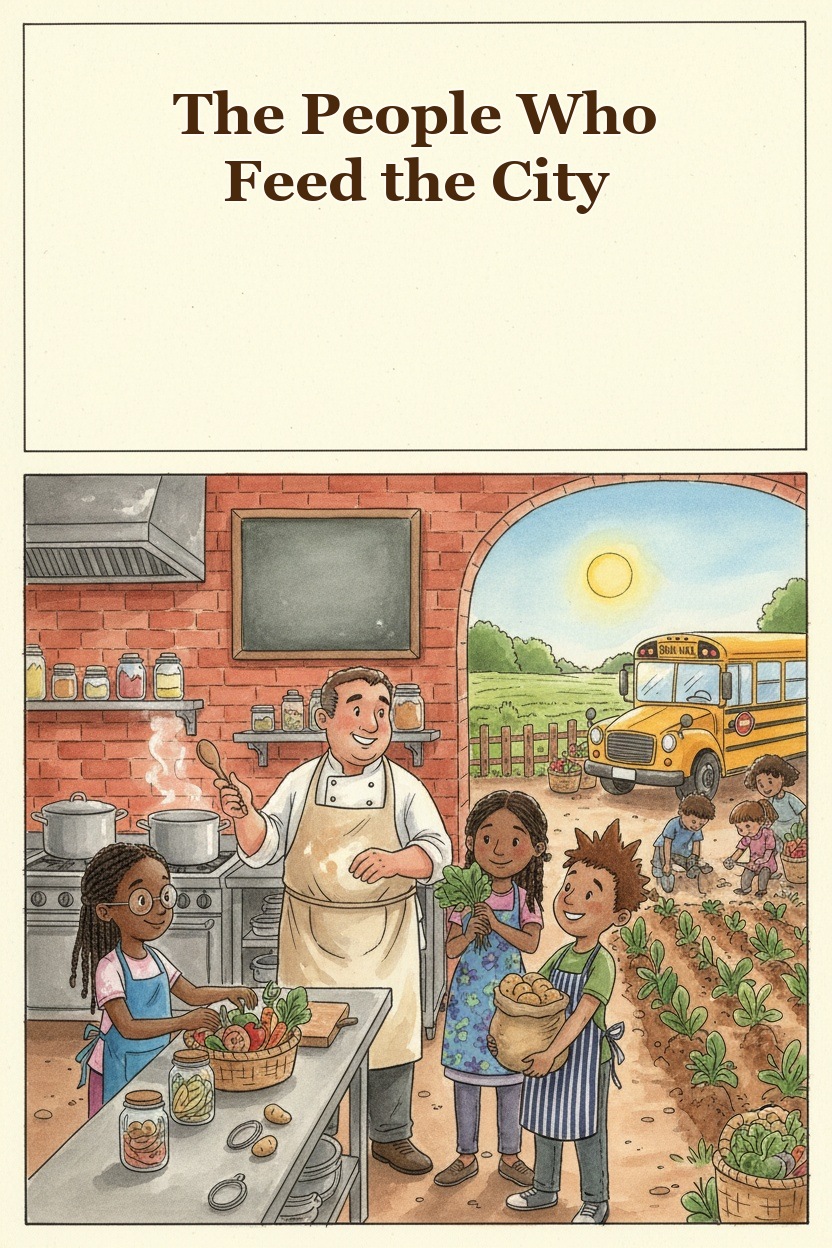
THE BUS THAT SMELLED LIKE DIRT
The Kitchen Lab was empty when Maya arrived, which was strange. Iggy was always there first, usually with something simmering on the range and a question written on the chalkboard.
Today the chalkboard said: MEET AT THE FRONT DOOR. WEAR SHOES YOU DON'T MIND GETTING DIRTY.
Maya looked down at her sneakers. They were her favorite pair. She had a second pair, older, that she wore to the community garden with her aunt. She ran to her cubby and swapped them.
By the time she got to the front door, the whole class was there—Tommy, Priya, Dev, Lucia, Sam, and a few others—all staring at the yellow school bus idling in the fire station driveway.
"What kind of field trip needs a bus?" Tommy asked.
"The kind where we're going somewhere far," Dev said.
Iggy appeared at the bus door, already seated in the front row, waving. "Come on! The soil won't turn itself!"
The bus smelled like old vinyl and, faintly, like something green. The students spread out across the seats. Sam pulled out a notebook and wrote "FIELD TRIP" at the top of a fresh page. Lucia was already sketching the bus windows.
"Where are we going?" Priya asked.
Iggy turned around in his seat. His eyes were bright in a way that meant he was about to say something he'd been waiting to say for a long time. "We're going to see where food actually comes from. Not the store. Not the market. The source."
"I know where food comes from," Tommy said. "The kitchen."
Iggy shook his head slowly. "The kitchen is the last stop, Tommy. The buffet is at the end of a very long road. And that road starts in the dirt."
The bus pulled out of the fire station driveway and headed for the edge of the city. The buildings got shorter, then spread out, then disappeared into fields that stretched in every direction. The students pressed their faces to the windows.
"Look at the lines in the dirt," Dev said. "It's like a grid."
"Those are rows," Maya said. "For planting."
The bus turned down a gravel road with a wooden sign at the entrance. The sign read:
SUNRISE ACRES FARM
Rosa Delgado, Proprietor
Growing Food Since 1998
A woman was standing by a big red barn, waiting for them. She was wearing overalls and tall rubber boots and a wide-brimmed hat. When the bus doors opened, she smiled like she'd been expecting them all along.
"Welcome to my farm," she said. "I'm Rosa. And I have a question for you before we get started."
She looked at each of them in turn, her eyes crinkling. "Who here has ever eaten a vegetable?"
Everyone raised their hands.
"Okay, good. Now the harder question: Who here has ever watched a vegetable grow?"
Only Priya raised her hand. "My grandmother has chili plants on her balcony. I've seen them get bigger."
"That counts," Rosa said. "But my guess is that most of you have never seen the whole life of a vegetable—from tiny seed to full-grown plant to your plate. And today, you're going to."
Tommy looked at the endless rows of green stretching into the distance. "All of them?"
"All of them," Rosa said. "Maybe not all of them—I have forty acres. But we'll cover a lot of ground."
THE DIRT THAT MAKES DINNER
Rosa led them to a field where low green plants grew in straight lines. She crouched down and scooped a handful of soil, then held it out.
"Smell that," she said.
Tommy leaned in and inhaled. "It smells... alive?"
"That's exactly what it smells like," Rosa said. "Good soil smells like life. And it's the most important thing on this farm. The seeds don't grow the food. The soil grows the food. The seeds just need the right soil to do their job."
She passed the soil to Iggy, who held it like it was precious. "You've heard me talk about nutrients—what food gives your body. But where do the nutrients in vegetables come from?"
"The soil?" Maya guessed.
"The soil," Rosa confirmed. "Plants draw water and minerals up through their roots. They use sunlight to turn those materials into leaves and stems and fruit. The soil is the pantry that feeds the plant. If the pantry is bare, the plant can't grow well—no matter how much sun it gets."
"How do you keep the pantry stocked?" Priya asked.
Rosa smiled. "Now you're asking the right question." She walked them to the edge of the field, where a different crop was growing—tall stalks with feathery leaves. "Last year, this field grew tomatoes. The year before that, it grew green beans. The year before that, corn. And next year, it'll grow something else entirely."
"Why?" Dev asked.
"Because plants are hungry in different ways," Rosa said. "Tomatoes take a lot of nitrogen out of the soil. But beans put nitrogen back in—they have a partnership with bacteria in their roots that pulls nitrogen from the air and turns it into plant food. So if I plant beans after tomatoes, the beans help repair the soil I used to grow the tomatoes."
"That's brilliant," Iggy said. He didn't ask a question. He just stood there, nodding, with the look he got when someone else explained something well.
"It's called crop rotation," Rosa said. "Humans have been doing it for thousands of years. It's one of the oldest farming tricks there is. And it means I don't have to use chemical fertilizers on everything—I let the plants take care of each other."
"Look!" Lucia pointed at a patch of purple flowers at the edge of the tomato field. "Those are pretty."
Rosa walked over and picked one. "They're borage. I plant them on purpose."
"For decoration?" Maya asked.
"For the bees," Rosa said. "And for the other bugs." She cupped the flower in her palm. "See how it's shaped? It's like a little cup. The bees love it. And when the bees come, they pollinate my crops—that means they help the plants make fruit."
"So you plant flowers to attract bugs," Tommy said.
"Good bugs," Rosa said. "The bees are my friends. But there are also bad bugs. You know what the bugs that eat my vegetables do?"
"Eat your vegetables?" Tommy said.
"They eat my vegetables," Rosa confirmed. "And my first plan isn't to spray poison at them. My first plan is to build a farm where the good bugs outnumber the bad bugs. The ladybugs eat the little insects that would eat my crops. The borage attracts the ladybugs. So I plant things that bring the helpers, and I don't lose as much to the pests."
"What if the bad bugs get bad anyway?" Dev asked.
"Then I have to make a choice," Rosa said. "There are sprays—and some of them are fine, some are organic, some are things I use rarely, when a crop would be lost entirely. But I always try to start with nature, not chemicals."
She led them to the edge of the field, where a small stream ran through a channel. "And this is my watering system. I use drip irrigation—little tubes that carry water right to the roots of each plant. It uses way less water than spraying the whole field."
"That's engineering," Dev said, sounding impressed.
"That's farming," Rosa said. "Farming is full of engineering."
THE MATH OF A MEAL
They walked through the fields for another hour. Rosa showed them how she planted seeds—some by hand, some with a machine. She showed them the greenhouse where she started plants in the spring, keeping them safe from cold until the soil was warm enough. She showed them the compost pile, where leftover plant material and manure turned into rich, dark new soil.
"The compost is the farm's recycling program," she said. "What we don't eat or sell goes back into the soil to feed next year's crop. Nothing gets wasted."
It was mid-morning when Rosa led them to a picnic table under a big oak tree. Water bottles were waiting for them.
"I want to talk to you about money," Rosa said.
Tommy perked up. "This is my favorite topic."
"I thought you just liked eating," Maya said.
"I like eating and money," Tommy said. "You can buy food with money."
Rosa laughed. "Okay, so here's the math problem. A head of lettuce at the supermarket costs about two dollars. My farm sells that lettuce to a distributor for about one dollar. The distributor sells it to the supermarket for one dollar and fifty cents. The supermarket sells it to you for two dollars."
"Everyone makes a little money," Priya said.
"Everyone makes a little money," Rosa corrected. "But I have to grow that lettuce first. I pay for the seeds, the water, the soil amendments, the fuel for my tractor, the insurance, the labor. And I have to hope that the weather is good, the bugs don't get too bad, and nothing unexpected happens. If everything goes right, I have maybe twenty cents of profit on each head of lettuce."
"Twenty cents?" Dev's eyes widened.
"For one lettuce," Rosa said. "A farm's profit is in growing a lot of things, not in growing one thing at a big profit. And some years, I lose money. Two years ago, we had a drought in July. I lost half my tomato crop. I still had to pay for the water and the labor. The tomatoes that didn't grow didn't make any money back."
"That's hard," Maya said quietly.
"It's the hardest part of farming," Rosa said. "You're in partnership with the weather, and the weather doesn't read the contract. That's why I try to grow many different things. If the tomatoes fail, maybe the carrots do fine. And I'm not dependent on one crop."
"Like not putting all your eggs in one basket," Tommy said.
"Exactly like that," Rosa said. "Which is also a farm expression."
Iggy had been quiet, letting Rosa teach. Now he spoke. "And when we buy food at the store, we're not just buying a vegetable. We're supporting everything that went into growing it. The farmer's planning, the soil building, the bug balancing, the risk of a bad season."
"You're saying we're buying the farmer's work too," Priya said.
"Exactly," Iggy said. "The vegetable is the end of a long story. And the farmer is the person who makes sure the story keeps going."
Rosa nodded. "You're feeding people, but the people are also feeding you. Without farmers, nobody eats. Nobody. Not the richest person in the city, not the president, not anyone. The whole world runs on people like me, out here, watching the sky and tending the soil."
THE HARVEST
Rosa stood up and looked at her watch. "You've asked a lot of questions. I think it's time to get your hands dirty."
She led them to the lettuce field—row after row of crisp green heads, each one perfect.
"We're going to harvest today," she said. "I have an order to fill." She showed them how to cut the lettuce at the base, just above the soil line. "You cut it clean and you don't pull, because we might get a second crop from the root."
Each student took a row. It was harder than it looked. The lettuce didn't want to sit still. Lucia's first head fell apart. Tommy's first cut was too high, leaving leaves behind.
"Keep trying," Rosa said. "Practice is how you get good."
They worked for an hour. The morning sun got hotter, and their backs got tired. Dev figured out a rhythm—cut, lift, place in the crate, repeat. Sam kept a running count. Maya cut with precise, gentle strokes, and her heads were the cleanest.
When they were done, Rosa weighed the crates. "Forty pounds of lettuce. That's about three hundred heads. That's going to a school district in the city—they use it in their school lunch program."
"Kids are going to eat the lettuce we picked?" Tommy asked.
"Tomorrow," Rosa said. "It'll be in a salad or a sandwich on Tuesday."
Tommy looked at his hands. They were covered in dirt, and there was a small cut on his thumb from a rough stem. He flexed his fingers. "That was work."
"It was," Rosa said. "It always is."
"That was a lot of work," Tommy repeated. He looked at the crates of lettuce, then at the rows they'd cut, then at Rosa. "And this is just one field. On one farm. And there are farms everywhere."
"That's right," Rosa said.
Tommy was quiet for a long moment. Then he said, very softly, "I didn't know lettuce was this heavy."
They washed their hands at the pump. Rosa let them each take a carrot she pulled from a different field—sweet and cold and still covered in soil. They wiped the dirt off on their shirts and ate them standing in the field, looking at the rows of food stretching in every direction.
"This is the best carrot I've ever had," Priya said.
"Because you watched it come out of the ground?" Iggy asked.
"Because I'm eating it right where it grew," Priya said. "It didn't have to go anywhere. It just grew and now I'm eating it."
"That's the whole point of a farm," Rosa said. "The food grows here. And then we send it to the city, where people like you are waiting."
Maya looked at the carrot in her hand. "I think I'll think about this next time I'm at the grocery store."
"What will you think about?" Rosa asked.
"Everything that happened before I got to the store," Maya said. "The seed, the soil, the water, the bugs, the farmer. It's all inside this carrot."
Iggy had that look again—the one that meant something had clicked. "That's the whole lesson, Maya. That's the whole thing."
THE TEACHER'S TABLE
Back at the Kitchen Lab, Iggy didn't set up the range. Instead, he set up the big prep table with cutting boards and knives and a basket of vegetables from Rosa's farm—the carrots they'd pulled, plus tomatoes, onions, and herbs.
"We're going to make one dish," he said. "And we're going to make it with the vegetables Rosa grew, the water and soil and work that went into them, and the respect we brought back from her farm."
They made a simple salad—not cooking, but preparation. Iggy showed them how to make a vinaigrette from olive oil, vinegar, and a little mustard. The dressing came together in a stream, the oil and vinegar reluctant to mix until the mustard helped them find a way.
"Remember Book 17?" Iggy said. "An emulsion. The mustard is the emulsifier."
"Oil and water don't want to mix," Maya said.
"But with help, they find a way," Iggy said.
The salad came together in a great wooden bowl. It was nothing fancy: torn lettuce, sliced carrots, cherry tomatoes, a few leaves of basil. But the whole class stood around the bowl, looking at it.
"Who wants to do the honors?" Iggy asked.
Tommy stepped forward. He took the tongs and tossed the salad carefully, flipping the leaves over and over until every one was coated. The dressing caught the light.
He served a small portion to each student, then to himself.
"Wait," Iggy said. He held up his fork. Everyone waited.
"When we're out at the farm, we're at the beginning of the story," he said. "We're watching the lettuce become a plant. We're watching the carrots grow. But we're also in the middle of the story—because we're eaters too. And the best way to understand food is to know the whole story, from the soil to the seed to the farmer to the kitchen to the table."
"I thought it was from soil to fruit," Dev said.
"The fruit is in the table," Iggy said. "The table is part of the story."
They took their first bites.
Tommy chewed very slowly. He swallowed. He looked at his plate.
"This tastes different," he said.
"Really?" Iggy asked. "Or do you see it differently?"
"I tasted it differently," Tommy said. "Because I met it."
Iggy nodded. "That's the lesson. You will never eat a vegetable the same way again. Now you know what it took to get to you."
He reached for the pepper mill on the counter to add a grind to his salad.
The pepper mill was, by his elbow, the only thing on that section of counter.
It went over the edge with a clatter. The class burst into laughter.
"One day," Tommy said, shaking his head, "one day I'll predict it."
"Epistemologically impossible," Iggy said. "Now. Who wants seconds?"
THE PEOPLE WHO FEED THE CITY
Kitchen Lab Notes from Chef Iggy
Today we went to the source. We met Rosa, who grows food for the whole city, and she showed us the three things every farmer has to manage: the soil (the pantry that feeds the plants), the pests (the bugs who want their share), and the money (because farms have to be businesses too). Remember: when you see a vegetable at the store, that vegetable is the end of a very long story—a story about sunlight and water and soil and bugs and weather and a person who checked the sky every morning and worked until sunset. Farmers feed the world. And next time you eat a carrot, you'll know the whole story.
Question to think about until next time: If you had a farm, what would you grow first—and why?
SUNRISE ACRES HARVEST SALAD
From Rosa's farm to Iggy's kitchen
Ingredients:
-
4 cups mixed lettuce or greens, washed and torn
-
2 carrots, scrubbed and sliced into thin rounds
-
1 cup cherry tomatoes, halved
-
A handful of fresh basil leaves, torn
-
For the vinaigrette:
-
3 tablespoons olive oil
-
1 tablespoon red wine vinegar
-
1 teaspoon Dijon mustard
-
A pinch of salt
Instructions:
-
Put the lettuce, carrots, tomatoes, and basil in a large bowl.
-
In a small bowl, whisk the mustard, salt, and vinegar together. Keep whisking as you drizzle in the olive oil. Watch it come together—that's your emulsion!
-
Pour the dressing over the salad and toss until every leaf is coated.
-
Taste it. Remember where it came from.
Chef Iggy's Note: This salad is a whole farm on one plate—leaves for the soil, carrots for the roots, tomatoes for the sun, basil for the smell, and a dressing that teaches you chemistry. If you eat it outside, it tastes even better. If you eat it in the field where it grew, you'll understand everything.