Inside Out Academy
THE RIVER INSIDE
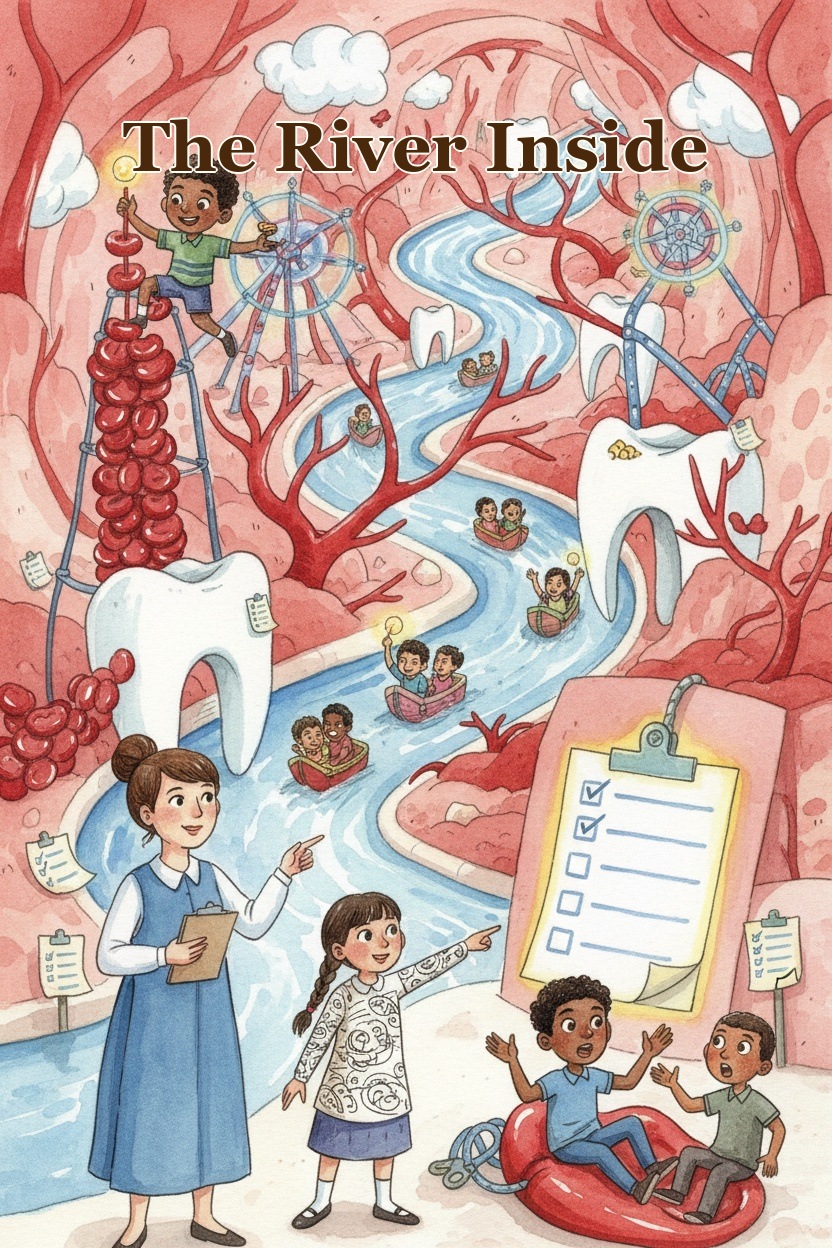
MS. VANCE'S CURRENT CHECKLIST STATUS:
-
Location: Circulatory System (Approaching Vein)
-
Students Accounted For: 22 of 22 (but Leo is on something)
-
Current Concern: The word "current" being used in two different ways
-
Backup Plan: Sadie has the energy bar wrapper. She doesn't know why yet.
SECTION ONE: THE EDGE OF THE RIVER
The class stood at the edge of something that looked like a wide, dark river—except the river was inside Mr. Gomez's arm, and it was moving.
"Okay," Ms. Vance said, consulting her checklist. "We are now at the entrance to the circulatory system. This is a vein. Everyone stay together."
Sadie Chen raised her hand. "Technically, this is a venule—a small vein. We're at the branch point where it joins a larger vein. And I'd like to note that this is the part where my mom's stories get really dramatic."
"What do you mean?" asked Marcus Bell, who had his notebook out and was already writing.
"Blood is a liquid highway," Sadie said. "And we're about to get on it."
The vein wall curved away from them in both directions—smooth, pale, and faintly pulsing. The floor they stood on was the inner lining of the vessel. And below them, flowing past at what seemed like a fast walking pace, was the river itself.
It was deep red and glossy. It moved with a steady, patient rhythm—push, pause, push, pause—like it was breathing.
Fatima Hassan knelt down and looked at the surface of the blood. "It's not one thing," she said quietly. "It's millions of things."
She was right. The blood wasn't a single smooth liquid—it was crowded. Disk-shaped cells tumbled along in the current, flexing and bending as they moved. Here and there a larger white cell drifted past, slower and more deliberate. Small fragments—platelets—bounced along the edges like pebbles.
"There's so many," whispered Mei, one of the students who rarely spoke in class.
"There are about five million red blood cells in a single drop of blood," Marcus announced. "And Mr. Gomez has about five liters of blood. So if you do the math—"
"We trust you, Marcus," Ms. Vance said.
Leo Okafor was not listening. Leo Okafor was staring at the river with the expression of a child who has just discovered that the swimming pool has a diving board.
"Leo," Ms. Vance said, without looking up from her checklist. "No."
"I didn't say anything."
"I know. That's how I know you're thinking about it."
Leo put his hands in his pockets. He rocked back on his heels. "I'm just saying—the red blood cells are right there. They're right there. And they're going somewhere. And we need to go somewhere. So—"
"So we build a raft," Ms. Vance said firmly. "We've done it before. We'll do it again. We use the rope and some of the spare fabric from the emergency kit, and we construct a vessel that we control."
"Or," Leo said, "I could just hop on."
"Leo."
"I'll hold on really tight."
"Leo."
"I've held on to things before."
"Leo, the last time you said 'I'll hold on really tight' was in the stomach at the beginning of the digestive preview, and you got—"
"Launched," Leo admitted. "But that was different. That was peristalsis. This is just a river. And the red blood cell has a nice, flat shape. It's basically a boat."
Fatima looked at the passing cells. "He's not entirely wrong," she said.
Ms. Vance stared at her.
"The red blood cells are flexible and disk-shaped," Fatima continued. "They're designed to travel through vessels that are smaller than they are. They're incredibly stable in the current. And they're going exactly where we need to go."
"But," Ms. Vance said, "he would be riding a cell. Without permission. Without—"
"Without a safety harness," Sadie said, pulling something from her emergency kit. "Which I have. Because my mom said 'you never know when you'll need a safety harness' and I put it in the kit and everyone laughed at me."
Nobody had laughed at Sadie's safety harness. In fact, several people had thanked her for it after the tendon adventure.
Ms. Vance looked at the river. She looked at Leo. She looked at the safety harness.
"If we do this," she said, "we do it properly. Leo wears the harness. The rope is tied to my belt. And you stay on that cell until I say otherwise."
"Yes!" Leo said.
"And when we reach the heart, you get off. You don't ride a cell through the heart. That's a completely different situation."
"Of course," Leo said, in a tone that suggested he had not heard a single word after "yes."
Ms. Vance sighed and wrote something on her checklist: One (1) Leo currently attached to a red blood cell. Re-evaluate decision in ten minutes.
SECTION TWO: RIDING THE CURRENT
Leo's first landing on the red blood cell was not graceful.
The cell was about the size of a dinner plate from their perspective—soft, flexible, and constantly shifting. It had no hard edges. It was like trying to stand on a slightly squishy trampoline that was also moving very fast.
He hit it with both feet, wobbled, threw his arms out, wobbled more, and then—with the rope tied firmly around his waist—managed to find a stable position near the center of the cell.
"It's like standing on a jellyfish!" he called back to the class. "A really fast jellyfish!"
"Hold still," Ms. Vance said. "I'm trying to—"
The current caught the red blood cell and it accelerated. Leo made a sound that was somewhere between a laugh and a yelp.
The red blood cell was in a lane of traffic now. It moved with the flow of the vein, pushed along by the pressure behind it. The walls of the vein streamed past on either side. Other red blood cells moved alongside them, a vast convoy of identical disk-shaped vessels, all traveling in the same direction.
"Push, pause, push, pause," the movement went. Each push came from somewhere behind them—a wave of pressure that moved through the entire river. Each pause was the moment of stillness between beats.
"This is what a heartbeat feels like from the inside," Sadie said, watching Leo from the bank. "Every beat is a wave of pressure that pushes the blood forward."
"Where does the pressure come from?" asked Marcus, notebook ready.
"The heart," Sadie said. "It's like a pump. When it squeezes, it pushes blood forward. And the veins have little flaps inside them—one-way valves—that keep the blood from flowing backward."
"Valves?" Marcus wrote the word down.
"You can't see them from here yet," Sadie said. "But every few centimeters, there's a small flap of tissue that opens when blood flows forward and closes when it tries to flow backward. It's like a door that only swings one way."
The current carried Leo past something that looked exactly like that—a small fold in the vein wall, pushed flat against the side as the blood flowed through, but visible as a small pocket of tissue.
"Did you see that?" Leo shouted. "I just went through a door thing!"
"That's a venous valve!" Sadie shouted back. "It's why blood can flow through veins even when it's going uphill!"
The class was moving along the bank now, staying parallel to Leo's cell, following the current. The vein was widening. The walls were getting smoother and thicker.
"The vessel is getting bigger," Fatima observed.
"Because it's a larger vein," Ms. Vance said. "The veins of the body collect blood from all the small vessels and carry it toward the heart. They get bigger as they get closer to—"
She stopped.
Around a bend in the vein, the river opened into a vast cavern. The walls curved away in every direction. And in the center of the cavern—
"It's the heart," Fatima said. "We're here."
The heart was enormous. It moved with a rhythm that was visible from everywhere—a great muscular drum that flexed and relaxed, flexed and relaxed, each beat sending a wave of pressure through the blood. The sound was everywhere. Not just in their ears, but in their chests, in their bones, in the floor beneath their feet.
Lub-DUB. Lub-DUB. Lub-DUB.
The class stood at the edge of the vein, looking out at the chamber of the heart beyond.
"That's the right atrium," Sadie said, her voice more awed than anxious for once. "It's the upper chamber on the right side of the heart. It's where blood from the body arrives."
"And the blood from the body is the blood that's been traveling through the veins," Marcus said. "So this blood—"
"Is deoxygenated," Sadie said. "It's already given its oxygen to the body. Now it's coming back to the heart to be sent to the lungs to get more."
"Leo," Ms. Vance called. "This is where you get off."
Leo was still clinging to his red blood cell, which was drifting toward the heart's entrance. He looked up at the massive chamber ahead of him. His eyes were very wide.
"That's really big," he said.
"Yes," Ms. Vance said. "Which is why you are getting off now."
The red blood cell carried Leo to the edge of the heart chamber. The current pulled at him. The rope tightened against Ms. Vance's belt.
"Now, Leo!"
Leo jumped. He cleared the edge of the chamber and landed on the heart's inner wall—a surface of muscle tissue, textured and warm, moving gently with each beat. He rolled with the motion and came up on his feet.
"That was amazing," he breathed. "I want to do that again."
" You are not doing that again," Ms. Vance said.
SECTION THREE: THROUGH THE PUMP
The class reassembled on the wall of the right atrium. The heart beat around them—a steady, powerful rhythm that moved everything slightly with each pulse.
"Okay," Ms. Vance said, pulling out her checklist. "We are in the right atrium. We need to get to the other side of the heart and out through an artery. For that, we need to understand where we are and where we're going."
Marcus cleared his throat. "The heart has four chambers," he announced. "Two on the top—the left and right atria—and two on the bottom—the left and right ventricles. Blood flows from the atria into the ventricles, then out of the heart."
"And which side are we on?" Ms. Vance asked.
"The right side," Marcus said. "And the right side of the heart sends blood to the lungs—that's the pulmonary circulation. The left side sends blood to the rest of the body—that's the systemic circulation."
"So we're currently in the pulmonary circuit," Fatima said. "Blood from the body comes into the right atrium, goes into the right ventricle, then goes to the lungs to get oxygen, then comes back to the left side of the heart, and then goes out to the body."
"Exactly," Ms. Vance said. "And we need to go through the right ventricle and out through the pulmonary artery, to the lungs. Then—"
"Wait," Sadie said. "We're going to the lungs? That's Book 16. We're in Book 13. We can't skip ahead."
"Of course not," Ms. Vance said. "We're not going to the lungs. We're going to pass briefly through the pulmonary artery—for educational purposes—and then we'll take the route that lets us observe the systemic side. We'll come back out through the aorta and see how the body gets its oxygenated blood."
"But not to the lungs," Marcus confirmed.
"Not to the lungs," Ms. Vance said. "We only need to see the direction of flow. The actual lungs books are Books 16 and 17."
"But we're going to see the pulmonary artery right?" Leo asked.
"You're going to see the pulmonary artery from the inside," Ms. Vance said. "That's enough."
The class moved across the wall of the atrium, following the current of blood that was being pulled toward a large opening below them. The opening was the tricuspid valve—a set of three flaps of tissue that opened and closed with each heartbeat.
"Eventually, Mr. Gomez is going to need to know we're in the heart," Fatima said. "Is that going to be weird for him?"
Ms. Vance reached for her walkie-talkie. "Mr. Gomez," she said. "Can you feel anything in your chest?"
There was a pause, then the walkie-talkie crackled: "Huh. Yeah, actually. Feels like—like something small just landed in my heart? Not like a heart attack. More like a tiny tickle. Is that you?"
"Yes, Mr. Gomez," Ms. Vance said. "That's us. We're in the right atrium. We'll be passing through shortly."
"Okay," Mr. Gomez said. "My heart is doing the thing where it thumps extra hard after I laugh. Is that related?"
"That's likely your heart responding to a physiological stress response," Sadie said.
"Thanks, Sadie," Mr. Gomez said. "I'm going to sit down for a minute."
The class reached the edge of the tricuspid valve. Through the opening, they could see the right ventricle—a powerful chamber of muscle that flexed with each beat. The blood was flowing through the valve in pulses, each one timed to the heart's rhythm.
Ms. Vance looked at the checklist. "Current location: right atrium. Next: right ventricle. Then: pulmonary artery. Then: aortic exit."
She looked up. "Everybody ready to go with the flow?"
The class looked at the moving river of blood, the enormous pumping chambers, the constant motion of the heart.
Fatima spoke first. "I think," she said, "that's the only way to go."
SECTION FOUR: OUT THROUGH THE ARTERY
Getting through the right ventricle was like being in the middle of a powerful storm that was also somehow beautiful.
The class moved with the pulse of the blood—pushed forward from the atrium into the ventricle, then carried upward as the ventricle contracted. The walls of the heart flexed around them, huge and solid and alive.
And then they were through.
The pulmonary artery opened ahead of them—a thick, muscular tube that carried blood away from the heart. The class stood at its entrance, looking at the difference.
"This is an artery," Ms. Vance said. "What's different about it compared to the vein we traveled through?"
Marcus looked at the walls. "They're thicker," he said. "More muscular."
Fatima touched the surface. "It pulses more strongly," she said. "You can feel the pressure wave from the heart in the walls."
"Good," Ms. Vance said. "Arteries carry blood away from the heart. They have thicker walls because the blood is under higher pressure. Veins carry blood back to the heart, and they have valves because the pressure is lower and the blood needs help going against gravity."
" And this is a pulmonary artery," Sadie said. "Which carries deoxygenated blood to the lungs. Even though it's an artery, the blood is not oxygenated. It's one of the only arteries in the body that carries deoxygenated blood."
"That's a trick question everyone gets wrong," Marcus said, writing in his notebook.
"We're going to follow this artery for a short distance," Ms. Vance said. "Then we'll take a connecting route through the heart's structure to the other side—where the aorta is."
"How?" Leo asked.
"There's a shortcut," Ms. Vance said. "It's called the ductus arteriosus connection—a small vessel that connects the pulmonary artery to the aorta in fetal development. In adults, it becomes a small ligament. But there are also other routes through the heart tissue itself. We'll take the safe one."
The class moved along the pulmonary artery for a short distance, observing the thick muscular walls, the pulsing pressure, the constant flow of blood.
Then Ms. Vance led them through a passage in the heart's tissue—a route that Sadie navigated using her mother's notes—and they emerged on the other side of the heart.
"Welcome," Ms. Vance said, "to the left side."
The left ventricle was even more powerful than the right. The muscle was thicker, stronger, pumping with more force.
"This side sends blood to the whole body," Marcus said. "It has to pump harder."
"Right," Ms. Vance said. "The left ventricle has the thickest muscle of any heart chamber because it's doing the most work—pumping blood through the systemic circulation, delivering oxygen to every part of the body."
Ahead of them, the entrance to the aorta opened—a massive artery, the largest in the body. The blood that flowed out of it was bright red, carrying oxygen from the lungs.
"Wait," Leo said. "If this blood has oxygen, that means it went to the lungs first. But we skipped the lungs."
"The heart works in a loop," Ms. Vance said. "Deoxygenated blood comes from the body to the right side. The right side sends it to the lungs. Oxygenated blood returns to the left side. The left side sends it back out to the body. We entered on the right side from a vein, crossed to the left side through the tissue, and we're now exiting through the aorta."
Fatima pulled out the energy bar wrapper Sadie had given her earlier. On it, she had drawn a figure-eight: one loop going from the heart to the lungs and back, one loop going from the heart to the body and back.
"Two loops," she said, showing the class. "Pulmonary circulation: heart to lungs to heart. Systemic circulation: heart to body to heart. They share the heart, but they're separate routes."
Ms. Vance looked at the drawing. It was accurate. It was clear. It was exactly what they needed.
"Fatima," she said, "that's excellent work."
Fatima nodded and put the wrapper in her pocket.
"Are we going in the aorta?" Leo asked, already leaning toward it.
"We are," Ms. Vance said. "For a short distance. Then we find a place to stop and plan our next move. The aorta is the biggest artery in the body. It's going to feel different from the vein."
Different was an understatement.
The moment the class stepped into the aorta, the pressure hit them. The blood was moving faster here, pushed by the force of the left ventricle's contraction. The walls were thick and elastic, expanding with each pulse of blood and then springing back.
"Feel that?" Sadie said. "That's blood pressure. The expansion of the artery with each heartbeat—that's what you feel when you check a pulse."
Leo held out his hand and touched the wall of the aorta. The surface was smooth, but the pulse was unmistakable—a strong, rhythmic expansion that seemed to shake the whole world.
"Books 15 is going to be intense," he said.
"Books 15 is blood pressure," Sadie said. "You're going to love it."
The class flowed with the current for a short distance, feeling the power of the aorta, watching the branch points where smaller arteries split off to carry blood to different parts of the body.
Then Ms. Vance pointed to a safe ledge where they could climb out of the current. Everyone, including Leo—who had somehow found another red blood cell to attempt to ride—came ashore.
Ms. Vance made the final note on that day's checklist: Circulatory system entered and navigated. Vein identified. Heart chambers exited through. Artery identified. Route mapped. Leo retrieved.
"Good work, everyone," she said. "Does anyone have any questions?"
Leo raised his hand.
"Yes, Leo?"
"Can I ride a red blood cell through the whole body next time?"
"No."
"Okay," Leo said. "But I'll ask again in Book 14."
MR. GOMEZ'S EXTERNAL LOG:
Day 4 of being the school's strangest vacation.
Ms. Vance told me they were going into my heart today. That was a sentence I never expected to say. I felt them in there—like a tiny tickle in my chest, which is a weird thing to feel. My heart did a few funny beats, nothing bad. I sat down anyway. Then they left through some big blood tube thing and I felt a gentle pressure in my chest that moved down my arm.
I called my brother to tell him about it. He said I should go to a doctor. Maybe he's right, but also—I have twenty-two fifth-graders in my bloodstream, and I think I'm more worried about them than they are about me.
The principal called again about my sick days. I told him I have a family emergency. This is technically true—I have a family of twenty-three people inside my body.
Ate a sandwich for lunch. Ms. Vance said my blood sugar was very stable. I don't know what that means, but I'll take it as a compliment.
Knee is fine, which is nice for a change.