Lighthouse Cats
The Ice Drift
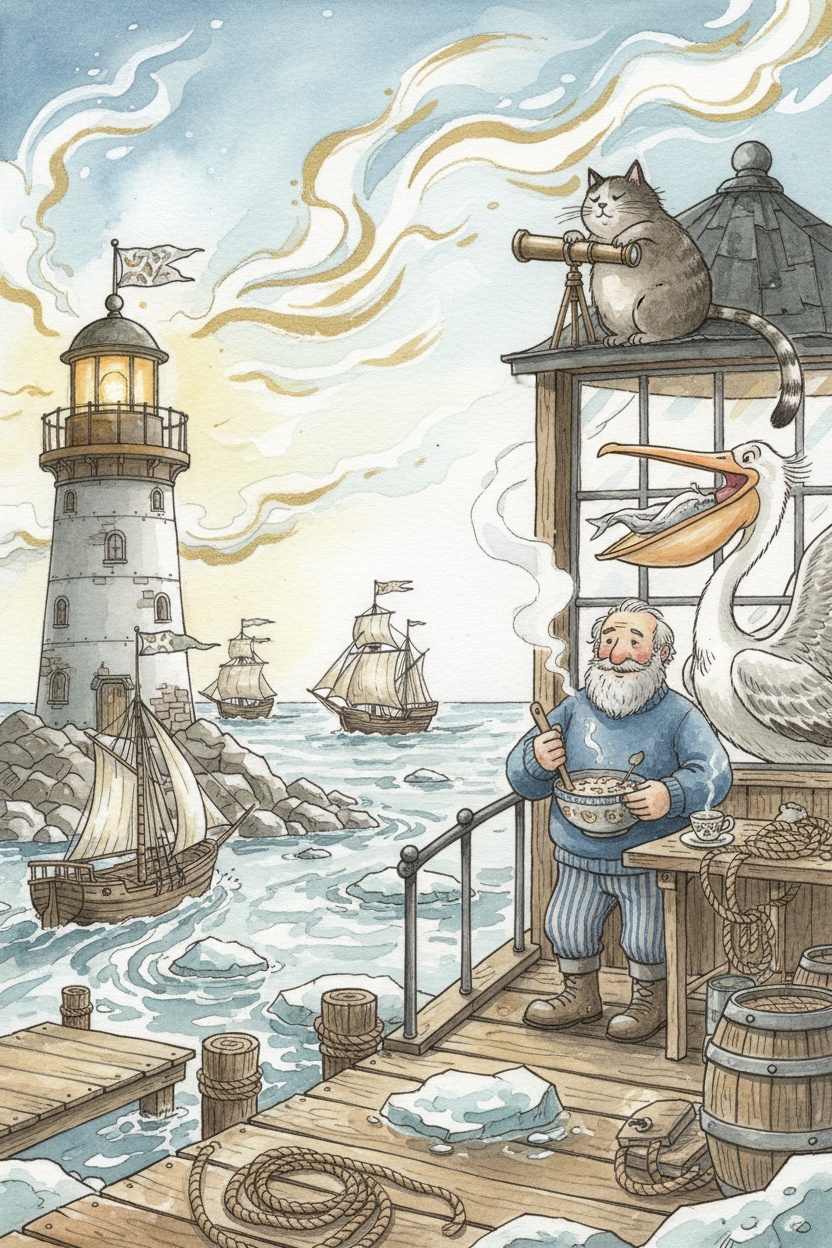
The morning was crisp and cold. Captain Whiskers sat in her window, high at the top of the lighthouse, watching the sea with quiet, careful eyes.
Below, the harbour was calm. The water was flat and silver. The fishing boats bobbed gently at their ropes, and the gulls wheeled overhead, singing their creaky morning songs.
It was, Captain Whiskers thought, a very good morning indeed.
Until Morris the seagull arrived.
“WHISKERS!” he screamed, flapping his wings in wild circles. “WHISKERS! IT’S COMING! IT’S HUGE! IT’S COLD! IT’S— IT’S—!”
He landed on the windowsill, panting.
“Morris,” said Captain Whiskers calmly. “What is coming?”
“THE ICE!” he squawked. “A WHOLE MOUNTAIN OF ICE! It’s drifting right toward the harbour mouth! It’s going to block everything! It’s going to crush the boats! It’s going to—!”
“Show me,” said Captain Whiskers.
Morris flew ahead, shrieking directions. Captain Whiskers padded down the spiral stairs, her paws silent on the stone, and stepped out onto the rocks.
There, far out on the water, was an iceberg.
It was enormous. It was white and blue and glittering, and it was moving slowly, steadily, toward the thin opening of the harbour.
Penny the pelican landed beside her with a soft thump.
“Oh,” said Penny, her eyes wide. “That’s very big.”
“It is,” said Captain Whiskers.
“Can we push it away?” asked Penny.
Captain Whiskers studied the iceberg. She studied the current. She studied the tide, the wind, and the way the water swirled around the point.
“No,” she said. “We cannot push it. But we can steer it.”
“How?” asked Penny.
Captain Whiskers looked at the harbour. She looked at the little rowboats tied to the dock. She counted them.
Three.
“We will need rope,” she said. “And patience. And a very precise understanding of the tide.”
Down at the dock, Captain Whiskers explained her plan.
“The iceberg is moving with the current,” she said. “In twenty minutes, the tide will turn. For a few moments, the water will be perfectly still. If we pull from the right angles, we can nudge the iceberg past the harbour mouth and out to sea.”
Penny nodded, although her brow was furrowed.
“We will need one rope for each boat,” said Captain Whiskers. “Penny, you will take the north boat. I will take the south. Morris, you will take the middle.”
“ME?” squawked Morris. “IN A BOAT? I’M A SEAGULL, WHISKERS. I’M A BIRD OF THE AIR! NOT A— A— A SAILOR!”
“You are a bird of excellent eyesight,” said Captain Whiskers. “You will watch the tide and tell us when it turns.”
Morris puffed out his chest. “Oh. Well. That I can do.”
The three rowboats set out.
Captain Whiskers sat in the stern of hers, her paws on the oars, her tail curled neatly beside her. Penny rowed her boat with great concentration, her bill pointed forward like a compass. Morris perched in the middle boat, his head swivelling side to side, watching the water.
The iceberg loomed ahead.
It was closer now. Closer to the harbour mouth.
“Tide!” Morris shrieked. “The tide is turning! I can see it! The water is going— going— going SILENT!”
Captain Whiskers looked at the sea.
Morris was right. The water had gone still. Perfectly, glassily still.
“Now!” she called. “Pull!”
The three boats strained at their ropes. Captain Whiskers pulled north. Penny pulled south. Morris, still in the middle, pulled with his claws, his wings flapping furiously.
The iceberg groaned.
It was a deep, creaking, unhappy sound. It rolled slightly in the water.
“Pull!” called Captain Whiskers again.
The iceberg turned.
It was slow. So slow. But it was turning. The great white mountain began to shift, began to drift, began to slide away from the harbour mouth and out toward the open sea.
“It’s moving!” cried Penny. “It’s moving! We’re doing it!”
Captain Whiskers pulled once more. The iceberg slid past the point, past the rocks, past the lighthouse, and out into the deep blue water, where it floated peacefully away.
The tide began to flow again.
The harbour was safe.
Back on the dock, Penny flopped down, panting. Morris collapsed beside her, his feathers completely ruffled.
“That,” he gasped, “was the WORST thing that has EVER happened at this lighthouse.”
“It wasn’t a thing that happened at the lighthouse at all,” said Captain Whiskers mildly. “It happened at the harbour mouth.”
Morris opened his beak, then closed it.
“Well,” he said. “When you put it like that.”
From inside the lighthouse, there came the sound of a kettle whistling. The door creaked open, and old Angus stepped out, yawning.
“Mornin’, all,” he said. “Quiet one today, eh?”
Captain Whiskers blinked at him neutrally.
“Very quiet,” she said.
She sat down on the dock, watching the iceberg grow smaller and smaller on the horizon, and she smiled a small, private, perfectly satisfied smile.
Every ship gets home. That’s a promise.
And today, the whole harbour had been home to all of them.