Inside Out Academy
THE MAP OF US
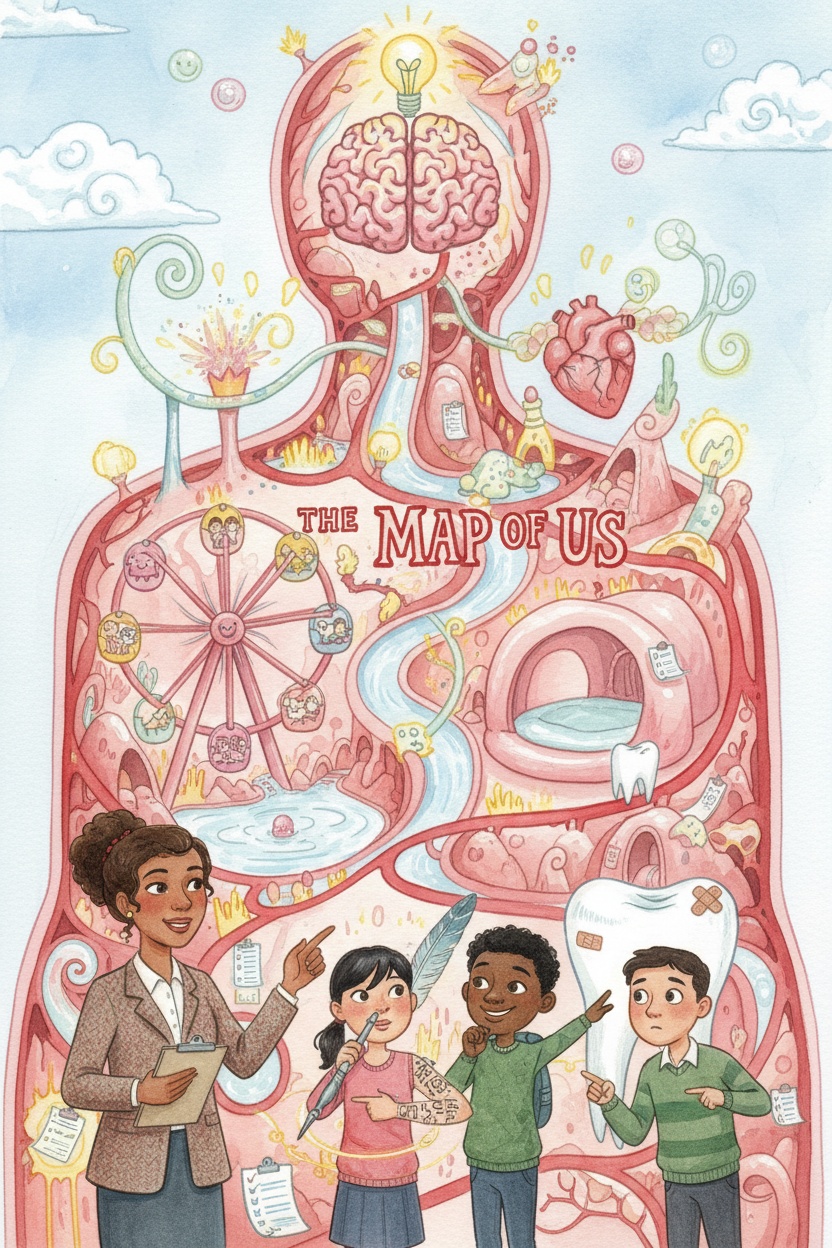
Ms. Vance's Current Checklist
Location: Base Camp, Right Heel (approximate)
Day 2 of being very, very small
Students accounted for: 22 (plus 1 teacher)
Leo: Present. For now.
The Map
The class had been inside Mr. Gomez for exactly one day, and already Leo was asking to go to the brain.
"We could just peek," he said, standing at the edge of the heel's thick skin like a captain surveying the sea. "Just a tiny peek. He wouldn't even notice."
"Leo." Ms. Vance did not look up from the paper in her hands. "No."
"But—"
"The brain is a command center. We are not ready for command centers. We are barely ready for the heel."
Ms. Vance was sitting cross-legged on a fold of skin, smoothing out a piece of crinkled brown paper. It was the wrapper from Sadie's emergency energy bar—the one Sadie carried in her pack "in case of sudden nutritional crisis." The wrapper was rectangular, slightly greasy on one side, and absolutely perfect for what Ms. Vance had in mind.
She pulled a marker from her pocket. The marker had been in Ms. Vance's pocket when the miniaturization happened. She had been using it to grade papers. Now it was approximately the size of a fire hydrant, and Ms. Vance was using it to draw.
"What are you making?" asked Fatima, who had been watching quietly from a nearby fold of skin.
"A map," Ms. Vance said. "A map of us."
The class gathered around. Twenty-two fifth-graders plus one teacher, all roughly the size of a red blood cell, all standing on the surface of Mr. Gomez's right heel, all looking at a paper map that Ms. Vance was drawing from memory.
Marcus leaned in, squinting. "That's the body? That's all the systems?"
"All eleven of them," Ms. Vance said. She drew a line through the middle. "First, we have the skeletal system—the bones. Two hundred and six of them. The frame everything else hangs on."
"Then the muscular system," Marcus said, nodding. "Muscles. Over six hundred of them."
"Correct. Then the circulatory system—heart, blood, blood vessels. The delivery network."
"The respiratory system," Sadie said, ticking off on her fingers. "Lungs. Breathing. Oxygen in, carbon dioxide out."
"The digestive system," Ms. Vance continued. "Food in, nutrients out, waste out. Then the nervous system—the brain, the spinal cord, and all the nerves."
Leo perked up. "The brain—"
"We are not going to the brain yet, Leo."
"I didn't say anything."
"You were thinking it. I could tell."
Ms. Vance kept drawing. "Then we have the endocrine system—the glands that make hormones, which are like chemical messages. The immune system—the body's defense against germs. The lymphatic system—which helps drain fluid and also helps with immunity. The integumentary system—the skin, hair, and nails."
"Skin is a system?" asked someone.
"Skin is the largest organ in the body," Sadie said. "It protects everything else. And it's what we'll need to get through when we eventually leave."
"And finally," Ms. Vance said, "the urinary system—kidneys, bladder, and the tubes that connect them—which filters waste from the blood. And the reproductive system, which we will discuss when we get to it, and not before."
She held up the wrapper. The map was rough but clear: eleven systems, drawn in different colors, all overlapping and connecting like a tangled city.
"This," Ms. Vance said, "is what we're inside."
The Vote
Marcus studied the map for a long time. Then he said, "If you don't understand the frame, you can't understand anything built on it."
Everyone turned to look at him.
"The skeleton," he explained. "It's the frame. The bones hold everything up. They protect the brain and the heart and the lungs. They're where the muscles attach. They make blood cells. If we don't understand the skeleton, we can't understand—" He gestured at the map. "—anything."
"That's the most sensible thing anyone has said since we became the size of dust," Ms. Vance said.
"Leo voted for the brain," Sadie pointed out.
"The brain is a terrible first stop," Marcus said. "Too complicated. Too protected. We'd get lost in the folds and never find our way out."
"We could take breadcrumbs," Leo said.
"There is no bread in the brain, Leo."
"Then we'd have a snack AND a map."
Ms. Vance cleared her throat. "We're voting. Where do we go first?"
The vote was overwhelming. Nineteen students voted for the skeleton. Two voted for the digestive system (they were hungry, which was a reasonable concern given that they were extremely small and their standards for a snack had changed dramatically). One vote—Leo's—was for the brain.
"The brain has been overruled," Ms. Vance said. "The skeleton it is."
"How do we get there?" asked Fatima.
Ms. Vance looked at the map. The heel was at the bottom of the leg. The bones were... everywhere, actually. The skeleton was the frame of everything. They were standing on skin, but just beneath the skin, there was bone.
"We're already on a heel," she said. "There's bone underneath us right now. We just have to find our way down."
"Down, then," Leo said, and started walking.
"And that's why we don't let Leo navigate," Sadie muttered.
The Frame
They found the bone the way you find anything large and unexpected: by walking into it.
The class had been making their way through the skin layers, which were like navigating a dense forest of collagen fibers. Ms. Vance kept consulting her map. Sadie kept consulting her memory of every medical fact her mother had ever said aloud. Leo kept suggesting they slide down a blood vessel "just to see."
And then the ground changed.
Fatima noticed it first. She stopped walking and put her hand flat on the surface beneath her feet.
"This isn't skin," she said.
Marcus knelt down. The surface was pale, almost ivory-colored, and it didn't flex the way skin did. It was hard. Dense. Regular.
"Is this—" Marcus started.
"The periosteum," Sadie said. "The outer layer of bone. Every bone in the body is covered in this—it's how bones get nutrients, and it's where muscles attach. We're on top of the bone."
"Which bone?" asked Leo, who was already running along the surface like it was a playground.
Ms. Vance consulted the map. "The calcaneus," she said. "The heel bone. The largest bone in the foot."
Marcus's eyes went wide. "That's it? That's the frame?"
"The beginning of it," Ms. Vance said.
They all looked down at the surface beneath them. It was smooth and strong and completely solid. It didn't move. It didn't pulse. It just... held.
"This is what everything is built on," Fatima said quietly. "The skin. The muscles. The blood vessels. Everything is attached to this. Everything is held up by this."
"That's right," Ms. Vance said. "The bones are the foundation. Without them, the body would just collapse into a pile of soft tissue. The bones hold us up. They shape us. They protect the soft parts—the brain inside the skull, the heart and lungs inside the rib cage. And they make blood cells inside the marrow."
Leo stopped running. He stood still on the bone and looked down at it.
"The bones are doing stuff," he said. "Even when we're not moving."
"They're always doing stuff," Sadie said. "Your bones are alive. They're constantly rebuilding themselves—old bone gets broken down, new bone gets made. It's called remodeling. Your entire skeleton replaces itself about every ten years."
"So the Mr. Gomez we're standing on is not the same Mr. Gomez he was ten years ago?" Marcus asked.
"Exactly."
"Huh," Leo said. He was quiet for a moment. That was rare enough that everyone noticed.
"What are you thinking?" asked Fatima.
"I'm thinking," Leo said slowly, "that the body is more interesting than I thought."
Ms. Vance smiled. She looked down at her map—the eleven systems drawn on a crinkled energy bar wrapper—and she thought about how the skeleton connected to everything, how every system in the body was built on something else, how nothing worked alone.
"The skeletal system helps the muscular system move," she said. "The muscular system helps the circulatory system move blood. The circulatory system delivers oxygen from the respiratory system to every tissue. The digestive system gives the body fuel. The nervous system tells all of it what to do. Everything depends on everything else."
"That's a lot of connections," said Marcus.
"That's what a body is," Ms. Vance said. "A city of connections. And right now, we're standing on its foundation."
A strange sensation rippled through the ground beneath them.
"Mr. Gomez is standing up," Ms. Vance said calmly. "Everyone hold onto something."
The class grabbed onto the periosteum as the world tilted. They were being lifted—the entire heel, the entire leg, the entire body of Mr. Gomez rising up from a sitting position.
Leo whooped. "WE'RE MOVING!"
"We're always moving," Sadie said, clinging to a fold of tissue. "The body is always moving. Even when it's standing still, the bones are making blood cells and the heart is beating and the lungs are breathing and—"
"Can you do this the whole time?" asked Marcus. "Explain things while the ground moves?"
"I can try," Sadie said.
The ground settled. Mr. Gomez's heel was firmly on the floor again. The class stood up, brushed themselves off, and looked at the bone beneath them.
"Okay," Ms. Vance said, pulling out her checklist and adding a note. Class has successfully located and identified the calcaneus. Educational objective met. Leo has not gone to the brain.
"We're going to learn everything about bones," she said. "And then we're going to climb the whole skeleton."
"All the way up?" asked Leo.
"All the way up."
Leo grinned. "I'm going to find the brain eventually."
"Not today, Leo."
"Not today," he agreed. And for now, that was enough.
Mr. Gomez's External Log, Evening
Today the tiny people in my foot drew a map on something that looked like a snack wrapper. Marcus was very excited about this. He kept saying "the frame" at dinner. I had a sandwich and some grapes, and I tried to sit very still so they wouldn't fall over.
I told my sister I had a "foot thing" and couldn't come to her place for dinner. She asked if it was a bunion. I said no, it was more of an educational opportunity.
My foot itched for about three hours. I think that was them.
The principal called again. I told him I was developing curriculum materials. He seemed pleased. I am developing curriculum materials. I'm just also the curriculum.
—Mr. Gomez