Inside Out Academy
THE INCREDIBLE SHRINKING FIELD TRIP
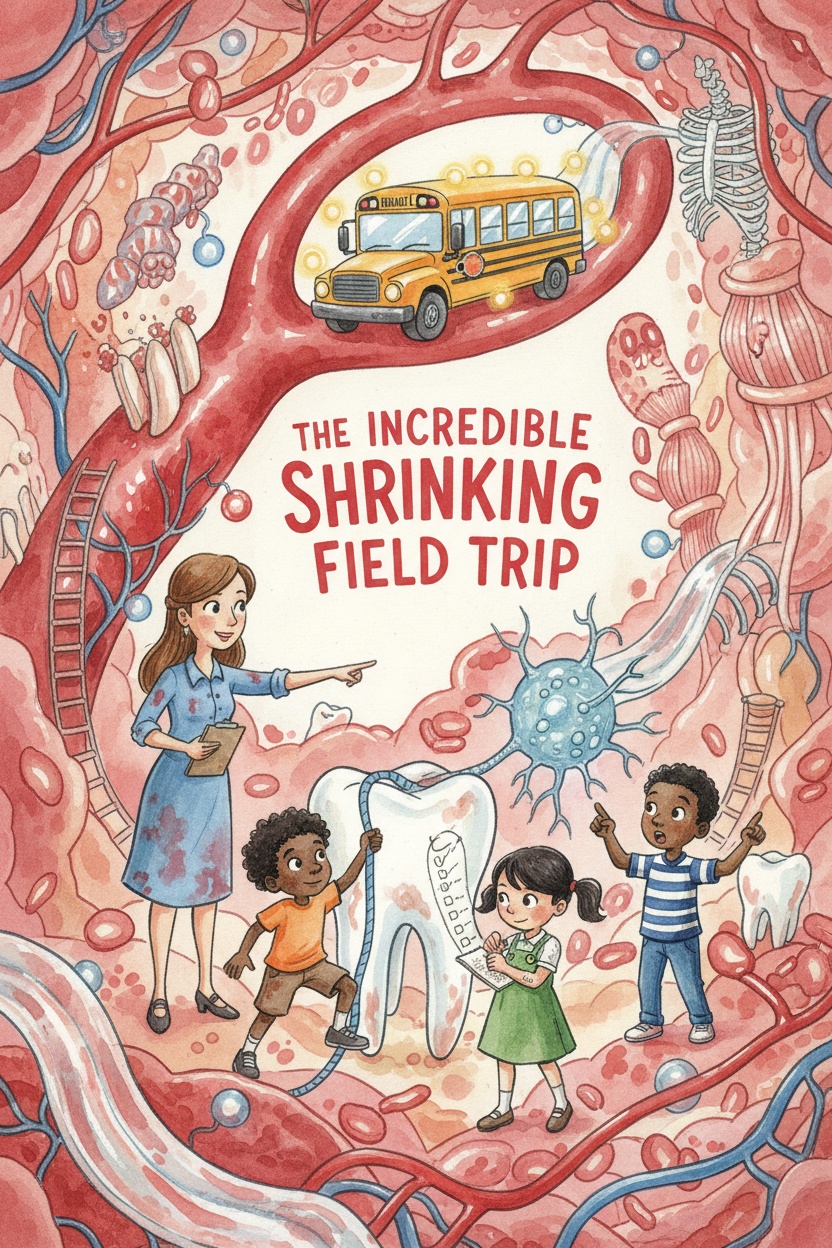
Ms. Vance's Current Checklist:
-
Location: Science Lab, Westbrook Elementary (then: Mr. Gomez's palm)
-
Date: Last Tuesday of the school year
-
Students accounted for: 21 of 22 (Leo is on the lab table, doing something)
-
Situation: Miniaturization demonstration... went sideways
-
Principal has been emailed. Three times. Response: "Please advise."
Section 1: The Demonstration That Wasn't Supposed to Work
The last Tuesday of the school year was supposed to be easy.
Ms. Vance's fifth-grade science class had finished their final projects. The posters were graded. The experiments were cleaned up. All that remained was the principal's special demonstration—a brand-new machine she was very excited about.
"Class," Principal Washington announced, wheeling in a large glass chamber connected to a tangle of wires, "this is the Miniaturization Module 3000. With your permission, I'll demonstrate how it works. On this!" She held up a small rubber duck.
Leo Okafor leaned forward in his seat. "Is it going to make the duck tiny?"
"That's exactly what it's going to do," said the principal proudly. "One hundredth of its normal size!"
The class gathered around. Ms. Vance made a checklist.
Demonstration observation checklist:
-
Observe safely from marked distance
-
Use proper scientific terminology when discussing results
-
Do not touch the shiny red button
The principal pressed the shiny red button.
The machine made a sound like a washing machine eating a harmonica.
The rubber duck shrank to the size of a grain of rice.
The class applauded.
Then—with a sound like a balloon popping underwater—the machine hummed louder, and the glass chamber filled with a blue-white light. Ms. Vance was still writing on her clipboard. The students were still clapping.
And then the light swallowed them all.
Later, Ms. Vance would describe the sensation as "like being put through a very small laundry chute while someone was also pulling on your socks." The students described it as "the best and worst ride ever."
When the light faded, they were standing on what appeared to be a tiny shore, surrounded by liquid.
The science lab looked enormous. The desk they'd been standing next to was now the size of a mountain range. The rubber duck—still miniaturized—floated nearby, looking confused.
"Oh no," said Principal Washington's voice, distant like a thunderstorm. "Oh no no no no no."
Ms. Vance looked down at herself. She was about the size of a red blood cell. So were all her students.
"Class," she said, in her calmest teacher voice, "everyone stay exactly where you are. I'm making a checklist."
Section 2: The Checklist and the First Problem
Emergency Checklist:
-
Everyone present? COUNT STUDENTS
-
Establish safe location
-
Contact outside world
-
Do not panic (optional but recommended)
"Twenty-one!" called Sadie Chen, counting rapidly. "Ms. Vance, twenty-one! We're missing someone!"
Everyone looked around.
On the edge of the glass chamber—which from their size looked like the rim of a crater—a small figure was crouched, looking down at the puddle of saline solution that had spilled when the machine malfunctioned.
"Leo!" Ms. Vance called. "Leo Okafor, you get back here right now!"
"BUT THERE'S A LAKE!" Leo shouted back, his voice echoing across the glass floor. "IT'S THE SIZE OF A LAKE!"
"IT IS NOT A LAKE!" Ms. Vance shouted. "It is approximately thirty milliliters of saline solution, and you are not allowed to—"
Leo jumped.
He landed with a splash—a very, very small splash—and began swimming across the puddle with great enthusiasm.
Sadie put her face in her hands. "He's going to do something inadvisable. He's going to do something inadvisable in the first ten minutes."
"He's already doing something inadvisable," Marcus Bell pointed out. "He's doing it right now."
From outside—enormously far away—came the sound of the science lab door opening. A mop appeared, moving across the floor in wide, careful strokes. The class watched it approach like a tidal wave of bristles and water.
"Excuse me," called Ms. Vance, cupping her hands around her mouth. "Excuse me! Whoever is mopping! We're down here!"
The mop stopped.
A face appeared, enormous, looking down at the glass chamber. It was a kind face, weathered and gentle, belonging to a man in a gray uniform with a name tag that read: GOMEZ.
Mr. Gomez blinked. He squinted. He leaned closer.
"Are you... tiny people?" he asked.
"We're Ms. Vance's fifth-grade science class!" called Ms. Vance. "There's been a miniaturization incident, and we need assistance!"
Mr. Gomez considered this for a moment. He looked at the tiny people in the glass chamber. He looked at the tiny rubber duck. He looked at the machine, still humming.
"Huh," he said. "Principal Washington's been wanting to test that thing for a while."
"Test it!" Marcus shouted. "We were the test!"
"Ah," said Mr. Gomez. "Well. That's a thing to be."
He knelt down and looked at the class more closely. His face was very large and very kind. He had a small mustache and very gentle eyes.
"Okay," he said. "Tell me what you need."
Section 3: The Negotiation and the Palm
Negotiation Checklist:
-
Establish mutual understanding (done—Mr. Gomez seems reasonable)
-
Identify needs: safe transportation, food supplies, eventual un-shrinking
-
Determine location strategy
-
Retrieve Leo from saline solution puddle
"I'm going to ask you a question," Ms. Vance called up to Mr. Gomez, "and I need you to answer honestly."
"Shoot," said Mr. Gomez.
"Can you help us get out of this chamber and to a safe location where we can make a plan?"
Mr. Gomez thought about this. He was the janitor at Westbrook Elementary, and he had been for fifteen years. He had cleaned up everything from glitter explosions to vomit-covered art projects. Tiny fifth-graders were unusual, but they weren't the strangest thing he'd ever dealt with.
"Eighth graders," he muttered, "dissecting owl pellets. That was stranger."
"What?" called Ms. Vance.
"Nothing," said Mr. Gomez. "Okay. Here's what I'll do. I'll hold out my hand. You climb onto my palm. I'll carry you somewhere safe—maybe my break room—and we'll figure this out together."
"That's very kind of you," said Ms. Vance.
"It's Tuesday," said Mr. Gomez. "I wasn't doing anything else."
Meanwhile, Leo had reached the edge of the saline lake and was climbing out, dripping and triumphant.
"Was that smart?" Sadie asked.
"It was wet," said Leo. "That's enough for me."
"Everyone line up!" Ms. Vance called. "We're taking Mr. Gomez up on his offer. Single file, watch your step, and nobody—nobody—jumps onto anything without checking first!"
Mr. Gomez held out his hand, palm up, and lowered it into the chamber.
The palm was like a landing field—warm, slightly damp, with tiny ridges and lines that looked like canyons. Marcus immediately started examining the skin.
"The stratum corneum," he said. "Made of dead skin cells, flattened and packed together. This is the outermost layer of the epidermis."
"Marcus," said Ms. Vance, "we're climbing onto someone's hand. Can we at least wait until we're settled before you start giving lectures?"
"I'm giving a lecture," said Marcus. "This is a lecture. I've been waiting all week."
The class climbed onto Mr. Gomez's palm, making their way across the warm landscape until all twenty-two students and Ms. Vance were standing in the approximate center.
"Everyone present?" Ms. Vance counted. "Twenty-two students plus me. And Leo, you're dripping on Marcus."
"I can't help it. I was in a lake."
"Someone get him a tissue."
Mr. Gomez lifted his hand carefully, slowly, like he was carrying a tray of very fragile drinks. He brought the class up to his face and squinted at them.
"Comfortable?"
"We're standing on your hand," said Fatima Hassan, in her quiet, measured voice. "I believe 'comfortable' is not the precise term."
"No," Mr. Gomez agreed. "I don't suppose it is. But it'll do for now."
Section 4: Into the Warm Dark
Entry Checklist:
-
Determine safe entry point (Mr. Gomez suggests his palm—it's thick-skinned and there's already a small cut from yesterday's toolbox incident)
-
Get all students safely inside
-
Establish base camp before venturing further
-
Ask Leo what he's doing. Again.
Where to go? This was the question.
"Back to the lab?" suggested Marcus. "Maybe Principal Washington can figure out how to reverse it."
"Principal Washington is currently running around the parking lot," reported Mr. Gomez, who had picked up an earpiece that allowed him to hear Ms. Vance's walkie-talkie. "She's yelling about paperwork. I don't think she's going to be helpful for a while."
"Safe to say," said Sadie, "we need a plan that doesn't depend on the principal."
From somewhere in the mass of students, Leo's voice rose: "We could go inside Mr. Gomez."
The class went very quiet.
"I'm sorry," said Ms. Vance. "You want to go inside our rescuer?"
"Why not?" Leo's head appeared above the crowd. He was grinning. "We're tiny. He's big. There's plenty of room. And we could see everything—muscles, bones, organs!"
"Leo, you cannot just—"
"He has a point," said Fatima.
Everyone turned to look at her. Fatima rarely spoke, and when she did, it was usually because she had been observing something very carefully for a very long time.
"He's right that we're small enough to go inside a body," she said. "And we need somewhere safe to stay while we figure out how to get back to normal. Mr. Gomez's body is warm and protected. And it's true that we'd see things no one has ever seen."
"Scientifically speaking," said Sadie, "this is the most terrible idea I've ever heard."
"Scientifically speaking," said Marcus, "it's incredible."
Mr. Gomez, who had been listening to all of this, looked down at the tiny people on his palm.
"You want to go inside me?"
"Not all of us," Ms. Vance said quickly. "We haven't voted yet."
"I vote yes," said Leo.
"You always vote yes," said Sadie. "You voted yes when they asked if anyone wanted to see what was in the cafeteria freezer."
"And it was snow peas," said Leo. "Worth it."
Mr. Gomez held up his other hand. "Excuse me. I've been thinking about this for about thirty seconds, and I have a proposal."
Everyone looked up at him.
"I'm not saying no," he said. "I'm just saying: if you're going to come inside me, I want to make sure you know where you're going. And I want to make sure you're prepared. So how about this: I'll help you get in. We'll set up somewhere safe. And then you learn as much as you can, and you figure out how to get out. Deal?"
"That's very generous," Ms. Vance said.
"I've been working here for fifteen years," said Mr. Gomez. "I've seen fifth graders do a lot of things. This might be the most interesting thing yet."
He pointed to his palm, where a small cut caught the light. It was from yesterday, he explained. A toolbox, an afternoon of fixing a door hinge.
"You can go in here," he said. "The skin is thick, there aren't many nerve endings, and there's a clear path to somewhere stable. I'll tell you what I feel so you know if you're going the right way."
Ms. Vance looked at the tiny opening in Mr. Gomez's skin, incredibly close now, like the entrance to a cave.
"Everyone," she said, "hold hands. We're doing this."
"Hold hands?" said Leo. "Isn't that a little—"
"Yes," said Ms. Vance. "We're holding hands. There's something you need to learn first."
Section 5: What Ms. Vance Said
Inside Mr. Gomez's palm, the class followed the small opening in his skin, which widened into a warm, dark interior. It was red and pink and textured like a landscape of small hills and valleys. The lamp—which Mr. Gomez had helpfully provided from his own pocket, then magically allowed three students to carry—cast a warm glow across everything.
"Okay," said Ms. Vance, standing in the center of a relatively flat area on the thick skin of the heel, "this is where we're setting up base camp. It's large, stable, and quiet. Professor Leo is not to wander off. Marcus, you're not a professor yet, either. We're all just students right now."
She looked around at the red landscape, at the strange architecture of the body they were now inside.
"Here's what you need to understand," she said, and her voice changed slightly—became the voice of someone who had been waiting a long time to say something wonderful. "You are looking at the most extraordinary thing in the universe."
"Is it a cell?" asked Marcus.
"Eventually," said Ms. Vance. "But first, look bigger. You're standing on tissue. A group of similar cells working together. All around you, in every direction, there are cells—tiny units, too small to see with your eyes. They're the building blocks of everything."
"Cells," said Sadie, nodding. "My mom talks about them. They're like little factories, right?"
"That's exactly right," said Ms. Vance. "Each cell has a membrane that keeps it safe, a nucleus with instructions, and parts that do specific jobs. And when cells work together in groups, they form tissues. Like this skin we're standing on."
Fatima knelt down and pressed her hand against the ground. "It feels... alive."
"It's the stratum corneum," said Marcus. "Dead skin cells, mostly."
"That's the outer layer," said Ms. Vance. "But under that, you have living tissue. Cells dividing, repairing, protecting. That's the thing about the body—everything is alive. Everything is moving. Everything is connected."
"So cells make tissues," said Leo, bouncing slightly. "Then what?"
"Tissues make organs," Ms. Vance continued. "Groups of tissues working together to do a specific job. Your heart is an organ. So is your stomach, your brain, your lungs. They're each made of different kinds of tissue, all working together."
"And organs make systems," said Marcus, snapping his fingers. "The heart is part of the circulatory system. Along with blood vessels. And blood."
"Exactly," said Ms. Vance. She looked around at the warm red interior of Mr. Gomez's hand. "You're in the smallest scale right now. You're in tissue. But all around you—if you could see further—you'd find organs. And systems. There are eleven systems in the human body, and they're all working right now, this very second, just to keep Mr. Gomez alive and healthy."
From outside came Mr. Gomez's voice, slightly muffled but cheerful: "Is that a compliment? I'm blushing."
"Focus," said Ms. Vance. "Here's what we need to know: the human body is organized in levels. Cells make tissues. Tissues make organs. Organs make systems. Systems make a complete human—someone like Mr. Gomez, or you, or me. Understand?"
"Cells to tissues to organs to systems," recited Leo. "Got it. So when do we get to see something cool?"
Ms. Vance looked at her students—twenty-two tiny people, standing on the skin of a kind man who had agreed to host them in his body while they figured out how to become normal-sized again.
"Leo," she said, "you're standing inside a human body. It doesn't get much cooler than this."
Final Checklist (for now):
-
Location: Base camp, Mr. Gomez's palm skin
-
Students: 22 present (Leo is now attempting to turn cartwheels)
-
Status: Stable
-
Next: Learn everything we can. Then figure out how to leave.
Mr. Gomez's External Log, Day 1:
Well. This is definitely the strangest Tuesday I've had at Westbrook Elementary.
I've got twenty-three tiny people inside my hand right now, which is not something I expected to say when I woke up this morning. They're setting up camp in my skin. It feels like a very small, very polite tickle. The teacher—Ms. Vance—is very organized. She's already made three lists.
I called in sick for the rest of the week. The principal asked why. I said I had a medical condition. I didn't mention that the medical condition was five-graders.
I've agreed to help them learn about the body while they're in there. They want to know how to get out safely, and I want to make sure they don't get lost. Seems fair.
Also, I'm going to need to eat well this week. The teacher says they'll need energy. I'm thinking maybe some fruit. Something with vitamin C.
The kids are nice. The one named Leo is very enthusiastic. He asked if they could see my tonsils.
I told him we'd talk about it later.
My hand itches, in a kind way. I think they're settling in.
I hope they're comfortable. They're doing something no one has ever done before.
I'm glad they chose me.
— Mr. Gomez