The Number Kingdom
The Logic Labyrinth
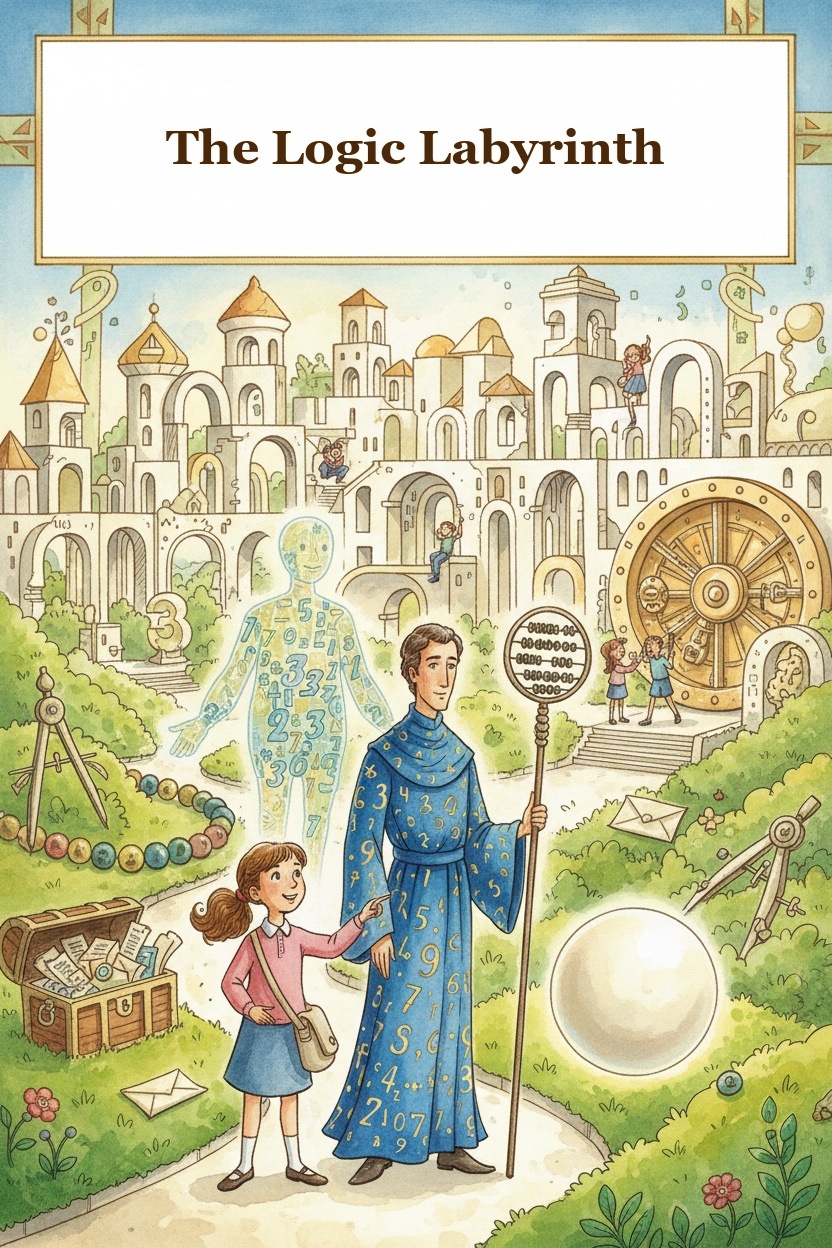
The Puzzle at the Edge
"Right. Let's see what's broken," Mira said, arriving at the edge of the Number Kingdom.
Before her stretched the Logic Labyrinth—a vast maze of hedges and stone walls that had stood for centuries. It was where the kingdom's scholars came to sharpen their thinking, to practice the art of drawing good conclusions from good reasons. The walls were covered in carvings: "If the sky is clear, then it is not raining." "All squares are rectangles, but not all rectangles are squares."
"Everything," the Count said gravely, appearing beside her with Zero at his feet. "The Remainder has filled the labyrinth with traps—false trails, twisted reasoning, doors that open only when you think correctly and slam shut when you don't. Citizens are wandering in circles, reaching conclusions that don't follow from their premises, and declaring themselves lost."
From somewhere inside the maze, Mira heard a gleeful voice. "Oh, it's WONDERFUL!" the Remainder called. "One traveler told me that because all triangles have three sides, anything with three sides must be a triangle! Then a hedge walked past and confused them enormously!"
"Nothing with three sides is walking anywhere that isn't logical," Mira muttered. She adjusted her satchel and stepped toward the entrance. "Let's see what's broken."
The First Trap
The labyrinth's entrance was a stone archway. Above it, carved in ancient letters: IF YOU REASON CORRECTLY, THE PATH WILL OPEN.
Beneath the words were two doors: one red, one blue. A sign between them read:
IF THE RED DOOR IS SAFE, THEN THE BLUE DOOR IS SAFE. THE RED DOOR IS SAFE. THEREFORE:
Choose the red door. Choose the blue door.
Mira studied the sign. "Okay," she said slowly. "The sign tells me two things. First: if the red door is safe, then the blue door is safe. That's a promise—a conditional statement. It doesn't tell me the blue door is safe by itself. It only tells me that IF the red door is safe, THEN the blue door is safe."
She tapped the second line. "And the second line tells me the red door IS safe. So the promise applies. Red is safe, and the promise says red being safe means blue is safe. So the blue door must be safe."
She pushed the blue door. It swung open easily.
Behind her, the Remainder made a disappointed sound. "You're supposed to get distracted! People always think the red door is the answer because it's mentioned first! That's not logic, that's just looking at the word 'therefore' and hoping!"
"No," Mira said, stepping through. "The first statement gives me a condition. The second statement tells me the condition is met. When both are true, the conclusion follows. That's how if-then works."
Inside, the labyrinth opened into a circular clearing with three paths leading out. Each path had a sign.
The Ancient Signs
The first sign said: THIS PATH LEADS TO THE CENTER.
The second sign said: THIS PATH DOES NOT LEAD TO THE CENTER.
The third sign said: THE SECOND SIGN IS WRONG.
A small creature—some sort of logic-fox—sat beside the signs, cleaning its whiskers. "Only one sign is true," it said. "The other two are false. Choose the path that truly leads onward."
Mira sat down on a stone and pulled out her pencil. "Okay. Let me think."
She wrote in her notebook:
Sign 1 says: Path 1 leads to center.
Sign 2 says: Path 2 does not lead to center.
Sign 3 says: Sign 2 is wrong (so Path 2 DOES lead to center).
"Sign 2 and Sign 3 are direct opposites," she said. "If Sign 2 is true, Sign 3 is false. If Sign 3 is true, Sign 2 is false. They can't both be true, and they can't both be false."
The logic-fox tilted its head. "And if they can't both be false, then one of them must be true."
Mira nodded. "And since only one sign total is true, the true sign must be either Sign 2 or Sign 3. That means Sign 1 is definitely false. Path 1 does NOT lead to the center."
She looked up. "But I still don't know if the true sign is 2 or 3."
"Try assuming," the fox suggested.
Mira wrote again. "Let's assume Sign 2 is true. Then Path 2 does not lead to the center, and Sign 3 is false—which matches what it says, because Sign 3 says Sign 2 is wrong, and we've assumed it's right."
She paused. "That works. No contradiction."
"Now assume Sign 3 is true," the fox said.
Mira wrote: "If Sign 3 is true, then Sign 2 IS wrong. And Sign 2 says Path 2 does not lead to the center, so if it's wrong, Path 2 DOES lead to the center. That also works—no contradiction."
She frowned. "Both assumptions work? That means I can't tell from the signs alone which path is right."
"That's correct," the fox said approvingly. "The signs, taken together, only tell you Path 1 is wrong. You know something, and you assume something else—and knowing the difference matters."
Mira looked at the three paths. "So I've eliminated Path 1. But I need more information to choose between Paths 2 and 3."
From somewhere close, the Remainder giggled. "Eliminate! She's eliminating! Do you know what's beautiful about elimination? It's not about knowing the answer immediately. It's about crossing out what CAN'T be true until what's left—"
"Until what's left is the only possibility," Mira finished. She turned to the fox. "Is there any other information I'm allowed to have?"
The fox smiled. "The labyrinth always offers exactly enough clues. You just haven't found them all yet."
The Sorting Circles
Mira took the path that was NOT Path 1—the second path—and emerged in a chamber where the floor was painted with two large overlapping circles. A sign overhead read:
THE CENTER LIES PAST THE CATEGORY GATE. PLACE EACH RESIDENT IN THEIR CORRECT CIRCLE TO OPEN THE WAY.
Sitting in the chamber were three creatures: a brick, a number, and something that looked like a fuzzy green triangle with legs.
"The circles are labeled," the brick said. "Left circle: THINGS THAT ARE SHAPES. Right circle: THINGS THAT ARE NUMBERS. Where the circles overlap is for things that are both shapes AND numbers."
Mira looked at the creatures. "The triangle is a shape, so it goes in the left circle. The number—what number are you?"
"Four," said the number.
"Four is a number, not a shape." She placed it in the right circle.
"And the brick?" she asked.
"I am a shape," the brick said. "Specifically, a rectangular prism, which is a three-dimensional shape."
Mira put the brick in the left circle with the triangle.
The gate remained closed.
"Is something wrong?" she asked.
"Consider what belongs in the middle," the brick said patiently. "The middle is for things that are both shapes AND numbers. Not everyone has placed themselves yet."
Mira looked at the four. "You're a number. Are you also a shape?"
"Am I?" The four wiggled. "I am a numeral—the written symbol for a number. And a numeral is drawn on paper. It has a shape. I am both a numeral and a number, which makes me a shape and a number."
Mira moved the four into the overlapping middle section. The gate creaked and began to open.
"There!" the Remainder called from somewhere. "She had to sort into overlapping categories! Did you see? It's not just one-or-the-other—things can be multiple things, and the overlap is its own place!"
Mira stepped through the gate and found herself at the heart of the labyrinth: a circular room with a single door, locked, with a brass keyhole. And in the center of the room, on a pedestal, sat the key.
Next to the key was a note: IF THIS KEY OPENS THE DOOR, THEN THE DOOR CAN BE OPENED. THE DOOR CAN BE OPENED. THEREFORE, THIS KEY OPENS THE DOOR.
Below, in different handwriting: THIS IS A TRAP. THE REASONING IS WRONG. FIGURE OUT WHY, AND THE KEY WILL FIT.
Mira read the note three times. "Okay," she said slowly. "The first statement is: if this key opens the door, then the door can be opened. That's a conditional."
She wrote in her notebook:
Statement 1: IF key opens door, THEN door can be opened.
Statement 2: The door can be opened.
Conclusion: Therefore, the key opens the door.
"You see the problem?" she said, tapping the page. "The first statement tells me what follows IF the key works. But the second statement—that the door CAN be opened—doesn't tell me what opens it. The door could open by magic, by a different key, by pushing it. Just because it CAN be opened doesn't mean THIS key opens it."
Zero spoke for the first time, quietly. "The conclusion doesn't follow from the premises. It's assuming something not stated: that the only way to open the door is with this key."
"Exactly," Mira said. "I know the first statement is a promise. I know the door can be opened. But I don't know that the promise's condition is met. And I've been assuming I need the key at all—maybe the door just pushes."
She walked to the door and gave it a gentle push. It swung open.
Behind her, the Remainder let out a long, approving whistle. "You caught it! Most people don't! They confuse 'if this, then that' with 'if that, then this'—they flip the direction entirely! But you knew the difference between what you KNOW and what you ASSUME."
On the pedestal, the key dissolved into light, and the note changed. In shimmering letters, it read: THE CENTER IS BEYOND. YOU HAVE PASSED THE FINAL TEST.
Mira stepped through the open door and found herself outside the labyrinth, blinking in the afternoon sun. The Count stood waiting, and Zero sat at his feet.
"You restored the labyrinth," the Count said. "The doors now open only for true reasoning. The citizens have all found their way out."
"Not just out," Mira said. "They had to think to do it. The labyrinth isn't about reaching the center—it's about learning how to get there."
From the labyrinth's edge, the Remainder appeared, floating like a wisp of smoke. "You know," it said thoughtfully, "I filled that labyrinth with traps. But you kept noticing something important. That 'if-then' doesn't go backward. That knowing and assuming are different. That sorting things into categories—even overlapping ones—helps you see what belongs where."
It tilted, as if considering. "Logic is just careful thinking. And careful thinking is a kind of mathematics. The mathematics of if and then, and of what follows from what."
Mira nodded. "That's right. And I couldn't have done it without noticing when I didn't actually know something. I had to be honest about what I knew and what I only assumed."
Zero drifted forward, a perfect silver circle. "Yes," it said quietly. "That tends to work."
The Remainder laughed—not unkindly—and scattered into the breeze, leaving only the sound of its voice: "Until next time, then. I'll be thinking about the parts of logic that DON'T work out neatly. There are more than you'd think!"
Mira watched it go, then turned back to the labyrinth. The walls were straight now, the signs clear, the paths true. The Logic Labyrinth was restored.
"Right," she said, tucking her pencil into her satchel. "Let's see what's broken next."
The End