The Logic League
Secret Language
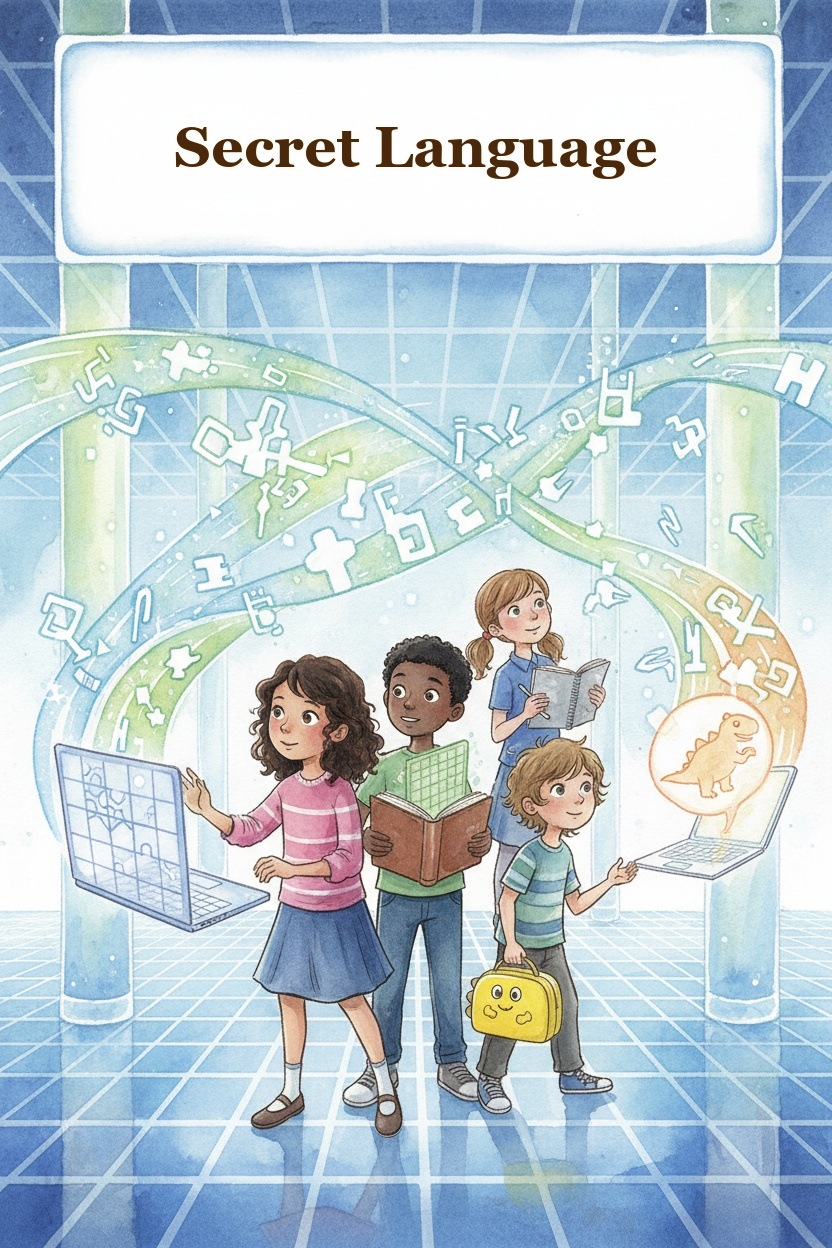
The Whispering Cables
The lost-and-found closet smelled like old sneakers and raincoats, as it always did. Priya was already on her knees, shoving aside a bin of mittens, when the laptop glowed through the stack of forgotten library books.
"Showtime," Kwame said, and the four of them gathered around as the screen flickered to life. The familiar green text cascaded down, then formed a single line:
PORTAL OPEN. DESTINATION: OUTER GRID — TRANSMISSION SPIRE.
The transmission spire rose before them like a twisted metal tree, its branches made of cables that stretched in every direction, humming with light pulses. The kids stepped out of the portal onto a platform that circled the spire's base. Messages raced along the cables overhead—bright streams of light that zipped past in both directions.
"This is the network backbone," Lily said, watching the data flow with obvious delight. "Book 28 explained it. Information travels through these cables in packets."
"Looks like a highway," Sam said, craning their neck to watch the streams.
"More like a thousand highways," Priya corrected. "All the information in the Grid, moving at once."
As they watched, one of the cables near them began to pulse differently—not the steady flow of the others, but a stuttering sequence. Blink. Blink-blink. Blink. A long pause. Then it repeated.
"That one's not like the others," Sam observed.
Kwame tilted his head. "It's like it's trying to say something."
A panel on the spire's base slid open, revealing a small chamber with a single terminal. On the screen, words appeared:
INCOMING TRANSMISSION. DECODE REQUIRED.
MESSAGE: IKWTVG YG EQO G
ERROR: MESSAGE INTEGRITY COMPROMISED. KEY REQUIRED.
"Decode required," Lily read. "Key required. That's a new one."
"Maybe it's just garbled," Sam suggested. "Like when the radio in Dad's car loses signal and everything sounds like static."
Priya shook her head. "Garbled would be random. Look at the message—IKWTVG YG EQO G. There's a pattern. Every letter has been changed somehow."
Sam squinted at the screen. "Why would someone change letters on purpose?"
"To hide what it says," Kwame said slowly. "From anyone who shouldn't read it."
The Letter-Shift Lock
Lily was already at the terminal, her fingers hovering over the keys. "If it's a pattern, maybe I can figure it out by comparing what we see to what makes sense."
She typed a few test messages and studied the results. "Letters are shifting. Every letter in the coded message is three positions earlier in the alphabet than it should be."
"Wait, three positions earlier?" Priya leaned in. "So the coded 'I' is actually—"
"An 'F'?" Sam counted on their fingers. "I... H... G... F. Yes!"
Lily typed the decoded letters. IKWTVG became FHTQSD. She frowned.
"That's not a word either."
"Try going the other direction," Kwame suggested. "What if the coded message shifted letters forward to encode it? Then to decode, you'd shift them backward. But maybe we have the direction wrong."
Sam's eyes lit up. "So to decode, we go forward three letters instead of backward! Let's see—I becomes L. K becomes N. W becomes Z."
"LNZ..." Priya counted. "That's not it either."
The terminal displayed:
ERROR: DECODE ATTEMPT UNSUCCESSFUL. THE KEY IS THE SHIFT. THE SHIFT IS THE KEY.
"Okay," Lily said, tapping her chin. "The error message says the key IS the shift. Not the direction of the shift, the number of the shift. A key... what if the key tells us how many letters to shift?"
Kwame pulled out his journal and flipped to a fresh page. "In the real world, when you send a secret message across a public network—like the internet—anyone could intercept it. The Grid is the same. These cables are public. Anyone could read what's traveling through them."
"So encoding makes it unreadable to people without the key," Priya said. "Like writing in a secret language."
"Exactly," Kwame said. "And the key is the special knowledge that lets you translate the secret language back into normal language. If you know the key, you can read it. If you don't, it's just gibberish."
Lily studied the terminal. "But we don't know the key. The error message is being deliberately unhelpful again."
"It says the key IS the shift," Sam said slowly. "What if the key is different for different messages? What if the sender and receiver agree on a key beforehand?"
Priya's eyes widened. "So we need to figure out what key this particular sender used!" She turned to the cables above them. "That cable was pulsing in a pattern. Maybe the pattern IS the key."
The four of them watched the stuttering cable again. Blink. Blink-blink. Blink. Long pause. Repeat.
"I count three blinks before the pause," Kwame said. "Three."
"Three!" Sam bounced on their heels. "Shift of three! We tried that!"
"But we tried the wrong direction," Lily said. "What if the coded message was made by shifting letters backward three, so to decode it, we shift forward three?"
She typed quickly. IKWTVG became NLWYJ.
"That's worse!" Priya groaned.
Sam's Question
"Wait," Sam said, their voice small but steady. Everyone turned to look at them.
Sam pointed at the blinking cable. "We counted three blinks. But the message has spaces. What if the spaces matter?"
"What do you mean?" Kwame asked.
"The coded message is IKWTVG YG EQO G. It has spaces separating chunks of letters. But the message is thirteen letters long total. What if thirteen is part of the key?"
Lily's fingers flew across the keys. "Shift of thirteen!" She typed it in. IKWTVG became VDJGIT.
"Still not a word," Priya said, her voice tight with frustration. "Every letter shifts the same amount, but we keep getting nonsense. There has to be something we're missing."
Kwame stared at the message. IKWTVG YG EQO G. Four chunks. Different lengths. Something about the spaces bothered him.
"Sam," he said slowly, "when you said the spaces matter—what made you think of that?"
Sam shrugged. "Because when I write secret messages to my friends, I take out all the spaces so nobody can guess where words end. If someone left the spaces in, they'd be telling you something about the message's shape. But these spaces..."
"These spaces are wrong," Lily finished. "Look at the last chunk. Just the letter G. A single letter. That would be a pretty short word in any language."
"Unless it's not a letter," Kwame said. "What if it's a number?"
He wrote the message out on a piece of paper from his journal:
I K W T V G Y G E Q O G
"Count the letters in each chunk," he said. "Six letters. Two letters. Three letters. One letter."
"Six, two, three, one," Priya repeated. "6231. That could be a key!"
Lily was already typing. "Let's try shifting the first chunk by six, the second by two, the third by three, and the last by one. But which direction?"
"Forward," Sam said. "To decode, we go forward. Because the person who wrote it was trying to hide it, so they would have shifted it backward to scramble it. Undoing it means going forward."
Lily typed. The first chunk, IKWTVG shifted forward by six, became:
C O O L S T
She gasped. "Cool st—that's almost something! Let me finish!"
The second chunk, YG shifted forward by two:
W E
The third chunk, EQO shifted forward by three:
H O M
The final chunk, G shifted forward by one:
E
The terminal displayed the complete decoded message in bright green:
COOL ST WE HOM E
"Cool st we hom e," Priya read. "That's not—"
"C O O L S T W E H O M E," Sam said slowly. "It's one word if you put the chunks together! COOLSTWEHOME. But that's not a word either."
Kwame laughed suddenly. "No—look at the chunks again. Six, two, three, one. It's the KEY. Six-two-three-one is the key for how to split the decoded message too!"
He wrote it out: COOLST WE HOM E
"Now divide it differently," he said. "What if the key tells us the message was jammed together and then split into wrong chunks to confuse us? The real message is just COOLSTWEHOME."
Priya stared at it. "Wait. If we re-read it with different word breaks... COOL ST WE HOME... no. COOLES THE ONE... no." She gasped. "COOL—ST—WE—HOME. Cool. St. We. Home."
"Coolest we home," Sam tried. "Coolest we home... Coolestwehome... Coolest..." Sam's eyes went wide. "COOLEST WE HOME! It says COOLEST WE HOME!"
"Coolest we home," Kwame repeated. "We're the coolest? We're home?" He frowned. "That doesn't make sense as a sentence. Unless—"
"Unless the G is part of the code," Lily said. "Not a letter G but a number—NO. It decoded to ONE because we shifted by one. But what if the last chunk wasn't meant to be decoded at all? What if it's telling us the key for the NEXT message?"
The terminal blinked and displayed:
CORRECT. THE KEY IS 6231. NEXT MESSAGE INCOMING.
The Real Message
A new message scrolled onto the screen, longer this time:
YJHQFWJ RJXXFNJ NS ZWLSFSNH NSYJWSTY NX F UTZW YWTZQJ
"No spaces," Priya observed. "That's better encryption. Take out the spaces and it's harder to guess where words begin and end."
Lily referenced the key. Six, two, three, one. She started decoding, shifting each chunk of the message by the corresponding number of the key—first six letters forward, then two, then three, then one.
The first chunk decoded to:
S E C R E T
"Secret!" Sam cheered.
She continued through the entire message: SECRET MESSAGE IN ORGANSATION INTERNET IS POUR TROUBLE.
She frowned. "That's not right. Secret message in organson internet is pour trouble? It's close but some words are wrong."
"Because the key is shorter than the message," Kwame said. "You have to repeat it." He counted. "Six, two, three, one–then start over. Six, two, three, one–over and over–until you've decoded every letter."
Lily tried again, this time cycling through the key digits repeatedly. Slowly, the true message emerged:
SECRET MESSAGE IN ORGANISATION INTERNET IS A POUR TROUBLE
"No," Lily said, even as Kwame's hand moved faster. "Organization. Internet is—" She looked closer. "A POUR TROUBLE?"
Priya was laughing now. "POUR trouble? Like when you pour a glass of water? That makes no sense."
"Unless it's a homophone," Sam said quietly. "Pour. P-O-U-R. Or... P-O-O-R?"
"POOR TROUBLE?" Priya snorted. "That's not—"
"With a different letter, it would be YOUR trouble," Kwame murmured. "POUR. In code, if you shift the P forward... wait. What if not every letter shifts the same direction?"
The terminal displayed:
ERROR: KEY APPLICATION INCONSISTENT. ENCRYPTION REQUIRES EXACTNESS.
And suddenly Lily understood.
"The message is encrypted BEFORE the key is applied," she said. "Whoever sent this message encrypted it first by shifting letters according to the key pattern. We decrypted it by shifting the OTHER direction. But if the sender made a mistake—if they weren't exact—then the message would corrupt."
She turned to the others, eyes shining. "Real encryption doesn't have mistakes, because computers are exact. But messages that go across real networks sometimes get scrambled by noise—interference, damage, something in the path. Encryption makes sure that even if someone intercepts the message, they can't read it without the key. But encryption CAN'T protect against the message being changed in transit."
A new error appeared:
ERROR: TRANSMISSION CORRUPTED. MESSAGE UNREADABLE. REQUEST RESEND.
"Request resend," Priya read. "The sender will try again."
"But now we know the key," Sam said. "So we'll be able to read it when it arrives."
"More than that," Kwame said, flipping to a fresh page in his journal. He wrote:
Journal Entry 29: The Grid speaks in secret sometimes. Anyone can see the coded message traveling through the public cables—it's right there, out in the open, for anyone to look at. But seeing isn't reading. The message is protected by a key, a number that tells you how to unlock the letters. Without the key, the message is just noise. With the key, it becomes information. In the real world, when you send private messages over the internet—bank information, passwords, notes to friends—encryption does the same thing. It scrambles the message so that only people with the key can read it. The message travels across public networks, through cables and servers where anyone could technically intercept it. But encryption makes interception useless. The message is secret language, and the key is the secret. He smiled. The Grid taught us that some words are meant for everyone, and some words are meant only for the people who share the key.
The terminal beeped. A new message appeared:
YZGDUA LK RWMGDDA DCQAKFGSEA ZQUMK FQ MST FQ OEDD. CDQEDD YJXWYJ WDGHLFWJ BMFSFGNNDZYMGJ FQ ZLAOSGHI XKF DYMPT FQGZWWD.
"Once the resend comes in with clean data," Lily said, cracking her knuckles, "we decode it with the same key pattern."
She typed the key sequence: six-two-three-one, repeating, and applied it to the new message. Slowly, letter by letter, the true communication emerged:
REMEMBER THE NETWORK CHANNELS. RESEND YJXWYJ WDGHLFWJ BMFSFGNNDZYMGJ FQ ZLAOSGHI XKF DYMPT FQGZWWD
"That second half didn't decode," Priya said. "It's still garbled."
"Because the resend is still coming through!" Sam pointed at the cable above, which was pulsing rapidly. "Watch!"
The cable stuttered and glitched, then steadied. The screen flickered and the remainder of the message decoded:
RESEND COMPLETE. REMEMBER THE NETWORK CHANNELS. THE PRIVATE WORDS STAY PRIVATE BECAUSE THE KEY IS OURS.
The terminal displayed a green checkmark, and a new line appeared:
TRANSMISSION SECURE. CHANNEL ENCRYPTED.
The cable above them glowed steady and bright, joining the other streams of light.
"We did it," Priya said softly. "We decoded their message."
"More importantly," Lily said, "we understood why it was coded in the first place. The messages travel through public channels—anyone could intercept them. But without the key, they're just strings of letters. Encrypted messages can travel safely across public networks because the code protects them."
"Secret language," Sam said, smiling. "The Grid taught us a secret language."
"Not just us," Kwame said, closing his journal. "Everyone who knows the key can read it. That's the point of encryption—it keeps secrets private from the people who shouldn't see them, while still sharing them with the people who should."
The platform beneath them began to glow, and the familiar portal hum filled the air. The laptop's light flickered at the edge of the chamber.
"Back to the lost-and-found?" Sam asked.
"Back to the lost-and-found," Priya agreed.
As they stepped toward the portal, Kwame paused and looked back at the terminal. A final message scrolled across the screen:
ENCRYPTION IS NOT MAGIC. IT IS LOGIC WITH A KEY.
"I guess that's the real secret," Kwame murmured. "Magic would be easier to break. Logic—logic you have to understand."
The portal swallowed them, and the transmission spire faded into green static, carrying its secrets safely through the network—readable only to those who held the key.