Professor Plunks Impossible Lab
The Circuit Catastrophe
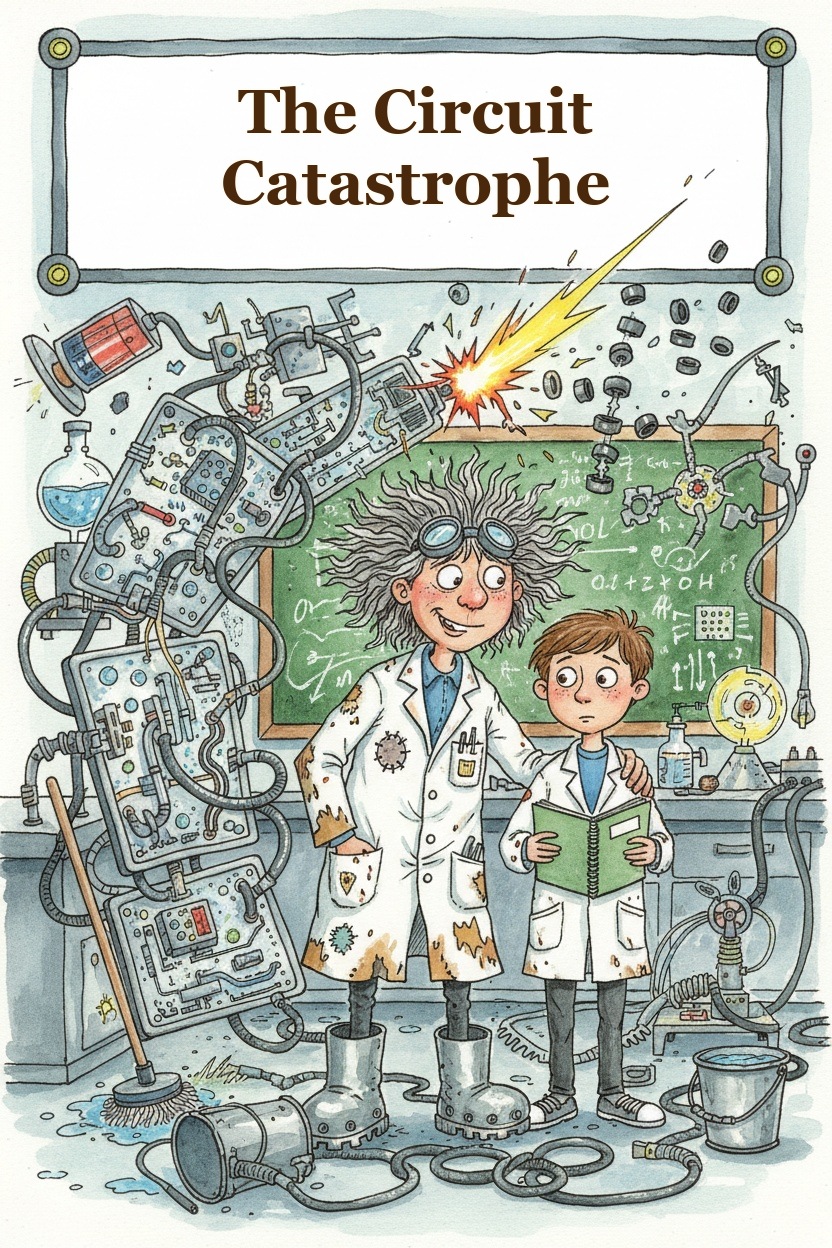
The Simple Circuit
"Otto! My careful colleague! Today we make history!"
Professor Plunk burst through the laboratory door with a cardboard box tucked under one arm and a coil of copper wire wrapped around her shoulder like a scarf. Her safety goggles sat on her forehead, catching the morning light.
Otto looked up from his lab notebook, where he had been carefully drawing a picture of the lab's resident spider, Mr. Wiggles. "What kind of history, Professor?"
"Electrical history!" Plunk slammed the box onto the workbench. Inside were batteries, bulbs, a small bell, a buzzer, and approximately one million wires. "We are going to build a simple circuit."
Otto opened his notebook to a fresh page. He wrote at the top:
Experiment: Simple Circuit
Goal: Make one light bulb glow
Expected chaos level: Low
He paused, then added: Probably.
"A circuit," Plunk announced, "is a complete path for electricity to flow through. Electricity flows from the battery, through the wire, to the bulb, and back to the battery. If the path is broken—"
"Nothing works?" Otto guessed.
"Exactly! No flow, no light. But if we connect everything properly—" She held up a bulb triumphantly, "—light!"
Otto studied the box. "How many bulbs are in there, Professor?"
"Oh, quite a few. But we only need one for a simple circuit." She wound the copper wire around her finger. "One little bulb, one little battery, one little path."
Otto wrote: One of everything. Simple.
He was wrong.
The Chain Reaction
The first circuit was beautiful.
Professor Plunk connected the battery to the bulb with two neat wires, and the bulb glowed warm yellow. Otto drew a careful diagram in his notebook and labeled it: Working Circuit - Path Complete.
"See?" Plunk beamed. "Perfectly simple. Now let's make it more interesting!"
Otto's pencil stopped. "More interesting?"
"Series circuit!" Plunk declared. "That's when bulbs share the current. The electricity flows through one bulb, then the next, then the next, all in a line like ducks following their mother."
She connected three bulbs in a row. They glowed, though each was slightly dimmer than the single bulb had been.
"Look at that," Otto said, surprised. "They're sharing the current. Each one gets a little less."
"Precisely! Series circuits share current between all the components. Now for parallel circuits—"
"Wait," Otto said. "Before you add more, let me check something."
He examined the connections carefully. Each wire was secure. Each bulb was in its socket. Everything looked right.
"And here," Plunk said, connecting another row of bulbs, "each branch gets the full battery voltage. The current splits between them."
The second row glowed bright and strong. Otto watched, genuinely impressed. "So in parallel, each bulb gets the same current as if it were alone?"
"Correct! Now, what happens if we have a series circuit and a parallel circuit together?"
"I don't think we should—"
But Plunk was already wiring. She connected the series row to the parallel rows to a buzzer and a bell and a small fan and something that made a clicking sound.
"Professor Plunk," Otto said carefully, "how many bulbs are in this circuit now?"
Plunk paused to count. "Oh, ten? Twelve? Something like that."
Otto looked at the battery. It was small. "Don't you think we need more power?"
"No, no! The current will just divide. That's the beauty of parallel circuits—"
Click.
Otto's eyes went wide. "Was that the buzzer?"
No. It was the sound of the circuit completing.
Every Bulb, Bell, and Buzzer
The light was immediate.
All twelve bulbs blazed on at full brightness. The buzzer sounded like an angry wasp. The bell rang with the enthusiasm of a fire alarm. The fan spun so hard it lifted itself off the workbench and hovered briefly before flying across the room.
"Professor!" Otto dove under the workbench.
"Fascinating!" Plunk shouted over the noise. "The current is—" She paused to count wires. "Oh dear. I may have connected the series circuit to the parallel circuit incorrectly."
"CORRECTLY OR INCORRECTLY, CAN YOU TURN IT OFF?!"
But the buzzer and bell were just the beginning.
The wires ran along the workbench, and the workbench was connected to the wall, and the wall was connected to—
BZZZT.
The entire laboratory lights flickered. Every bulb in the building, not just the experiment ones, blazed at maximum brightness. The alarm system went off. The intercom crackled to life and played a cheerful tune that no one had programmed it to play.
Otto peeked out from under the workbench. "Professor, what's happening?!"
Plunk was scribbling calculations on a nearby chalkboard. "The resistance in the series section is limiting the current there! But the parallel sections—they're drawing full current from the main supply! It's, it's—"
CLICK.
Everything went dark.
Silence.
Then, in the sudden blackness, Otto heard Gloriana's footsteps.
She walked through the lab with a flashlight, looked at the burned-out circuit, and said: "Tripped the fuse."
"I know," Plunk said happily. "But here's the beautiful part—"
Gloriana reset the fuse.
CLICK.
Every bulb, bell, and buzzer came back on, louder and brighter than before.
"Oh no," Otto said.
"Not to worry!" Plunk grabbed a screwdriver. "I just need to add more resistance!"
She opened a drawer and pulled out a thick, gray component. "Resistors! These limit current flow. The more resistance, the less current gets through!"
She attached a resistor to the circuit.
The bulbs dimmed slightly.
"See?" she said. "Less current!"
CLICK.
The fuse tripped again.
"Wait—" Plunk looked at her resistor. "That should have—"
"The fan!" Otto pointed. The fan had been knocked loose by its flight across the room and had landed on a different part of the circuit. Now it was connecting the main power supply directly to the parallel section. There was no resistance at all.
Gloriana reset the fuse.
CLICK.
"I'll fix it—" Plunk lunged for the fan.
But she was too slow. And the circuit was too fast.
The Great Rebuild
Gloriana reset the fuse three times total.
Each time, the circuit did something different. The first time, it lit every bulb in the building and played the intercom tune. The second time, it made the lift open and close its doors forty-seven times. The third time, it sent the lab's old radiators into a gentle humming vibration that shook the teacups in the break room.
Otto's notebook page was now entirely filled with frantic, messy writing:
FUSE TRIPPED: 1st time (everything lit up)
FUSE TRIPPED: 2nd time (also lit up)
FUSE TRIPPED: 3rd time (STILL LIT UP)
THIS WAS NOT IN THE PLAN
THIS WAS SO MUCH NOT IN THE PLAN
THE PLAN WAS ONE BULB!!!
But between the chaos, Otto was learning.
"Wait," he said, looking at the tangled mess of wires. "I think I understand now. The series bulbs were sharing current, so they were dim. But the parallel bulbs each got full current, so they were bright. And when the fan accidentally connected the power supply directly—no resistance at all—"
"Massive current!" Plunk finished. "Enough to trip a fuse!"
Gloriana handed Otto a pair of wire cutters.
"The path," Otto said.
Plunk stopped. "What?"
"The circuit needs a complete path. If the path is broken—" He snipped one wire. The buzzer stopped. The bell halted mid-ring. The bulbs went dark. "—no current flows."
The lab was silent.
Professor Plunk looked at the dark bulbs, then at Otto, and broke into a huge grin. "EXACTLY! An incomplete path means no current. No current means no electricity. That's the fundamental rule of circuits!"
"So the problem," Otto said, now cutting more wires, "was that our circuit had too many complete paths. Every path connected to the battery. The parallel branches especially—they each drew full current."
"And with no resistance at the fan connection—" Plunk twirled, delighted.
"Too much current. Fuse trips."
Gloriana, who had been watching Otto work, gave a single nod. "Good thinking."
Otto beamed.
The Beautiful Light
With Otto carefully directing the rebuild, the new circuit was much simpler.
One battery. One bulb. Two wires.
A complete path from battery to bulb and back again.
"If I break the path here—" Otto lifted one wire. The bulb went dark. "No current."
He placed the wire back. The bulb glowed.
"Now if I add another bulb in series—" Plunk held it in place while Otto connected it. Both bulbs glowed, but dimmer. "They share the current."
"And in parallel?" Plunk added a third bulb to a new branch. All three glowed at full brightness.
"The current splits," Otto said. "Each branch gets its own path."
"Resistance?" Plunk offered him a resistor.
Otto connected it and watched the bulbs dim. "More resistance, less current."
He wrote in his notebook:
Completed circuit = current flows.
Broken circuit = current stops.
Series = sharing.
Parallel = splitting.
Resistance = control.
THE PLAN WAS ACTUALLY SORT OF WORKED.
But next time, fewer bells.
Plunk peered over his shoulder. "Otto, that's excellent. You've mastered circuits entirely through my magnificent disaster!"
"Your magnificent disaster," Otto said, "tripped the fuse three times."
"Yes! And now you understand everything!" Plunk spread her arms. "A complete circuit needs an unbroken path. Series circuits share current. Parallel circuits split it. More resistance means less current. That was the lesson!"
Otto looked back at the glowing bulbs. The light was warm, steady, and exactly as bright as it should be.
"When you explain it like that," he said quietly, "it seems simple."
"Because it is!" Plunk said. "Electricity follows rules. The rules are beautiful."
The three bulbs continued to glow, steady and calm, as Gloriana silently swept the remains of the buzzer and bell into her dustpan. She caught Otto's eye, nodded once, and walked away.
Otto opened his notebook to a fresh page and drew the circuit diagram carefully. Under it, he wrote:
The rules of circuits are simple.
The mistakes are not.
But that's why we take notes.
And he smiled.