Lighthouse Cats
The End of the Season
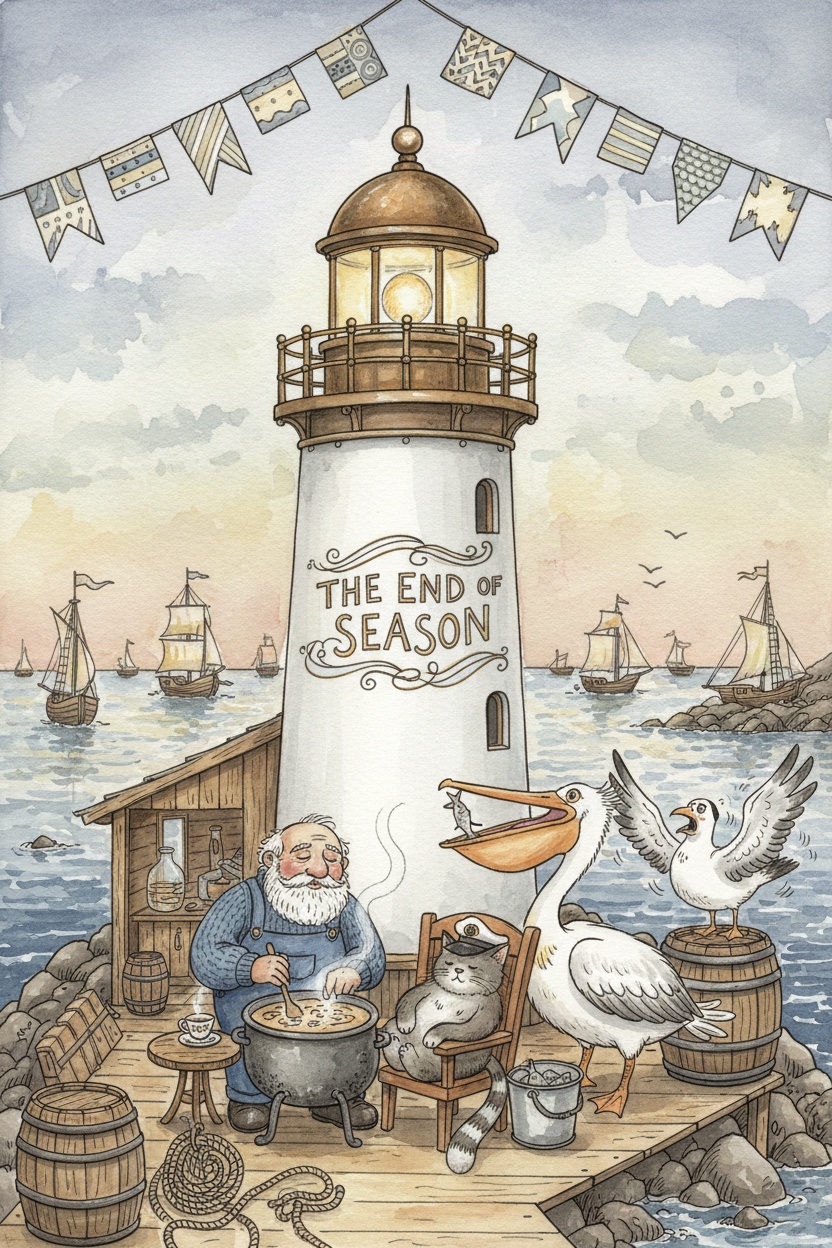
The summer was ending at Pelican Point.
The mornings came in cooler, with a nip in the air that made the hermit crabs of The Committee scuttle a little faster across the rockpools. The afternoons were shorter, and the light from the lighthouse—Angus’s good, steady light—began its evening sweep just a little bit earlier each day.
And the harbour was emptying.
One by one, the summer ships had weighed anchor and sailed away—the little yellow day-sailer, the green fishing boat with the squeaky winch, the red ketch whose captain always waved twice. Now the floating dock sat low and quiet, bobbing gently on water that seemed to have nothing left to wait for.
Captain Whiskers sat on the end of the dock, her silver-striped tail curled neatly around her paws. Her one black ear swivelled, listening to the silence.
It was a different kind of quiet. Not the quiet of fog, when ships were hidden and waiting. Not the quiet of night, when the sea held its breath. This was the quiet of gone.
Something small and round and very serious climbed onto the dock beside her.
It was a crab. A very young crab, with one claw slightly larger than the other and a shell that still had bits of summer seaweed stuck to it.
“Excuse me,” said the crab, in the small, careful voice of someone who had been practising a question for a very long time. “Are you Captain Whiskers?”
“I am,” said Captain Whiskers.
“The Committee said you would know,” said the crab. “They said you always know.”
Captain Whiskers blinked her slow, golden blink. “Know what?”
The crab looked out at the empty water. The horizon stretched wide and grey and bare. No sails. No masts. No little puffs of smoke from friendly chimneys.
“Will the ships come back?” the crab asked.
The wind blew across the dock, cool and sharp. A loose rope tapped against a cleat. Somewhere above them, Morris the Seagull was perched on the widow’s walk, and for once, he was perfectly silent—waiting, like everyone else, for her answer.
Captain Whiskers looked at the small crab. Then she looked at the sea. Then she looked at the place where the sun was sinking, painting the water gold and pink and deep, deep blue.
“Yes,” she said.
She did not hesitate. She did not pause to think. She said it the way she said everything—as though it were simply true, and had always been true, and there was nothing more to discuss.
The crab’s little eyes blinked. “Are you sure?”
“I am certain,” said Captain Whiskers.
The crab considered this. Then it nodded its small, serious nod, and climbed back down to the rockpools to report to The Committee.
Morris dropped down from the widow’s walk, feathers flapping. He landed on the dock with considerably less grace than he would have liked.
“That was a TERRIBLE question,” he announced. “The WORST question I have ever heard. Ships come and go, that’s what ships DO. They go and they come and they GO, and sometimes they DON’T come, and we shall all be very melancholy and—wait. Wait. You said yes.”
“I did,” said Captain Whiskers.
“Without hesitation! Without even a—a considering pause!”
“It did not require considering,” said Captain Whiskers.
Morris puffed out his chest. “But how can you KNOW? How can any cat possibly know such a thing? The sea is enormous! The weather is unpredictable! Ships break! Storms happen! There are PLENTY of ways for a ship to not come back!”
Captain Whiskers stood up. She stretched—front paws, then back—and her black ear gave a single, decisive flick.
“The ships know the way,” she said.
Morris tilted his head. “That’s… that’s not an answer.”
“It is,” said Captain Whiskers. “The ships know the way, and the sailors know the way, and the sea remembers them. Every harbour is a promise. Every departure is a return, waiting to happen.”
Morris opened his beak. Closed it. Opened it again.
“And ALSO,” said Captain Whiskers, “they will be hungry. The summer ships always come back hungry. And Angus’s chowder is best in the autumn.”
She turned and padded back up the dock toward the lighthouse, her tail high, her paws sure on the wooden planks.
Morris watched her go. Then he looked out at the empty sea.
“Hmph,” he said.
But there was something different in his voice. Something that was almost, almost like certainty.
That evening, Captain Whiskers sat in her window.
The light swept its steady arc across the water—on, off, on, off—a warm, golden heartbeat in the gathering dark.
Below, she could hear Angus humming in the kitchen. The smell of chowder drifted up, thick and rich and full of promise.
And in the rockpools, the Committee of hermit crabs had gathered around the small crab, listening to its report.
“She said yes,” the small crab said. “She said yes, without hesitation, and she was certain.”
The Committee nodded their small, wise nods.
And they settled in for the winter, the little crab tucked in the middle, feeling something warm and steady in its shell.
It did not have a name, that feeling. But if it had, it would have been this:
Every ship gets home.
That’s a promise.
And at the top of the lighthouse, silver-striped and black-eared and perfectly calm, Captain Whiskers watched the dark sea.
She could not see the ships. Not yet.
But she could feel them—all of them, everywhere, making their way home.
And in the spring, when the first sail appeared on the horizon, small and white and brave against the blue—
She would be right there, waiting.
She always was.