Professor Plunks Impossible Lab
Shadows and Surprises
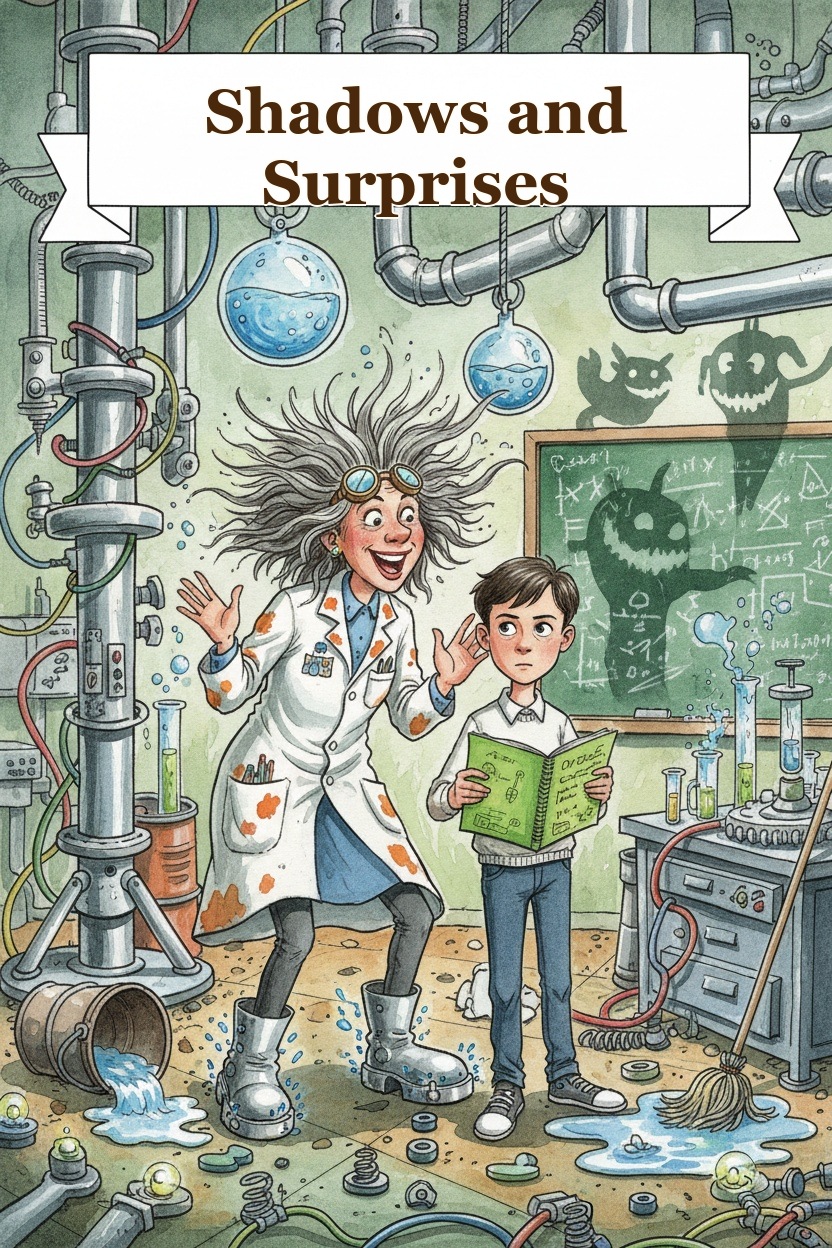
The Announcement
Otto Finch was organizing his lab notebook when Professor Plunk burst through the door with a cart the size of a small car. On it sat a metal contraption with a bulbous glass front, three dials, and a lever that looked dangerously loose.
"My careful colleague!" she announced. "Prepare yourself for the most illuminating experiment we have ever conducted!"
Otto looked up from his notebook. "Illuminating as in... educational?"
"As in LIGHT!" Professor Plunk threw open the curtains. Sunlight flooded the lab. "Today, we explore shadows!"
Otto relaxed slightly. Shadows seemed safe. Shadows were just dark shapes on the ground. What could possibly go wrong with shadows?
Professor Plunk patted the metal contraption lovingly. "I call this the Shadow Spectacular Projector, Mark Three! It's an experimental spotlight with a lens system designed to produce the sharpest, clearest shadows ever created!"
Otto opened his notebook to a fresh page and wrote:
Experiment #8: Shadows
Time: 10:15 AM
Goal: To observe how shadows are formed.
He paused, then added: Professor Plunk says this will go perfectly.
In his experience, that was either a good sign or a very, very bad one.
The First Surprise
"Now, the physics!" Professor Plunk wheeled the projector to the middle of the lab and switched it on. A brilliant beam of white light shot across the room, landing on the far wall in a perfect circle.
"Observe, Otto! Light travels in straight lines. It cannot bend around corners or curve through the air. It goes where it goes!"
Otto dutifully wrote: Light travels in straight lines.
"Shadows form when an opaque object blocks that straight-line path!" Professor Plunk grabbed a nearby coffee mug and held it in the beam. A perfect mug-shaped shadow appeared on the wall. "You see? The mug blocks the light, and beyond it, there is darkness!"
Otto nodded. This was actually making sense. He wrote: Shadows form when objects block light.
"Now," said Professor Plunk, her eyes gleaming with that particular sparkle Otto had learned to recognize, "let us make the demonstration more... dramatic."
She cranked the three dials on the Shadow Spectacular Projector Mark Three. The machine hummed loudly. The beam of light grew brighter and wider.
"Stand here, Otto, and I will adjust the angle to show how shadows change!"
Otto stepped in front of the beam. His shadow fell on the wall—a perfectly normal Otto-shaped shadow.
"Excellent!" Professor Plunk turned a dial labeled "LENS FOCUS." The shadow sharpened slightly.
Then she turned a dial labeled "LIGHT INTENSITY." The beam grew blindingly bright.
Then she turned the third dial, the one marked with a tiny warning symbol that Otto couldn't quite make out.
The machine made a sound like a very surprised trumpet.
And the shadow on the wall began to stretch.
Not a little stretch, like when the sun sets. This was a wobbling, growing stretch. Otto's shadow extended upward, then sideways, then upward again until it was twice his height. Three times. Five times.
"Professor!" Otto said. "Your machine is—"
"Magnificent, isn't it?" Professor Plunk beamed. "The lens must have adjusted the light spread! Now I can see every detail of your silhouette!"
Otto's shadow was now ten times his size. It loomed over the entire wall like a giant made of darkness.
"This is not in the plan!" Otto scribbled in his notebook.
THE SHADOW IS GROWING. THIS WAS NOT IN—
Before he could finish, the shadow separated from him entirely.
Otto blinked. He moved his arm. His shadow did not.
"Fascinating!" Professor Plunk leaned closer to the machine. "The projector seems to be casting light from multiple angles simultaneously! I must recalibrate!"
But Otto was staring at the wall. His shadow—his very, very large shadow—was moving on its own.
It raised one enormous hand.
Otto raised his hand.
The shadow waved.
Otto had definitely not waved.
The Giraffe Shadow
"Professor," Otto said carefully, "the shadow is doing things I'm not doing."
"Of course it is!" Professor Plunk said, not looking up from the projector's dials. "I designed the Mark Three to demonstrate how light angles affect shadow size! The shadow is moving because the light source is moving!"
"The light source is not moving," Otto pointed out. "I am standing perfectly still."
Professor Plunk finally looked at the wall. Her goggles slid down her nose.
"Hmm," she said. "That is unexpected."
The giant Otto shadow was now walking across the wall on its own. It wandered past the chalkboard and paused, as if examining the equations written there. Then it turned and walked through the beam of light, vanishing for a moment before reappearing on the other side.
"Wait a moment," Otto said, his scientific mind kicking in. "If that's my shadow, then where is my actual shadow? The one I'm supposed to see on the floor?"
Both of them looked down. Where Otto's shadow should have been, there was nothing but empty floor.
"Extraordinary!" Professor Plunk clapped her hands together. "The projector must be casting shadows from reflected light! The beam is bouncing off multiple surfaces, creating shadows that appear independent of their objects!"
"That doesn't explain why I don't have a normal shadow," Otto said.
"Who needs normal shadows when you can have SUPER shadows?" Professor Plunk gestured dramatically at the wall.
The giant Otto shadow had stopped walking. It was now looking at something on the wall—something that was also moving.
A giraffe shadow.
Tall and elegant, with a long neck and spindly legs, the giraffe shadow walked across the painted brick wall as if it had every right to be there. It stopped next to the giant Otto shadow. The two shadows stood side by side like old friends.
"Where is that coming from?" Otto spun around, looking for anything giraffe-shaped in the lab.
There was nothing. No giraffe stuffed animal. No giraffe statue. No giraffe-shaped lamp—although there was a lamp that was vaguely cow-shaped, but that was different.
"The light beam must be passing through something outside!" Professor Plunk rushed to the window. "Perhaps there's a giraffe in the courtyard!"
There was no giraffe in the courtyard. There was a small bicycle, a very determined bush, and Gloriana sweeping leaves. No giraffe.
The giraffe shadow tilted its head. Then it opened its mouth, and a tiny shadow leaf appeared, floating down into its shadow mouth.
"The palm plant," Otto said suddenly. "The palm plant on the bench! Its leaves make a shape like a giraffe's head when the light hits it at the right angle!"
He grabbed the small potted palm and moved it slightly. The giraffe shadow's neck stretched and curved. When he moved the plant back, the giraffe returned to its original shape.
"Of course!" Professor Plunk was practically dancing with excitement. "The light is striking the palm at an angle that elongates its leaves and stalk into a giraffe-like shape! The shadow is being cast at a completely unexpected angle because the beam is being deflected by the lens!"
Otto wrote in his notebook:
Shadows can look like other things depending on the angle of light.
The palm plant makes a giraffe shadow.
I am not sure how to explain the rest of this.
The Giant Otto
"Now," Professor Plunk said, rubbing her hands together, "let us see how many shadows we can create!"
She twisted the third dial—the one with the warning symbol—and the room filled with light.
Every object in the lab cast multiple shadows. The coffee mug cast a shadow AND a shadow of a shadow. The chalkboard eraser had a shadow on the wall and a shadow on the ceiling. The palm plant cast a giraffe, a bird, and—when the light hit it just right—something that looked remarkably like a submarine.
And the giant Otto shadow was back, now even bigger than before.
Otto watched it move across the wall. It was definitely not copying his movements anymore. It was walking on its own, pausing occasionally to look at the other shadows.
"This doesn't make sense," Otto said. "Light travels in straight lines. Shadows should match their objects. The size and position should depend on the distance and angle of the light source—not on what the shadow feels like doing!"
"Exactly right!" Professor Plunk said. "And that's why this is a fascinating discovery! The distance and angle of the light source are BOTH changing because the projector's lens is rotating!"
Otto looked at the projector. The lens was, indeed, slowly spinning. The light beam was sweeping across the room in a circle, which meant every shadow was being cast at a constantly changing angle.
"So the shadow size changes because the light angle changes," Otto said slowly. "When the light is low and close, the shadow is small. When the light is high and distant, the shadow is large."
"Yes!"
"And the giraffe shadow happens because the light angle elongates the palm plant's shape."
"Yes!"
"And the giant Otto shadow is just my shadow being cast from a low angle at a distance, making it look twenty times my size!"
"YES! And—" Professor Plunk paused. "Then why is it moving on its own?"
The giant Otto shadow turned around and looked at them.
Otto felt a shiver run down his spine. "That's what I'd like to know."
The shadow raised one enormous hand and pointed at the projector.
They both looked at the machine. The lens was still rotating, but now it was also tilting. The light beam was sweeping upward and downward, creating shadows that moved as the light moved.
"It's the projector," Otto realized. "The lens is rotating in a pattern. The light is sweeping across the room in a circle, which means the angle of light is changing continuously. The shadow appears to be walking because the light is moving!"
Professor Plunk's face lit up. "Every shadow follows the light! The shadow doesn't have its own legs—the light is doing the walking!"
She rushed over to a bicycle wheel propped against the wall. "Watch this!" She placed the wheel in the beam. Its shadow spun wildly as the light swept over it. "The wheel doesn't move, but its shadow appears to spin! It's an optical illusion caused by the moving light source!"
Otto laughed. "So the giraffe isn't walking either."
"Correct! The palm plant is as still as a statue, but the sweeping light makes its shadow appear to glide!"
Otto looked at his enormous shadow. It had stopped pointing and was now standing calmly next to the giraffe, the two of them looking like an impossible zoo exhibit cast in darkness.
"The giant shadow," he said, "is because the light is coming from a low angle and a far distance. The closer and lower the light, the bigger the shadow."
"And the position!" Professor Plunk added. "The shadow appears opposite the light source. Light from the left casts shadows to the right. Light from below casts shadows upward!"
Otto wrote quickly in his notebook:
Light travels in straight lines.
Shadows form when objects block light.
Different angles = different shadow shapes.
Lower and closer light = bigger shadows.
Moving light = moving shadows.
The palm plant is not actually a giraffe.
The giant shadow is my own shadow, enlarged by the low angle.
He looked at the last line and added, in slightly wobbly writing:
I am relieved about this.
The Wonder Moment
The rotating lens finally ran out of power. With a soft whir, the Shadow Spectacular Projector Mark Three wound down and clicked to a stop. The room's lights returned to normal, and Otto's shadow snapped back to its regular size at his feet.
He looked down at it. It looked up at him.
"I have to say, Professor," Otto said, "that was less destructive than most of our experiments."
"Less destructive!" Professor Plunk looked almost offended. "My dear boy, we created self-moving shadows! We discovered a three-story giraffe hidden in a potted plant! We demonstrated that light's distance and angle completely transform the shape and size of shadows!"
Otto smiled. "And the fact that the light source was rotating made the shadows appear to walk on their own."
"Exactly!" Professor Plunk dusted off her lab coat, which had somehow acquired a chalk mark shaped like Africa. "Well! That demonstrated light and shadow rather more vividly than I intended."
Gloriana appeared in the doorway. She was holding a pair of dark sunglasses.
"From the neighbours," she said. "They said the light show was very nice."
She placed the sunglasses on the workbench, nodded once, and left.
Otto looked at his notebook. His final entry read:
Today I learned that shadows are not scary, even when they are twenty times my size.
They are just light being blocked.
Different angles make different shadows.
Distance changes size.
Light travels in straight lines, but it can do surprising things along the way.
I will never look at a palm plant the same way again.
THIS WAS NOT IN THE PLAN—
He paused, then added:
—BUT IT WAS PRETTY AMAZING ANYWAY.
Professor Plunk was still admiring the palm plant's shadow, which was now casting a perfect giraffe shape on the floor in the afternoon sunlight.
"You know, Otto," she said softly, "shadows are proof that light exists. Without light, there would be no shadows. Without darkness, we couldn't see light at all."
Otto looked at his small, ordinary shadow. It was shaped exactly like him. It sat just where it should. It was, he thought, the best shadow he'd ever had.
"I think," he said, "I finally understand why shadows matter."
Professor Plunk nodded. "They show us where light is, what it's passing, and what it's passing around. Every shadow is a story of light."
Even the giraffe shadow seemed to nod in agreement.
Then the wind blew, the palm plant swayed, and the giraffe shadow galloped across the floor.
Otto didn't write "THIS WAS NOT IN THE PLAN."
He wrote: CHANGE OF PLAN.
And beneath it: BETTER.