Professor Plunks Impossible Lab
The Resonance Catastrophe
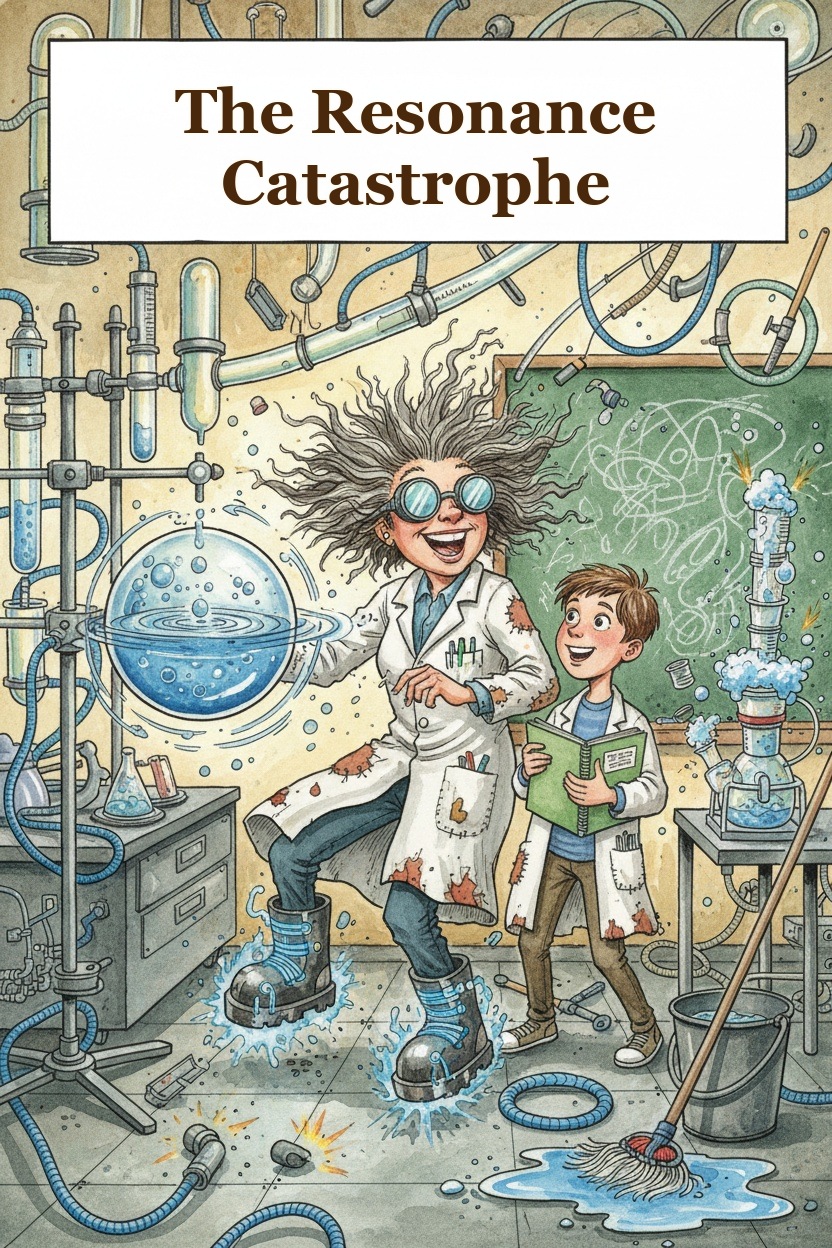
Section 1: The Discovery That Wasn't
"Otto! My careful colleague! Come quickly!"
Professor Plunk's voice bounced down the staircase like a rubber ball made of pure excitement. Otto looked up from his notebook, where he had been drawing a very precise diagram of a very boring shelf. He sighed, capped his pen, and climbed toward the sound.
He found Professor Plunk standing in the middle of the lab, completely still for once. This was unusual. Professor Plunk was never still. She vibrated. Literally, sometimes.
"Watch this," she whispered. She tapped her foot once on the floor.
Nothing happened.
"See?" she said. "Nothing happened."
Otto waited. "Is that... the experiment?"
"No! The experiment is that nothing happened when I tapped. But yesterday, when I dropped the wrench, the chalkboard fell off the wall. And last Tuesday, when I sneezed, all the test tubes on the third shelf rattled. But the fourth shelf was completely calm. Why?"
Otto pulled out his notebook. "Because the chalkboard was already loose?"
"No, no, no! I checked. It was firmly attached. And the test tubes were not close to the edge." Plunk's eyes sparkled. "But the wrench was heavy. And my sneeze was very powerful. Powerful enough to make things rattle. But a light tap on the floor produces nothing? Inconsistent! Unless..."
She grabbed a tuning fork from her pocket and struck it against the workbench. The fork hummed its pure, clear note.
"Mmm," Plunk said, holding the fork near a glass beaker. The beaker began to hum too—a quiet, glassy answer to the fork's song.
"You see? The beaker is singing with the fork. The fork's vibration is traveling through the air. But why did the wrench make the chalkboard fall? The wrench made a much deeper sound when it hit the floor."
Otto thought for a moment. "Maybe the chalkboard likes deeper sounds?"
"Exactly! Well, not likes. But it responds more easily to some vibrations than others." Plunk began pacing, which was her normal state. "Every object vibrates in its own special way. It's called its natural frequency. The chalkboard has one. The test tubes have one. This building—" she tapped the wall, "—has one too."
Otto wrote in his notebook:
Professor thinks every object has a favorite vibration. The chalkboard's favorite vibration is very low. The beaker's is higher. The building might have one too.
"Now," Plunk announced, "we are going to find the lab's natural frequency. And once we know it, we can demonstrate resonance in the most magnificent way possible!"
Otto's pen paused. "What's resonance?"
"Resonance is what happens when you add energy at just the right frequency. Small pushes, repeated at exactly the right moment, can make something vibrate bigger and bigger and BIGGER!" She spread her arms wide. "One singer can break a glass with voice alone! Soldiers break bridges by marching in step! We are going to find our building's favorite song and sing it!"
Otto looked around at the bookshelves, the chalkboard, the hanging lights, the jars of mysterious substances. "Is that safe?"
"Safety is relative, Otto! Now help me set up the Vibration Analysis Array, Mark One!"
Section 2: Finding the Song of the Lab
The Vibration Analysis Array, Mark One, looked like a very complicated musical instrument that had eaten a very complicated computer. It had a large speaker cone facing the floor, a microphone attached to the ceiling, and a screen that showed wavy lines whenever the floor vibrated in any way.
"It's a frequency scanner," Plunk explained, pointing to each part in turn. "It can make vibrations at any pitch, from deeper than a whale to higher than a bat. And the microphone will tell us which vibrations the building responds to most."
Otto looked at the screen. "So we hum the building's song to find out what music it wants to dance to?"
"Precisely! You're getting very good at this, Otto. Now, watch."
Plunk pressed a button. The speaker began to make a very low sound. It sounded like a giant refrigerator humming.
The microphone showed a small wavy line. The building hummed back a little.
Plunk adjusted the frequency. A slightly higher hum. The wavy line grew a tiny bit.
"Promising!" Plunk said. "It likes that one better."
For the next twenty minutes, Plunk slowly raised the frequency, and the building responded more and more enthusiastically. Otto kept track in his notebook:
Test 1: Very low. Building hums quietly.
Test 2: Low. Building hums a bit more.
Test 3: Medium-low. Lights sway slightly.
Test 4: Medium. Floor vibrates under my feet.
Test 5: Medium-high. Something in the back room is rattling.
At Test 12, the room began to hum along. It wasn't unpleasant. It felt like standing inside a giant guitar.
"Thirty-two vibrations per second!" Plunk announced, reading the machine's display. "That's the building's natural frequency, Otto! Every building has one. This one happens to be very close to a low E on a piano."
Otto wrote:
The building's favorite song is a low E. It hums along when we sing that note.
"Now comes the most exciting part," Plunk said. She reached into a drawer and pulled out a second, much more powerful speaker. It was as big as a washing machine. "The Resonance Demonstrator, Mark One! This can produce much more powerful vibrations. We're going to match the building's natural frequency exactly, then slowly turn up the power."
Otto studied the speaker. Then he studied the ceiling. Then he studied the jars of mysterious substances.
"Professor Plunk," he said carefully, "when you say 'slowly turn up the power'—"
"Exactly what I said! Slowly. Gradually. Scientifically. We'll watch the readings every step of the way."
Otto wrote in his notebook:
Prediction: The lab will vibrate noticeably. Everything will be fine.
Then he looked at the ceiling again. He added, in smaller letters:
Second prediction: The lab will vibrate more than noticeably. This may not be exactly fine.
Section 3: The Lab Sings Back
Plunk connected the big speaker to the frequency machine, set it to thirty-two vibrations per second, and pressed the power button.
The lab began to hum.
It was a nice hum, actually. Otto felt it in his chest and in his feet. The chalkboard began to produce a gentle, musical buzz. The windows sang softly in their frames.
"Marvelous!" Plunk said. "See how the building responds? It's absorbing the energy and vibrating along with it. That's resonance, Otto! Matching the vibration to the natural frequency means every tiny push arrives at exactly the right moment to make the building swing a little wider."
Otto nodded. It made sense. It was like pushing a swing—you had to push at the right moment, not just push hard.
"Now," Plunk said, "let's increase the power just a little."
She turned the dial.
The hum became a warm, deep note. The floor began to vibrate gently. A pencil rolled off the workbench.
"Wonderful! The amplitude is growing. Look at the screen!"
Otto looked. The wavy line was much taller now. The building was vibrating with more energy.
"Now just a bit more—"
The hum became a low, steady thrum. The windows began to rattle in their frames. The ceiling lights swayed gently. Otto's chair began to skid slowly across the floor.
"Professor?" Otto said. "Maybe we have enough data?"
"One more level," Plunk said, her eyes fixed on the screen. "Just to confirm the pattern. The data is beautiful!"
She turned the dial.
Everything changed at once.
The floor began to bounce. Not shake—bounce. The chalkboard's screws wiggled themselves loose, and the chalkboard fell off the wall with a bang, landing flat on a table. The jars on the shelves buzzed and clinked, their contents swirling. Somewhere in the back of the lab, something large and metallic crashed over.
"That's quite enough!" Plunk shouted, reaching for the power switch.
Her hand missed it. The lab bounced. She missed it again.
"Otto! A little help!"
Otto was on the floor, which was vibrating so hard he was gently bouncing two inches in the air. He crawled toward the machine, grabbed the dial, and turned it all the way down.
Silence.
The building stopped humming.
The lights stopped swaying.
Everything was quiet.
Otto looked up at Professor Plunk, who was sitting on the floor surrounded by equipment. Her hair was even wilder than usual, which Otto hadn't thought possible.
"THIS WAS NOT IN THE PLAN!" Otto wrote in his notebook, which he had miraculously managed to hold onto.
Then he wrote, more calmly:
Actually, it was. I predicted this. Second predictions count too, right?
Section 4: What Resonance Really Means
"Well!" Professor Plunk said, dusting off her lab coat. "That demonstrated resonance rather more vividly than I intended."
Otto sat down on a chair that was still rocking gently. "The building's natural frequency is thirty-two vibrations per second. And when we matched it, the building vibrated along with us. But why did it get so big?"
Plunk's face lit up. It always lit up when she explained things. "Think of the swing, Otto. What happens when you push at exactly the right moment?"
"The swing goes higher."
"Every push adds a tiny bit of energy. But because each push arrives at exactly the right time, it adds to the motion that's already happening. The energy builds up. And builds up!" She clapped her hands. "The building has a natural frequency because of its size, its materials, the way its parts connect. When we sent vibrations at that same frequency, each vibration arrived in time to make the building swing a little more. The energy stored up in the building itself—and the amplitude grew and grew."
"So the building wasn't just joining in. It was amplifying the vibration?"
"Exactly!" Plunk beamed. "Resonance is when a repeated force matches an object's natural frequency. The matching makes each input more effective. A little energy, applied consistently at exactly the right moment, creates a huge effect."
Otto wrote in his notebook:
Resonance = small pushes at the right time make a big swing. The building's natural frequency is 32 vibrations per second. Matching it = building bounces. Noted for future reference: do not match it.
"So resonance is dangerous?" Otto asked.
Plunk considered this. "It can be. Soldiers marching across a bridge can match its natural frequency with their footsteps. If the resonance gets strong enough, the bridge can shake itself apart. That really happens, Otto. Engineers design bridges to have natural frequencies that won't match common vibrations, just in case."
"What about the 'or useful' part?"
Plunk smiled. "Walk into a concert hall, Otto. The air inside the room has a natural frequency. The strings of a violin are designed to resonate at specific frequencies. When you pluck a string, the sound is amplified by the wooden body of the instrument. The body resonates along with the string, making the sound much louder than the string alone could make."
"So the violin is like the building?" Otto said.
"Exactly like the building! The string sets the pitch. The wooden body gives the sound power by resonating at the right frequencies. Musical instruments are controlled resonance machines, Otto!"
Section 5: A Song in the Bones
Gloriana arrived with a broom, a bucket, and a tool for re-hanging chalkboards. She surveyed the room. She said nothing. She looked at Otto, raised one eyebrow, and began to clean.
"Gloriana," Plunk said, "Otto and I have just discovered something wonderful about this building."
Gloriana nodded once. She did not ask what it was. She had been working in this lab for thirty years. She had probably known about the building's favorite song for decades.
Otto looked at the glass still on the table. "Professor Plunk? Can I try something?"
"Of course, my careful colleague!"
Otto picked up the tuning fork, struck it gently, and held it near the glass beaker. The beaker hummed softly with the fork's note.
"That's you playing the fork," Plunk said. "Try a different fork."
Otto set the first fork down and picked up a larger one. He struck it and held it near the beaker.
The beaker made a different sound. It didn't sing along—it barely made any sound at all.
So the fork had its own natural frequency. The beaker had its own natural frequency. The building had its own natural frequency.
Otto thought about all the things in the world, each with its own special song. Bridges and bones. Violin strings and window panes. Tiny things and enormous things.
"Professor Plunk?" he said.
"Yes, Otto?"
"Is everything in the world humming?"
Plunk's eyes sparkled. "Yes, Otto! Everything is vibrating, and everything has its own special frequency. The air is full of invisible songs. We can't hear most of them, but they're always there." She paused. "And when two things share a song, or when you find the song something wants to sing... you can move mountains."
Otto looked at his notebook. Then he looked at the building around him. Somewhere deep in its bones, it was still waiting to sing its low E at thirty-two vibrations per second.
"Your notebook?" Plunk asked, peering over his shoulder.
Otto wrote his final entry:
Not today. But tomorrow? Tomorrow the lab's song might be useful. Maybe we can find a way to use resonance to make something better. Maybe we can make beautiful sounds happen. Or maybe not. But the song is always there.
Also, the chalkboard is going to need stronger screws.
THIS WAS NOT IN THE PLAN.
But it was a good idea, anyway.
Gloriana handed Otto a pen. She had been carrying a spare, as always.
"Same tune," she said.
Otto blinked. "What?"
"Low E. The building." She hammered a screw into the wall. "Told her so."
Professor Plunk laughed, and the sound traveled through the room with a happy bounce. Otto noticed that the laugh was very close to thirty-two vibrations per second.
The building hummed its approval, warm and deep, from the floorboards to the rooftop.
Resonance, Otto thought, was not just about big disasters. It was about finding the song someone was already singing and joining in.
He grinned and started making a list of things the lab's favorite note might be good for.
The list ended with: DO NOT TURN THE DIAL UP TO TEN.