The Capy Series 2
The Alpaca’s Warning
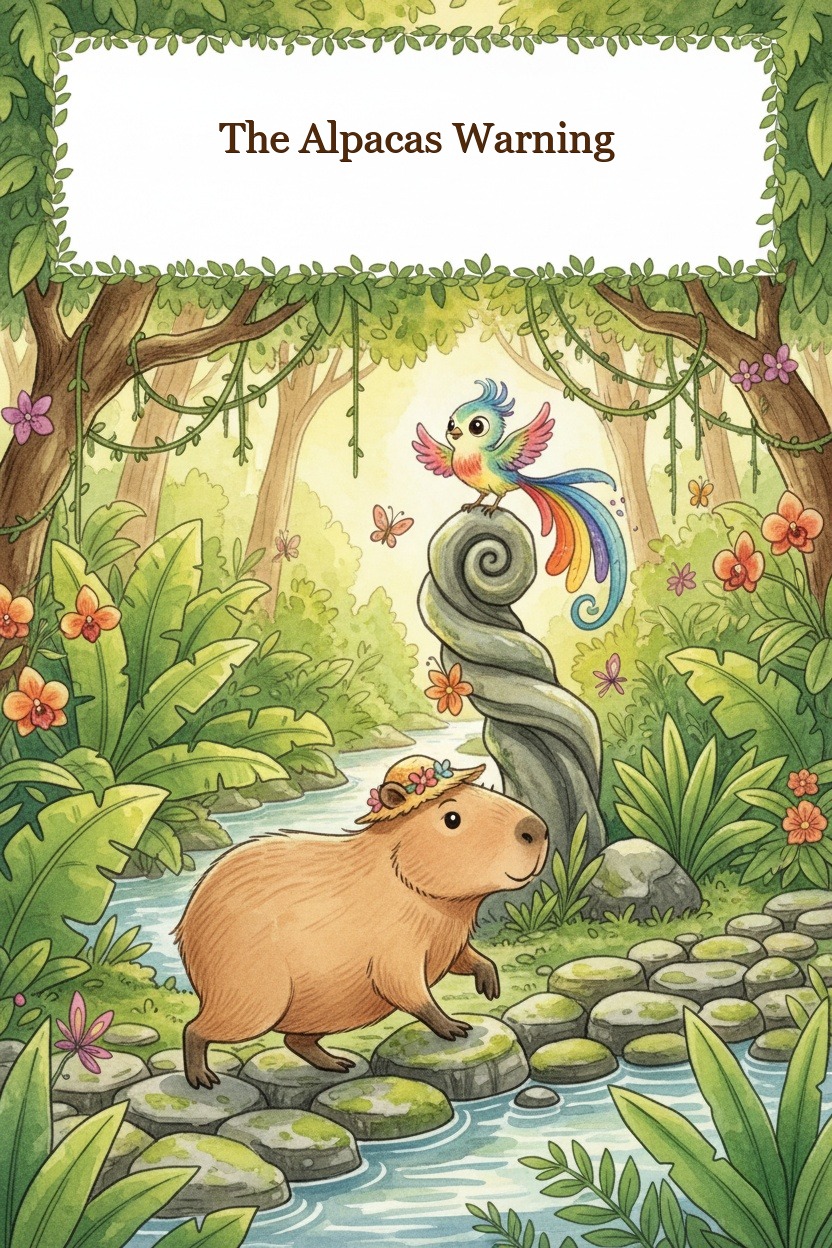
The highlands rose before them like a giant sleeping beast, its back covered in scrubby grass and strange, twisted rocks. The air was thin and cool, and Caper’s whiskers twitched as he sniffed it.
“It tickles my nose,” he said, waddling carefully over a patch of loose stones.
“It’s called altitude,” said Flora, fluffing her long rainbow tail. She perched on a tall rock and peered down at the group with one perfect eye. “We are very, very high up now. The air has less of the thick stuff in it.”
“Less thick stuff?” Squeaky chattered, swinging from a low, twisted branch. “Less thick stuff means less to breathe! I need lots of air! I’m full of ideas!” He puffed his little chest and took a huge, dramatic breath.
Hisss, who was currently coiled in a loose spiral beside Caper, let out a low, rumbly sigh. “Ideas,” he grumbled. “Great. More ideas. Last time you had ideas, we ended up in a cactus.”
“That was one time!” Squeaky said.
“It was twice,” Hisss said.
“It was once and a half!”
Flora sighed dramatically. “Must we bicker? We are on an important quest. The water in the highland streams is starting to taste… forgetful.”
Caper nodded slowly. He had felt it earlier, when they had crossed the first little creek. The water had whispered to him, but the whisper was faint and fuzzy, like a memory trying to remember itself. The Blight was here, too. It was everywhere, like a sleepy shadow that followed the rivers.
“We need to find where it’s coming from,” Caper said. “Maybe there’s a spring up here, or a lake. Maybe we can help it wake up.”
“Or at least make it sneeze,” Squeaky added helpfully.
They climbed higher. The ground grew rockier, and the grass turned silver-green in the pale light. And then, just as Caper’s legs were starting to feel like squishy bananas, they crested a small ridge—and stopped.
A herd of alpacas stood in a wide, grassy bowl between two hills. They were tall and fluffy, with long necks and big, gentle eyes. Their fur was the colour of clouds at sunset—soft white, warm brown, and a few spotted ones in between. They stood very, very still, all facing the same direction, like fuzzy statues.
“Ooh,” Squeaky whispered. “They’re pretty. Are they big sheep?”
“They are alpacas,” Flora said, puffing out her chest. “A noble and ancient people of the high mountains. They are known for their soft wool and their… hmm.”
She paused.
“Their what?” Caper asked.
“Their silence,” Flora said slowly. “They are being very silent.”
It was true. The alpacas were not making a sound. No hums, no bleats, no shuffling of hooves. They just stood, their long ears angled forward, staring at something on the far side of the bowl.
Caper took a step forward, and the nearest alpaca—a big one with cream-coloured fur—turned its head. Its eyes were kind but serious.
“You should not be here,” the alpaca said softly. His voice was like warm milk and honey, but there was a shiver in it. “The Wind is coming.”
“The wind?” Squeaky said. “We’ve been through wind! Wind is fine! Wind is just spicy air!”
The alpaca shook his head slowly, and his long neck swayed. “Not this wind. This is the Silent Wind. It carries the grey sleep.”
Caper felt his heart thump. “The grey sleep?” he said carefully. “Do you mean… the Blight?”
The alpaca blinked. “You know of it?”
“We’ve been following it,” Caper said. “Trying to stop it. It makes the water forget how to flow.”
The alpaca looked at his herd. They were still staring at the horizon. “Then you have come at the right time,” he said. “And the wrong time. The Silent Wind comes when the sun is just past its highest point. It blows from the old ruins beyond the ridge. And when it reaches us, our minds go soft. We forget. We stand. We wait. We forget why we are standing or waiting.”
“That sounds terrible,” Flora whispered.
“It is,” the alpaca said. “And the worst part is, we cannot warn each other. The wind steals our voices first. So we just… stand together, and wait for it to pass.”
Caper looked at his friends. Squeaky was no longer chattering. Hisss had stopped grumbling. Even Flora’s tail seemed to droop.
“We can help,” Caper said. “We’ve helped other places. Do you know what makes the wind come from the ruins?”
The alpaca said, “There is an old spring there. It used to sing. Now it is silent. I think the wind is its sigh.”
“A sigh,” Caper repeated. He thought about that. Water that could not sing would only sigh. And a sigh that carried forgetting… that was the Blight’s way.
He turned to his friends. “We have to go to the ruins. We have to help the spring remember its song.”
“As always, a lovely plan,” Hisss drawled. “Walk into the place where the forgetting wind lives. What could possibly go wrong?”
“We’ll be careful,” Caper said.
“We’re always careful,” Squeaky added. “We have a whole routine. Careful, then not careful, then very not careful, then we fix it!”
Hisss let out a long, slow breath. “Fine. But if I start forgetting my own name, I’m blaming you.”
The alpaca lowered his head. “I have a name. It is Pako. When the wind comes, I will forget it. So I am telling you now, and you must remember it for me.”
“We will,” Caper said. “Pako. We’ll remember.”
The ruins were not far. They were the bones of an old stone house, half-swallowed by grass and time. Moss clung to the walls, and a single stone archway stood like a doorway to nowhere. In the centre of the ruins, tucked between two broken pillars, was a small round pool.
It was the greyest water Caper had ever seen. It was not muddy or dirty—it was flat. Flat as a stone. Flat as silence. The water did not ripple, did not sparkle, did not move at all.
Caper walked to the edge of the pool and leaned over. The water reflected the sky, but the sky in the reflection was grey, even though above them the sky was blue.
“Hello?” Caper said softly.
His voice did not echo. It just dropped into the water and vanished.
“I don’t like this,” Squeaky whispered. “It’s too quiet. Even quiet isn’t this quiet.”
Caper closed his eyes and put his paw in the water. The cold was not the cold of the mountains. It was the cold of something that had forgotten how to be warm.
And then he felt it.
A memory. Faint and far away, like a song heard through a wall. There was a bubbling here once. A happy, dancing, singing bubble. A spring that fed the streams that fed the pastures that fed the bees that fed the flowers. It sang to the sky and the sky sang back.
But then something sad happened. The spring began to feel lonely. The seasons changed, and the animals headed lower, and the spring was left with only its own song. And eventually, it forgot why it was singing.
So it stopped.
“It’s sad,” Caper said, pulling his paw back. “The spring misses being happy. It gave up.”
“So how do we make it happy again?” Squeaky asked.
Caper thought. “Maybe we need to remind it. Remind it of what it sounds like. Of what it felt like to flow.”
Flora lifted her head. “I know a song,” she said quietly. “A highland song. The quetzal mothers sing it to their chicks when they’re high in the mountains. It’s about streams waking up.”
“Sing it,” Caper said.
Flora looked a bit embarrassed, which was unusual for her. “It’s not my most dramatic song. It’s very small.”
“Small is perfect,” Caper said.
So Flora closed her eyes and opened her beak, and she sang.
The song was not loud. It was not fancy. It was a tiny, twinkling melody, like raindrops landing on leaves. It went up and down, gently, like a stream wandering over stones. It was so soft that Caper had to lean in to hear it.
And as she sang, the grey water began to tremble.
Just a little. A tiny shiver at the centre of the pool.
“It’s working!” Squeaky squeaked.
But then the tremble stopped. The water went flat again.
“Not enough,” Caper whispered. “It’s still too lonely.”
He looked around. Hisss was coiled by the broken pillar, his scales dull. Squeaky was bouncing on his toes. Flora’s tail was glowing faintly in the light.
“We all have to do it,” Caper said. “We all have to add something.”
“Add what?” Hisss asked. “I don’t sing. I hiss.”
“Then hiss,” Caper said. “Hisss like rain on hot rocks. Hisss like the wind through the reeds.”
Hisss blinked. “You want me to hiss a song?”
“I want you to hiss like the water remembers you belong to it,” Caper said.
Hisss stared at him for a long moment. Then, slowly, he raised his head and let out a long, low hiss. It was not a warning hiss, and it was not a grumpy hiss. It was a soft, flowing hiss, like water sliding over smooth pebbles.
Squeaky joined in next, chattering in a gentle rhythm—tap-tap-tap, like a woodpecker drumming on a hollow branch, like a frog hopping across lily pads, like rain tapping on a roof.
And Caper, with his paw still in the water, began to hum.
He hummed the memory he had felt: the bubbling, dancing, singing spring. He hummed the sound of the water when it was happy. He hummed the sound of the home it had once been, and the home it could be again.
The four sounds wove together—Flora’s song, Hisss’s hiss, Squeaky’s chitter, and Caper’s hum. They rose like a braided river, twining through the broken pillars and over the grey water.
And the water began to shimmer.
A single ripple. Then another. Then a tiny fountain of bubbles burst up from the centre of the pool, and the water began to sing.
It was not a human song. It was not even an animal song. It was just the sound of water being water—a happy, bubbling, splashing, chuckling sound. It ran over itself and laughed.
Caper felt the joy rise up through his paws, through his whole body, and he laughed too.
“It remembers!” Squeaky cheered. “It remembers it’s a spring!”
The water became clearer and brighter, until it sparkled like a pool of tiny jewels. It flowed over the edge of the stone and began to trickle down the hillside, toward the pastures, toward the herd of alpacas.
The alpacas stirred. Their ears twitched. Their heads lifted.
And the nearest one—the cream-coloured one—blinked and said, “Oh! I’m Pako. I remember.”
Later, as the sun began to dip behind the hills, the herd gathered around the little spring, drinking the clean, singing water. Pako stood beside Caper, his head bowed in thanks.
“You did it,” Pako said. “You gave us back our song.”
“We gave it back to the water,” Caper said. “It just needed to remember who it was.”
“And you remembered my name,” Pako said. “I was so worried I would forget it. But I didn’t. Because you were here.”
Caper felt warm inside, like he’d swallowed a sunbeam. “That’s what friends are for,” he said. “To remember things when we can’t.”
As they packed up and began their journey back down the mountain, Squeaky chattered, “So, what’s next? More mountains? More springs? More very large fuzzy sheep?”
“They’re alpacas,” Flora corrected.
“Very large fuzzy alpacas,” Squeaky amended.
Hisss sighed. “I was just getting comfortable.”
“You were in a pile of rocks,” Caper pointed out gently.
“They were very comfortable rocks.”
Caper smiled. The water in his mind felt clear again, bouncy, bright. The Blight had been pushed back a little more, and somewhere below them, a small spring was singing its heart out, waking up every stream it touched.
And Caper knew, as long as there were friends to remember with, no song had to be forgotten for long.