Chef Sparks Kitchen Lab
THE LIVING POWDER
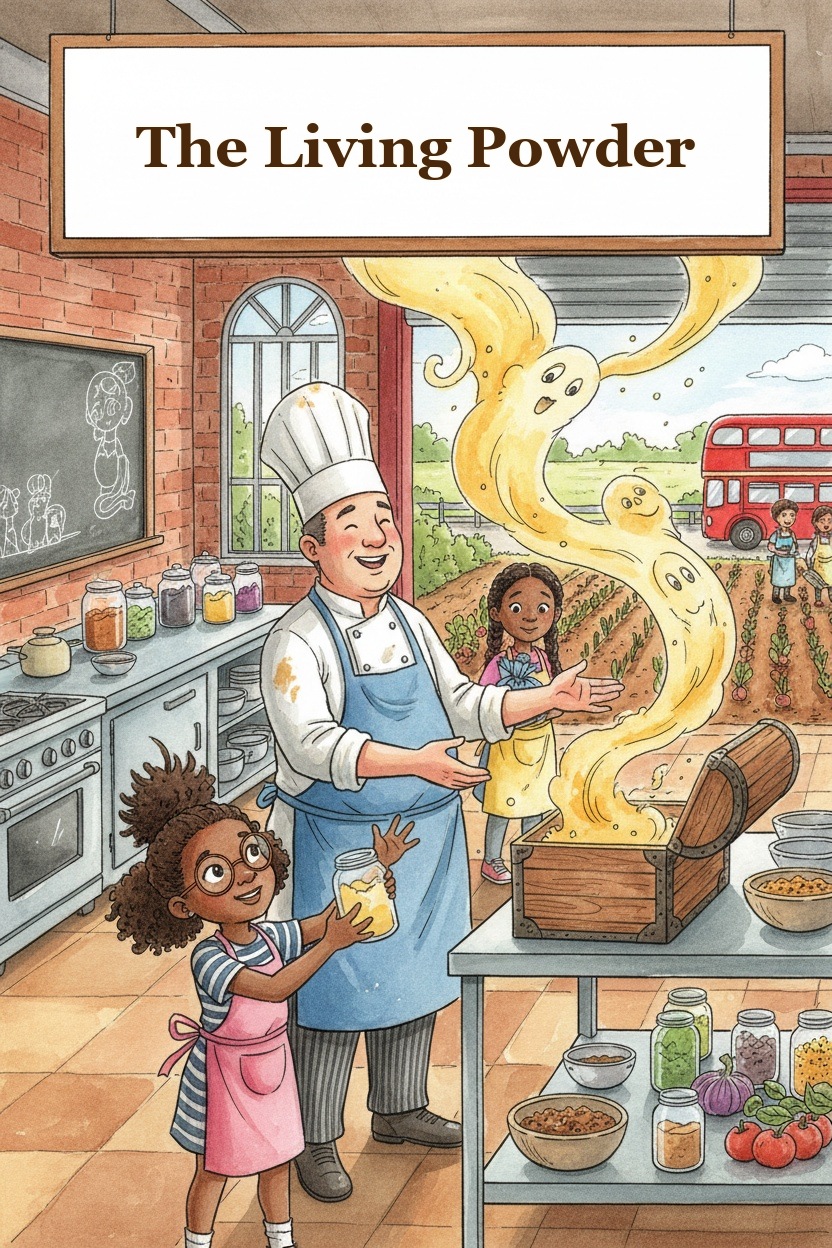
The Jar of Tiny Sleepers
The Riverside Fire Station smelled like warm flour before anyone even walked through the door. That was new. Usually it smelled like whatever Chef Iggy Spark had been testing the night before—last week it was burnt sugar, the week before that, garlic. But today it smelled like bread, and Tommy Reyes was almost running down the street to get inside.
"What is that smell?" he called out as he pushed through the big engine bay doors.
Chef Iggy appeared from behind the enormous stainless steel range, wiping his hands on a towel that had more flour on it than a marshmallow. His dark hair was dusted white.
"That," he said, his voice going into its storytelling register, "is the smell of something waking up."
Maya Okonkwo was already at her usual spot at the prep table, carefully reading the label on a bag of flour. "There's no weird stuff in this one," she reported. "Just flour. That's good."
Priya Subramaniam leaned over the counter, sniffing the air. "It smells like..." She paused. "Like Ammamma's house on Sunday mornings."
"Exactly right," Iggy said. "And that's a clue. Because today we're going to meet the reason your grandmother's house smells like that. We're going to meet the living powder."
He gestured dramatically toward a jar on the counter. The class gathered around and looked at it. Inside was a pile of tiny brown granules, smaller than sugar, lighter than sand. They looked completely boring.
"That's it?" Dev asked. "That's the living powder?"
"That's it," Iggy confirmed.
"It doesn't look alive," Sam said, giving it a rating of "four out of ten for visual interest, I'm sorry, Chef."
Iggy grinned. "Oh, it's alive. It's just... asleep. Billions of tiny sleeping organisms in that jar. Each one so small you'd need a microscope to see it. They're called yeast."
"Yeast?" Tommy made a face. "I thought that was in bread."
"That's exactly where it is," Iggy said. "Yeast is in bread. But yeast is not an ingredient like flour or water. Yeast is a creature. A living, hungry, breathing creature."
Maya looked at the jar more carefully. "What does it eat?"
Iggy's eyes lit up. "That is exactly the question to ask. Maya, you've just asked the question that the whole history of bread has been waiting for. What does yeast eat? Let me show you."
The Tiny Hungry Things
Iggy set up a series of small glass jars on the counter. Into each one he put warm water—not too hot, he explained, because you don't want to cook the yeast before it wakes up. Then he added a spoonful of yeast to each jar. The class watched as the powder floated on top of the water.
"Now watch," Iggy said.
Into the first jar, he added a spoonful of sugar. Into the second, a spoonful of honey. Into the third, nothing at all. He stirred each jar gently and set them in a row.
"Give it a minute," he said. "And then look at what happens."
The class waited. Tommy couldn't keep still. Lucia started drawing the jars. Dev was already leaning in, trying to see something.
Then it started.
The jar with the sugar began to change. Little bubbles appeared on the surface, tiny at first, then more and more, climbing up the side of the glass like a fizzy drink. The jar with the honey did the same thing, a little slower. But the third jar—the one with nothing added—was still and quiet.
"The yeast is eating the sugar," Iggy said. "That's what's waking it up. And when it eats, it does what every living thing does after a meal." He patted his stomach. "It produces waste. Specifically, it produces a gas called carbon dioxide. Those bubbles you're seeing? That's yeast gas."
"That's... gross," Tommy said, but he was smiling.
"It's not gross," Priya said, watching the bubbles rise. "It's amazing. The yeast is breathing. It's eating. It's alive."
"Exactly," Iggy said. "And here's the thing about this gas: it's the same gas you breathe out every time you exhale. It's the same gas that makes soda fizzy. And it's the same gas that will make bread rise. Because when you mix yeast into dough, the yeast starts eating the sugars in the flour—and the gas it produces has nowhere to go. So it makes bubbles. And those bubbles puff up the dough. That's what rising is. The bread is filling up with the breath of living creatures."
Maya was writing in her notebook. "So the yeast eats sugar and produces gas."
"Also a tiny bit of alcohol," Iggy said. "That's another kind of yeast waste. Don't worry—it cooks off in the oven. This process we're watching? It has a name. It's called fermentation. One of the oldest cooking processes in human history. People have been using yeast to make bread rise for thousands and thousands of years, and for most of that time, they didn't even know the yeast was alive. They just knew that if you left dough alone, it grew. Now we know why. Because the dough is full of tiny hungry living things."
Pressing the Spring
Now came the part Iggy had been waiting for.
"Time to make the actual bread," he announced, and the class let out a cheer.
They made the dough together: flour, water, salt, and the activated yeast from the jars. Iggy showed them how to knead, folding the dough and pressing it with the heels of their hands, again and again.
"Feels like Play-Doh," Tommy reported.
"Keep kneading," Iggy said. "You're building something important. Do you feel how the dough is starting to get stretchy?"
Tommy pressed his fingers into the dough and pulled gently. It stretched a little, then snapped back. "Whoa," he said. "It's like a rubber band."
"That's gluten," Iggy said. "When you mix flour and water together and work them, the proteins in the flour form long elastic chains. Gluten is like a net—a stretchy, bendy net made of protein. And the yeast is about to start making gas bubbles inside the dough. The gas pushes out against the gluten net, trying to escape. But the gluten holds it in. That's what makes the bread rise instead of just... deflating all over the counter."
He shaped the dough into a loaf and placed it in a metal bread tin. Then he covered it with a clean towel.
"This loaf needs time," Iggy said. "Time to ferment. Time for the yeast to eat and breathe and fill the dough with gas. We're going to let it rise for about twenty minutes. And while we wait, I want you to do something."
He set a timer. "Tommy, you're on dough duty. Every five minutes, I want you to press on that dough—gently, just a little—and feel what it does."
Tommy was confused. "Press it? While it's rising? Won't that pop the bubbles?"
"That's the interesting question," Iggy said. "Try it and see."
Five minutes later, Tommy pressed the dough. It was soft. It gave under his fingers. But when he lifted his hand, it slowly pushed back, filling the dent.
"It's springy," he said.
"Keep checking," Iggy said.
At ten minutes, the dough had grown noticeably taller in the tin. Tommy pressed it again. Same thing: it gave, then sprang back.
"It's fighting back," Tommy reported, delighted.
At fifteen minutes, the dough was above the rim of the tin. It looked like a big, pale pillow.
"Now it's really going to fight back," Iggy said. He mimed knocking something off the counter—and actually did it, sending a whisk clattering to the floor. The class erupted in laughter. Nobody had predicted the whisk. Tommy was now winning the prediction pool.
Iggy ignored the whisk completely. "Tommy, one more press."
Tommy pressed the dough. It felt different now—fuller, lighter, almost puffy. It pushed back even faster.
"The gluten net is stretched tight," Iggy explained. "The yeast has been filling it with gas for fifteen minutes. Every bubble is pressing outward, stretching the gluten thinner and thinner. And the gluten is fighting back, holding all that gas inside. That's what gives the bread its structure."
"Heading to the oven!" Priya sang out.
Iggy opened the big oven door and slid in the tin. "Now we wait," he said. "And while we wait, let me tell you about the crust."
The Golden Coat
While the bread baked, the kitchen filled with a smell so good that Tommy had to sit down because he couldn't concentrate.
"The crust," Iggy said, "is the bread's final secret. When the dough goes into the hot oven—very hot, much hotter than the room—the outside of the dough heats up fast. The yeast can't survive that heat. They've done their job, and now they're cooked. That's why bread has that golden-brown crust: the outside of the dough gets cooked hard and crispy, sealing the inside in. The heat also makes the gas bubbles expand—hot gas takes up more room than cool gas—so the bread puffs up one final time before the crust sets."
"The yeast dies?" Maya asked quietly.
"They do," Iggy said gently. "But that's not sad. They lived out their whole tiny lives doing exactly what living things do: they ate, they grew, they made more of themselves, and they made food possible for other living things. The yeast is gone, but its work is in every bite of bread. The gas they made is what made those little air pockets in the bread. The flavor they created is what makes bread taste like bread."
When the timer rang, Iggy pulled the loaf out. It was beautiful—golden and brown, puffed up high, with a crust that looked like it would make a cracking sound if you pressed it. The class gathered around as Iggy let it cool just enough to cut.
The knife made a sound like small fireworks. The crust cracked. Inside, the bread was soft and pale, full of holes—the holes from the yeast's breath.
"Look at that," Priya whispered. "Every one of those holes is where gas was trapped."
"Every one," Iggy said.
Tommy took the first slice. He didn't rate it out of ten. He just put it in his mouth, chewed once, and made the sound. The Tommy Hum. The two-note sound that meant success, pure and complete.
"Tastes like living," Dev said.
That was so strange that everyone laughed. But it was true. It tasted warm and bread-y and slightly sweet, and every bite was full of tiny air pockets that crunched between your teeth.
Maya took a slice and examined it before eating. "The yeast made the bread rise, the gluten held the gas, and the crust kept it all in," she said, like she was reading a label.
"That's right," Iggy said. "You just explained the whole book of bread."
Priya held her slice up, letting the steam curl off it. "Ammamma says you have to be patient with bread," she said. "She says the bread tells you when it's ready."
"I think that's true," Iggy said. "Bread is not fast food. Bread is the opposite of fast food. You feed the yeast, you wait for it to work, you let the dough rise, you bake it, you cool it, and then—only then—you eat it. Every step is a different miracle. And every step is because billions of tiny creatures spent their whole short lives making something beautiful."
He looked at the half-eaten loaf. "That's really the best thing about cooking," he said. "You're never cooking alone. There are always tiny helpers doing their part."
Tommy, his cheeks full of bread, raised his hand.
"Chef," he said, "can we make more?"
Iggy laughed and said yes.
Kitchen Lab Notes
Dear Students,
Today you met the living powder. Yeast is not an ingredient—it's a creature, and it has been helping humans bake bread for thousands of years. When you feed yeast sugar, it produces carbon dioxide, and that gas puffs up the dough. Gluten—the protein net in flour—traps the gas so the bread rises instead of flattening. And the hot oven gives the bread a golden crust while the yeast finishes its work.
Here's a question to think about: If yeast eats sugar and produces gas, what do you think happens in your own body when you eat food? What do you produce? Where does it go?
—Chef Iggy Spark
The Living Powder Recipe: Chef Spark's First Bread
Ingredients:
-
1 packet (2¼ teaspoons) active dry yeast
-
1 cup warm water (about 110°F—warm, not hot)
-
1 tablespoon honey or sugar
-
2¾ cups all-purpose flour
-
1 teaspoon salt
-
1 tablespoon olive oil (for the bowl)
Steps:
-
In a small bowl, mix the yeast, warm water, and honey. Let it stand for 5 minutes until it's bubbly and smells slightly sweet.
-
In a big bowl, mix the flour and salt.
-
Pour the yeast mixture into the flour and stir until a dough forms.
-
Turn the dough onto a floured counter and knead for 8-10 minutes, until it's smooth and stretchy.
-
Put the dough in an oiled bowl, cover with a towel, and let rise for 1 hour, until doubled in size.
-
Punch the dough down. Shape it into a loaf and put it in a greased bread tin.
-
Let it rise again for 30 minutes.
-
Bake at 375°F for 30-35 minutes, until the crust is golden and the bread sounds hollow when tapped.
-
Cool for 10 minutes. Then slice and enjoy—the yeast did the work, you just helped.
Chef's note: Warm water is the secret. Too hot, and you'll cook the yeast before it wakes up. Too cold, and it will never wake up at all. Just like you, yeast likes happening to be comfortable when the day begins.