The Logic League
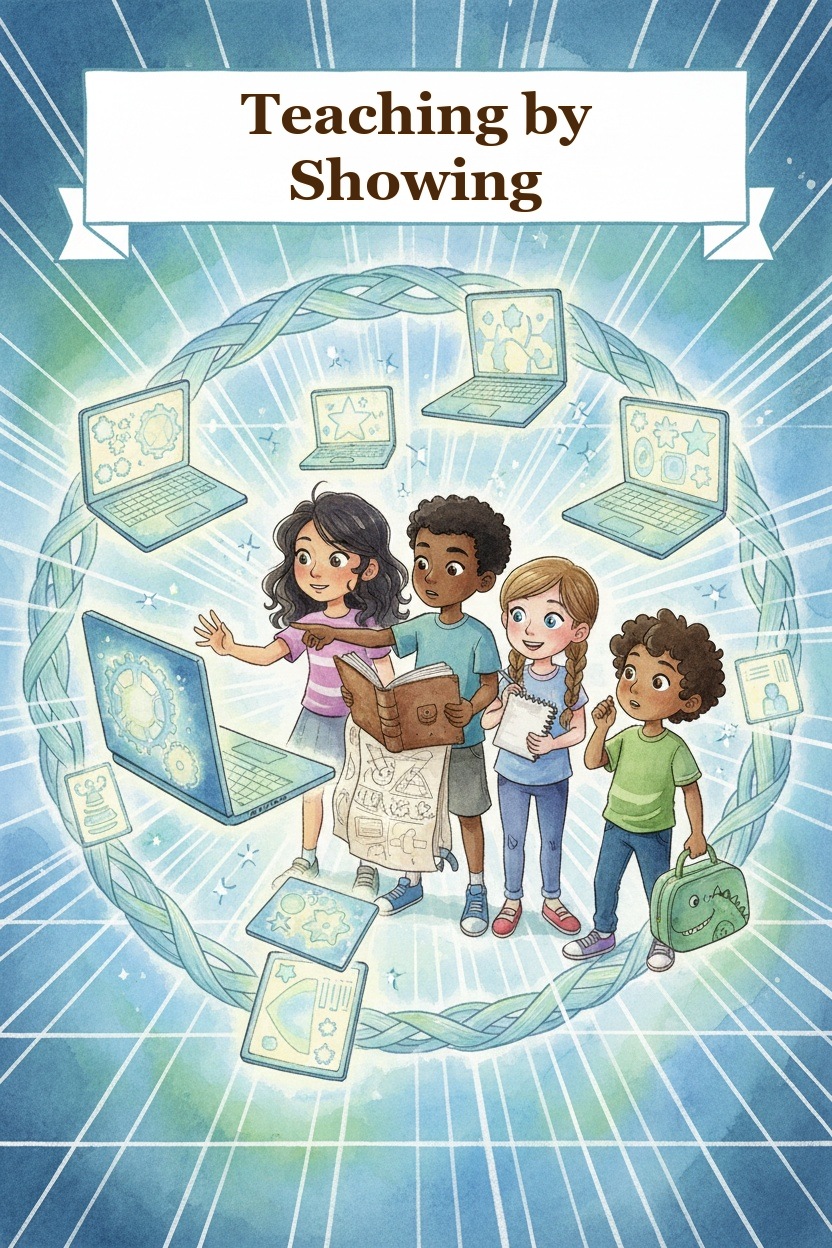
Teaching by Showing
The Wobbly Bridge
The laptop glowed in the dusty light of the lost-and-found closet, its screen already bright before Priya even opened it. She didn't hesitate anymore. None of them did.
"Ready?" she asked.
Kwame nodded, tucking his journal into his jacket. Lily was double-checking that all her pockets were zipped. Sam bounced on their heels.
"Where do you think we'll go this time?" Sam asked.
"We'll find out," Kwame said. "We always find out."
Priya opened the laptop. Green text cascaded down the screen, and then the familiar door appeared. She reached out, and they all stepped through together.
The Outer Grid opened around them like a vast machine. Silver corridors stretched in every direction, lined with cables that pulsed with light. But this part was different from what they'd seen before. The walls here didn't look built. They looked grown — soft, curved, and covered in something that shimmered like a living pattern, shifting and rearranging itself as they watched.
"Whoa," Sam breathed. "Is it supposed to do that?"
A path stretched ahead of them, but it wasn't a solid path. It was made of blocks — hundreds of small, floating platforms, each one lit with a different symbol. Some blocks were gold and solid. Others were translucent and wobbly, barely holding their shape. And at the end of the path, a gate with a sign:
TRAINING GROUND AHEAD.
DO NOT WALK ON THE BLOCKS.
TEACH THE BLOCKS.
"Teach the blocks?" Priya read aloud. "What does that mean?"
Lily walked up to the first translucent block and peered at it. On its surface, a shape flickered — a triangle, then a circle, then a square, changing every few seconds. "It's not decided yet," she said. "It's like it doesn't know what it's supposed to be."
Sam pointed at a shelf beside the gate. It was lined with cards, each one showing a different shape. "Maybe we have to show it?"
Kwame picked up a card with a blue triangle. "Show it what? A triangle?"
He placed the card on the block. The block flickered, pulsed, and then became solid gold — but only for a moment. Then it went translucent again.
Sam tilted their head. "It learned the triangle. But then it forgot?"
A red-bordered text block appeared in the air beside them.
ERROR: Single example insufficient for generalization. Pattern requires more evidence.
"That's not helpful," Priya muttered. "What's it even talking about?"
Lily was already pulling more cards from the shelf. "Wait. I think I get it. That block was trying to figure out what shapes it should be solid for. When Kwame showed it a triangle, it became solid — because it thought 'oh, triangles are solid.' But one triangle isn't enough to know for sure."
"Why not?" Sam asked.
"Because what if it was that one specific triangle?" Lily held up the card. "It doesn't know if it should be solid for all triangles, or just this triangle. One example doesn't tell you which pattern to learn."
Kwame's eyes lit up. "So you need more examples. You need to show it lots of triangles so it can figure out the pattern."
The Logic League: Teaching by Showing — Page 10
Feeding the Evidence
They started with the first block. Lily found every triangle card on the shelf — blue triangles, red triangles, big ones, small ones, pointy ones, flat ones. She fed them to the block one by one.
The block's surface flickered faster and faster. Each triangle made it glow more solidly. When all the triangles were done, the block turned bright gold and stayed that way.
"Whoa," Priya said. "It learned triangles."
"No," Sam corrected. "It learned that triangles are solid. Look."
Sam pointed at a circle-shaped card. "What if we show it that circles are solid too?"
They tried. They found every circle on the shelf and fed them to the block. The block flickered again, and then it stayed solid for both triangles and circles.
"Now it knows two patterns," Kwame said. He opened his journal and began writing.
The block doesn't follow rules we write down. It learns them from what we show it. Like teaching a friend a word by pointing at a hundred examples, until they say "Oh, I see what it means."
They moved to the second block, then the third. Each one needed examples — dozens of them. The kids pulled cards from the shelf in big armfuls, sorting through them to find what they needed.
"This is exhausting," Priya said, sitting down after the fifth block. "Why can't we just tell it what to do? Like a normal Grid puzzle?"
"Because it's not programmed," Lily said. "It's trained."
Lily knelt in front of a block that was still translucent — but she didn't feed it cards. Instead, she fed it cards with shapes the previous blocks had rejected. The block flickered, turned a strange color, and then opened a small hatch, spitting all the cards back out.
ERROR: Contradictory examples detected. Model uncertain. Please provide consistent evidence.
"I think I broke it," Lily said.
"No, you didn't." Sam ran over. "You just showed it a bunch of different things and then showed it the same shapes in different colors, so it couldn't figure out what the actual rule was."
Priya stood up, brushing off her hands. "So when you give it examples, you have to be consistent. You can't show it forty triangles and twenty squares and two circles and expect it to know what you want."
Lily nodded. "It finds the pattern in whatever you give it. If the examples are messy, the pattern it learns is messy too."
Sam picked up a new card — a purple star. "So what if we showed it a hundred stars but in different colors and different sizes? It would learn stars, right?"
"Let's try," Priya said.
They did. Twenty stars in red. Twenty in blue. Twenty in gold. Twenty in every color the shelf had. And when they were done, the block glowed a calm, steady gold for stars.
The pattern held.
The Logic League: Teaching by Showing — Page 21
The Block That Learned Snakes
The path stretched further, and the kids worked block by block, teaching each one what it needed to know. Some learned quickly. Some needed more examples. But gradually, a real, solid path formed through the Training Ground.
Then they reached a block that looked different. Its surface showed a long, wavy shape — like a snake. Or a river. Or a ribbon.
"Um," Sam said. "What is that supposed to be?"
Kwame checked the shelf. "There are cards with snakes on them. And rivers. And ribbons. And ropes. And... spaghetti. This is going to be a lot."
"How many do we need to show it?" Priya asked.
"All of them, I think," Lily said. "If we show it snakes and rivers and ribbons, it might learn something weird."
"It might learn 'wavy things.'" Priya frowned. "Is that wrong?"
Sam shrugged. "Maybe not. If we want it to be solid for wavy things, that's fine. But if we want it to be solid only for snakes, we have to show it snakes and not-rivers and not-ribbons."
Kwame looked at the block. "But we don't know which one it should learn. Nobody told us."
The block flickered impatiently.
"Let's just show it everything," Priya said. "All the cards. See what happens."
They piled the cards on the block. Snakes and rivers and ribbons and ropes and spaghetti and curly hair and winding roads. The block's surface erupted in a swirl of moving colors. For a moment, they thought it was working.
Then the block turned black and opened its hatch, ejecting cards everywhere.
ERROR: Training data too diverse. No single pattern discovered. Please choose clearer examples.
Sam sighed. "Right. Because a snake and a river and a piece of spaghetti don't have one thing in common. It couldn't find a rule that worked for all of them."
Priya sat down in the pile of cards. "So the problem isn't just how many examples we give it. It's what examples."
"Exactly," Lily said. "The block can only learn what we show it. If we show it a mess, it learns a mess. If we show it a clear pattern, it learns a clear pattern."
Kwame was writing in his journal again.
The block is like a friend who's never seen any of these things. If I show them ten snakes, they'll think "that thing with no legs is a snake." But if I show them ten snakes and ten rivers and ten pieces of spaghetti, they'll ask what I'm even trying to tell them. The examples teach, and confusing examples confuse.
"So we have to pick." Sam picked up all the snake cards. "We should just teach it snakes. That's the clearest pattern."
They fed the block every snake card they could find. Big snakes and small snakes. Green ones and brown ones and striped ones. And when they finished, the block glowed solid gold — for snakes only.
"Why snakes, though?" Kwame asked.
No one had an answer. The gate didn't explain.
The Logic League: Teaching by Showing — Page 34
The Gate That Opened
They moved to the final block, which sat directly in front of the gate. Its surface was blank, showing nothing at all. The shelf beside it was empty.
"There's nothing here," Lily said. "No cards telling us what to show it."
"So what does it learn?" Sam wondered.
Priya studied the block. "Maybe it learns from the other blocks. We taught them triangles and circles and stars and snakes. Maybe this one has to learn all of that from how the path goes?"
"No," Lily said. "That's not how training works. It can only learn from the examples it sees. If we don't give it examples, it can't learn anything."
"Unless—" Sam started.
Everyone turned to Sam.
"Unless we are the examples," Sam said. "We were the ones who taught the other blocks. What if this block is supposed to learn from what we do?"
Priya blinked. "We're... the training data?"
"Maybe." Sam walked up to the block and stood in front of it. "We want it to open the gate, right? So we show it what opening looks like."
Sam walked through the path, to the gate, and touched it. The gate shimmered but stayed closed.
"I don't think that's it," Kwame said quietly. "Maybe it needs to learn a pattern about us. What do we all have in common?"
Lily joined Sam at the block. "Four kids. We came through the portal. We're from the real world."
"Too much information," Priya said. "It can't learn a pattern from everything about us. It needs something simple."
Kwame stepped forward. "What did we do together, the whole time? What did we show every single block?"
They thought about it.
"We showed them examples," Priya said slowly. "We fed them cards. We gave them evidence. Again and again, we showed them what we wanted."
The block flickered. It turned a warm gold.
The gate ahead of them swung open.
TRAINING COMPLETE.
THE PATTERN WAS: CONSISTENT, CAREFUL EXAMPLES.
The kids stood in front of the gate, and the block that had learned from watching them glowed gently.
"Wow," Sam said. "It learned from watching us learn."
Priya looked at the path behind them — every block solid gold, every pattern carefully taught. "The examples we picked were the whole point. Not the block's decision. Our decisions."
Kwame closed his journal. "Garbage in, garbage out," he said. "But careful teaching in? A path as long as you need it."
They stepped through the gate, and the Outer Grid opened up before them, full of new mysteries to explore. But as they walked, Kwame wrote one last line in his journal.
The block wasn't told what to be. It became what we showed it. This is how machines learn: not from commands, but from examples. And the ones who choose the examples are the ones who make the machine what it becomes.
The laptop glowed in the lost-and-found closet. The kids stepped through, ready to tell the tale.