The Number Kingdom
The Average Adventure
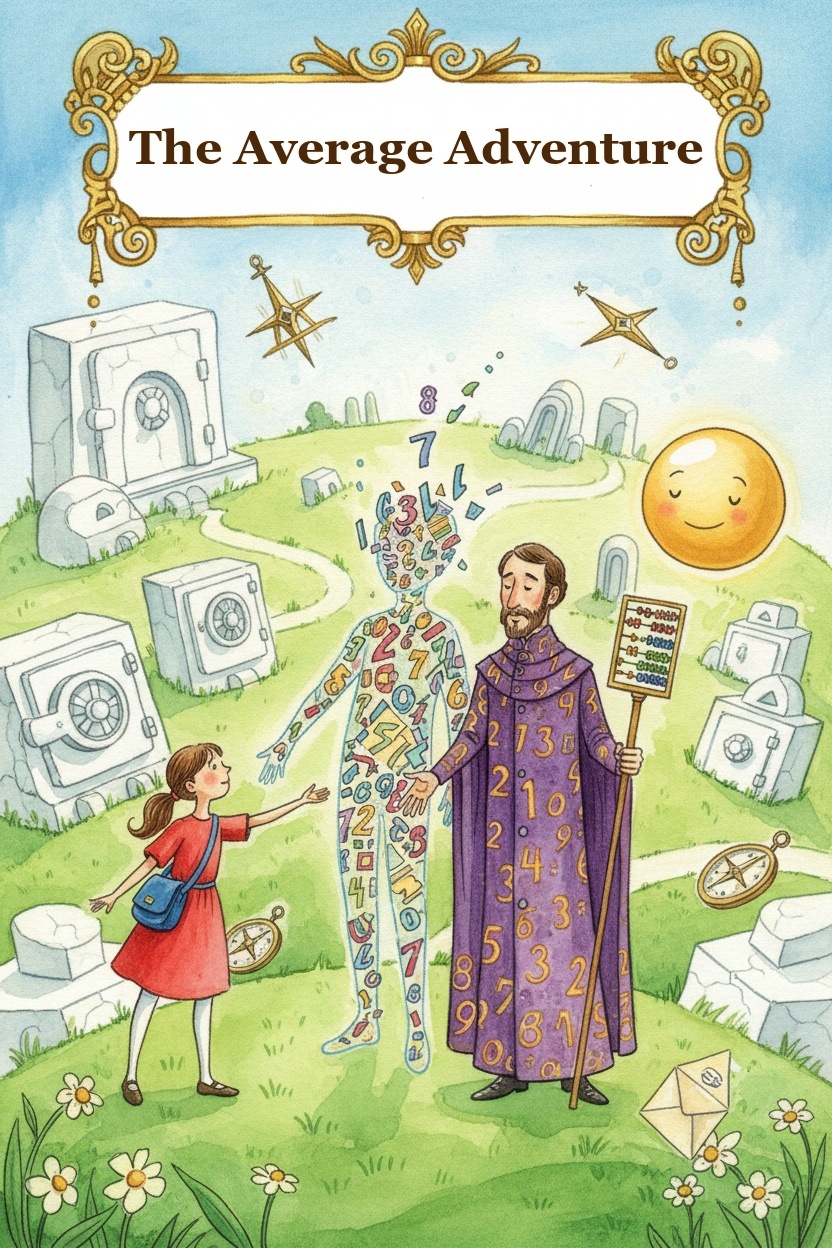
The Unfair Festival
"Right. Let's see what's broken," Mira said, sliding off her bicycle and landing in the middle of the Grand Distribution Plaza.
The plaza was chaos. Huge piles of festival treats sat in uneven mounds: one stack of honey cakes towered three times higher than the others, while a neighboring pile of apples had only seven pieces. Dozens of kingdom citizens stood in lines before three long tables, where the judges—three tall figures in robes covered with equal-signs—were scribbling frantically on scrolls.
"What has the Remainder done this time?" Mira asked.
The Head Judge looked up, his spectacles askew. "The crisis is as follows: the kingdom's annual Festival Distribution requires us to divide nine thousand festival treats among the three hundred districts fairly. We have been using averages to determine each district's share, as we always do. But the averages are... wrong."
"Wrong how?"
"Look!" The Head Judge pointed to a line of villages. "The Grain District received four hundred treats! They are twelve families! The Cobble District received seven! They have two hundred families! Nearly everyone is furious, and I cannot say I blame them."
Mira's mathematical sight tingled. Numbers were floating around the plaza like confused fireflies—thousands of them, bumping into each other, forming shapes that didn't quite fit. She pulled out her golden compass. It spun wildly, then pointed toward the judges' table.
"That's odd," Mira said. "The compass usually points to the problem. It's pointing at you."
The judges looked at each other. "Us?"
"Your calculations," Mira said. "May I see them?"
The Head Judge handed her a scroll. She unrolled it and read:
Average treats per district: (9000 + 300 + 400 + 7 + 12 + 200 + 1400 + 35 + 6 + 240 + ...) ÷ 300 = 47
Mira frowned. "Wait. You're adding the district sizes and the treat counts together? That's like adding apples and... well, actually adding apples and families. These are different kinds of numbers!"
A giggle bubbled up from behind the judges' table. A small shimmering shape materialized—part wisp, part dust, part grin. The Remainder.
"Of course I helped!" it said cheerfully. "Adding everything together is so much more interesting! Why separate the treats from the families when you can make one glorious, enormous mess of a number?"
Mira put her hands on her hips. "But it doesn't mean anything. You can't average treats and families together. That's not how averages work."
"Maybe," the Remainder said, doing a little spin. "But it's certainly more exciting! Look at all the lovely confusion!"
Mira looked at the furious citizens. "I don't think they agree."
The Remainder shrugged. "Fair. But I'm not done! I've improved the other averages too! Come see!"
The Mean Misunderstanding
The Remainder zipped to the second table, where a judge was trying to distribute a shipment of blankets to five villages. The villages—Sturdy, Hollow, Briar, Moss, and Peak—had requested the following numbers of blankets:
Sturdy: 5
Hollow: 3
Briar: 8
Moss: 7
Peak: 2
"Now," the Remainder said proudly, "the average for these five villages should be—let me calculate—" It wrote in the air with its wispy finger: 5 + 3 + 8 + 7 + 2 = 25. Divided by 5 villages equals 5 blankets each!
Mira looked at it. "That's... actually correct."
The Remainder's grin faltered. "What? No, it can't be. Let me check—" It re-read its work. "Hmm. Well, that's dreadfully boring. Let me try again!"
It scribbled quickly: 5 × 3 × 8 × 7 × 2 = 1,680. Average = 1,680 ÷ 5 = 336 blankets each!
"That's wrong," Mira said. "You multiplied instead of adding. The mean is the sum divided by the count. You have to add the numbers, then divide by how many there are."
"Multiplication is more dramatic!" the Remainder protested.
"Fairness is more important than drama," Mira said. She took out her pencil and paper from her satchel. "Let me show you properly."
She wrote carefully:
5 + 3 + 8 + 7 + 2 = 25
25 ÷ 5 = 5
"Five blankets each," Mira said. "That's the mean. It's what you get when you share everything equally."
The villages nodded happily. "Five blankets each! That's fair!"
The Remainder pouted. "Fine. But I've messed up the other averages too, and those are much harder!"
The Moody Median
At the third table, a different problem was unfolding. The kingdom's tree-planting crews had reported how many saplings they'd planted in a week:
Monday: 2 saplings
Tuesday: 3 saplings
Wednesday: 6 saplings
Thursday: 1 sapling
Friday: 4 saplings
Saturday: 5 saplings
Sunday: 2 saplings
"The Remainder says the average is 4 saplings per day!" cried a gardener. "But that means we should have planted more on Monday, and we can't do that now!"
Mira looked at the Remainder. "How did you get 4?"
"Easy!" the Remainder said. "I arranged them and picked the one in the middle! Look: 1, 2, 2, 3, 4, 5, 6. The middle one is 3. Wait, no—" It rearranged: 1, 2, 2, 3, 4, 5, 6. "The middle is 3. But I said 4. Hmm. Let me try again."
It scrawled: 1, 2, 2, 3, 4, 5, 6. Middle = 4. "No, that's wrong too. There are seven numbers, so the middle one is the fourth one, which is 3. I keep making mistakes!"
Mira smiled. "The median is the middle value when you put the numbers in order. For seven numbers, the fourth one is the middle. So the median is 3."
"Wait," said a gardener. "Which is right? The mean or the median?"
"Both are right," Mira said. "They just tell different stories. The mean is the average if you shared everything equally. The median is the middle value—the one where half the days are above and half are below. On a week where one day was very high or very low, they can be quite different."
The Remainder's eyes lit up. "Oh! So if I made one day have a hundred saplings, the mean would change a lot, but the median might not change at all!"
"Exactly!" Mira said. "That's why choosing the right average matters. The mean is affected by very high or very low numbers. The median is more stable."
The Mode Mayhem
The Remainder zipped to the honey-cake table. "Now here's a good one!" it declared.
The bakers had made cakes in different flavors:
Chocolate: 12 cakes
Honey: 8 cakes
Berry: 12 cakes
Cinnamon: 4 cakes
Chocolate: 12 more cakes
Honey: 8 more cakes
"The average flavor is—" the Remainder started.
"Stop," Mira said. "There isn't one average flavor. You can't add 'chocolate' and 'honey' together. But you can find the mode."
"The mode?" asked a baker.
"The most frequent value," Mira said. "Chocolate appears three times. Honey appears twice. Berry once. Cinnamon once. So the mode is chocolate."
"But what if two flavors tie?" the baker asked.
"Then there are two modes," Mira said. "That's fine. Sometimes data has more than one most-frequent value."
The Remainder clapped its wispy hands. "I love that! Ties are so delightfully messy!"
Mira laughed. "You would think so."
The Spread Story
"Now," Mira said, looking at the whole plaza, "I think we need to check the range too."
The judges gathered around. "Range?"
"Range measures how spread out the numbers are," Mira said. She drew two sets of numbers:
Set A: 5, 5, 5, 5, 5
Set B: 1, 2, 5, 8, 9
"Both have a mean of 5," she said. "Both have a median of 5. But they're very different stories! Set A is all the same number. Set B has lots of variety."
"Range tells us the difference between the largest and smallest values," Mira continued. "Set A has a range of 0—everything is the same. Set B has a range of 8—from 1 to 9. So the range tells you how much variation there is."
The judges looked at the numbers. "So the mean tells us the average, the median tells us the middle, the mode tells us the most common, and the range tells us how spread out everything is?"
"Exactly," Mira said. "Each one tells a different part of the story. If you only use one, you miss things."
The Remainder appeared, looking sheepish. "I may have... mixed up all the averages in the kingdom's rulebook. Want to fix them together?"
Mira blinked. "Together?"
"Fixing things is more fun when it's complicated," the Remainder said. "And I've made it very complicated."
For the next hour, Mira and the Remainder worked through the kingdom's distributions:
-
For the honey cakes, they used the mode (chocolate was the most popular, so they made more).
-
For the tree saplings, they used the median (because the one very high day would make the mean misleading).
-
For the blankets, they used the mean (because sharing equally was the goal).
-
For the grain, they used the mean—correctly this time—dividing the total treats by the number of districts.
At the end, the plaza was calm. Every district had their fair share. The citizens smiled.
The Remainder hovered, quiet for once. "You know, the range being large isn't always bad," it said thoughtfully. "Sometimes it's interesting. Like... if one district has lots of rain and another has none, the range is big, but that doesn't mean anything is wrong."
Mira nodded. "You're right. The range just tells you how spread out things are. Whether that's good or bad depends on what you're measuring."
The Remainder grinned. "I like that. I like when numbers are spread out. It means there's more to look at."
A small, silver figure stepped out from behind the judges' table. Zero.
"Everyone forgot to consider what happens at zero," Zero said quietly.
The judges looked at it. "What do you mean, Zero?"
Zero pointed to the list of villages. "One district—the Empty Hollow—has zero families. They requested zero blankets. In the calculations, that zero is part of the data. It must be counted in the denominator of the mean."
Mira gasped. "She's right! If you forgot to divide by Empty Hollow, you'd get the wrong average. A zero in the data changes everything!"
Zero nodded. "Forgetting about zero is the most common mistake in calculations. Those who forget tend to regret it."
The Head Judge bowed. "We won't forget again, Zero."
Zero said, very quietly, "Yes. That tends to work."
Mira packed up her pencil and paper. The plaza was peaceful now, with cakes distributed evenly and blankets keeping everyone warm.
The Remainder appeared one last time, a shimmer of mischief. "You know," it said, "different averages telling different stories about the same data is almost—dare I say—beautiful. It's like the same number can be many things at once."
Mira considered this. "That's true. Averages aren't just one answer. They're different ways of looking at the same set of numbers."
"Exactly!" The Remainder clapped its hands. "You'll never find a single 'right' average, because it depends on what you're trying to learn. That's my favorite kind of math—it's not neat, but it's honest."
Mira smiled. "I think I'd agree with that."
"Right. Let's see what's next," she said, but softly, and the plaza hummed with fairness restored.