Chef Sparks Kitchen Lab
THE FARMERS CHOICE
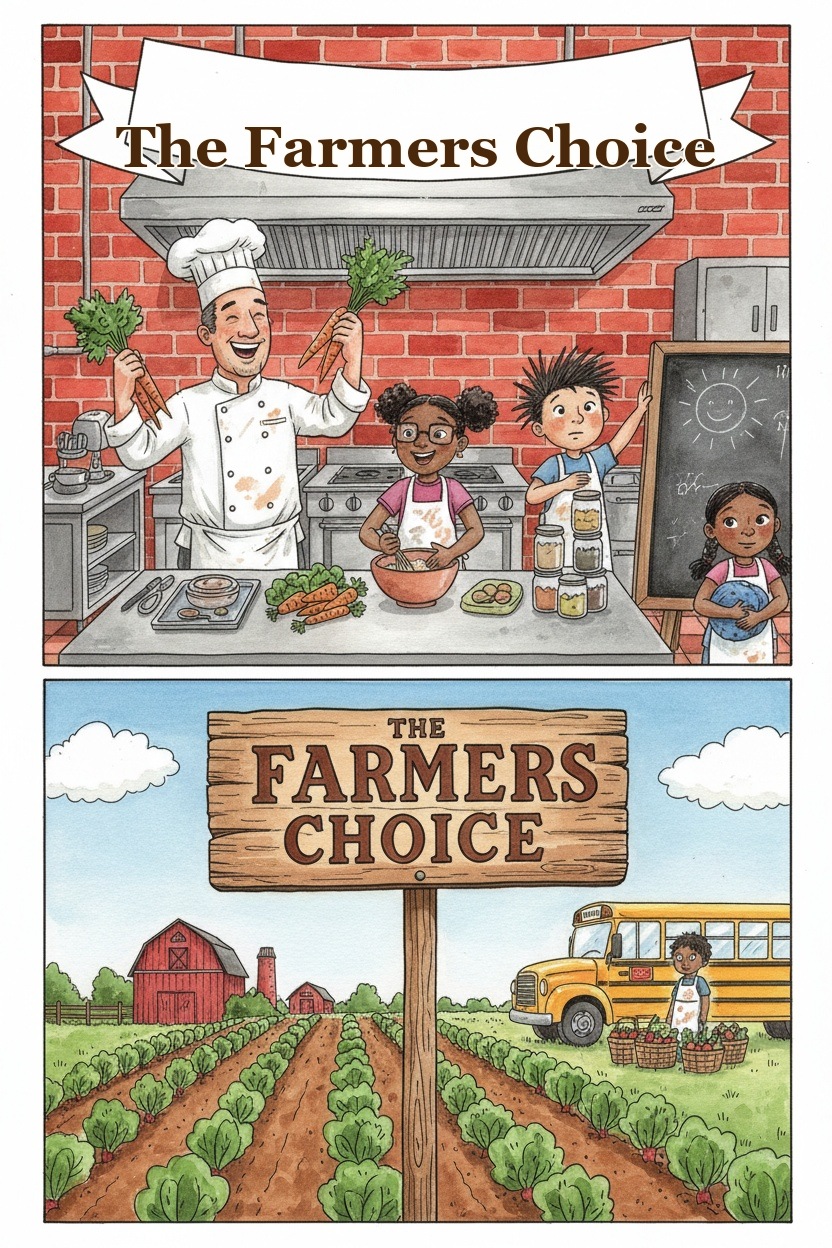
Chapter One: Two Very Important Carrots
The Riverside Fire Station's kitchen smelled like rain and soil, which was unusual. Usually it smelled like onions cooking or bread rising or—on the day Tommy had brought in his uncle's leftover carnitas—like heaven. But today, when Maya walked through the door, she stopped and sniffed.
"Why does it smell like a garden?" she asked.
Chef Iggy Spark stood at the enormous stainless steel counter, beaming like a man who had just pulled off a magic trick. In front of him were two small mounds of dirt. And in each mound, a carrot.
"Because, my dear Maya, today we are studying the most important ingredient in every meal. Not the salt. Not the butter, though butter is excellent. Today we are studying the story of food. Where it comes from. How it gets to us. And today, we have two carrots with two very different stories."
Tommy bounded through the door, already sniffing the air. "Are we eating dirt?"
"No," said Iggy. "We are eating carrots. But first, we are understanding them."
Priya came in last, carrying a small plastic bag. "My Ammamma sent these," she said, holding it up. Inside were tiny green chilies, wrinkled and fragrant. "She said every good lesson needs something to wake you up."
Iggy received the chilies with the reverence of a priest receiving a sacred offering. "Your Ammamma is a wise woman. We will use these in our dish today." He placed them carefully on the counter. Then—as the class gathered around the two carrots—he spread his arms wide.
"Observe. Two carrots. Both orange. Both crisp. Both grown in soil not very far from here. But one of them was grown organically and one was grown conventionally. And before anyone tells you which one is 'better,' let's find out what that actually means."
Lucia, who had already pulled out her sketchbook, raised her hand. "Can we take notes?"
"You may take notes, draw pictures, write poems, compose a song—whatever helps you remember. Because I promise you, what you're about to learn will change how you see every vegetable you've ever eaten."
Iggy picked up the first carrot—the organic one—and held it to the light.
"This carrot grew in a farm that follows very specific rules. Rules that were certified by an organization that inspects the farm and makes sure the farmer is doing what she says she's doing. No synthetic pesticides. No synthetic fertilizers. No GMO seeds. The farmer has to keep detailed records of everything she does to the soil, the plants, the water."
He set it down and picked up the other carrot.
"This carrot grew on a farm that uses modern agricultural methods. The farmer might use synthetic fertilizers to feed the plants and synthetic pesticides to protect them from insects and diseases. She might use seeds that have been modified to resist pests or grow faster."
Dev, who loved engineering and structure, frowned. "So one is clean and one is dirty?"
"Ah," said Iggy, holding up a finger. "That would be the easy version. But easy versions of complicated things are almost always wrong." He reached into his pocket and pulled out a small knife. "Let's see for ourselves."
He cut both carrots in half, then held out the pieces. "Look closely. Touch them. Smell them. What do you notice?"
The class leaned in. Maya examined each piece carefully, turning them over in her hands. "They look the same to me," she said.
"They smell the same," said Tommy.
"They're both orange," said Lucia, stating the obvious.
Iggy nodded. "Now taste them."
He gave each student a thin slice of each carrot. Tommy ate his immediately, made his two-note approval hum, and reached for more. Priya chewed slowly, thoughtfully.
"The organic one is sweeter," she said.
"Really?" Iggy raised an eyebrow.
"I think so. Maybe. Or maybe I'm just expecting it to be."
Iggy clapped his hands. "That, my friends, is the most honest answer anyone has ever given in this kitchen. Because the truth is, when scientists have studied the nutritional differences between organic and conventional carrots—between almost any organic and conventional food—they don't find consistent, significant differences. Sometimes one has more vitamin C. Sometimes the other has more. But the differences are small, and they vary from farm to farm, from season to season."
Maya looked confused. "So they're the same?"
"Nutritionally? Largely, yes. But the story is bigger than nutrition. Because these two carrots tell very different stories about the soil they grew in, the water that fed them, the insects that lived around them, and the people who grew them."
Iggy set down his knife and fixed the class with a serious look.
"To understand the farmer's choice, we need to understand what's at stake. And for that, I've invited someone very special."
Chapter Two: The Soil Professor
Dr. Elena Vasquez was a tall woman with dirt permanently embedded in the creases of her hands—hands that, Tommy later said, "looked like they'd high-fived the earth itself." She was a soil scientist, which meant she studied the thing that most people never thought about but that every single person depended on for survival.
"I'm going to tell you a secret," she said, settling onto a stool at the prep table. "The most important thing in your entire food system isn't the food. It's the stuff the food grows in."
"Old dirt?" asked Tommy.
Dr. Vasquez smiled. "Yes, Tommy. Exactly. But also no. Because the dirt in a field that's been farmed the same way for fifty years is not the same as the dirt in a garden that's been nurtured—do you understand? Soil is alive. It's full of billions of microorganisms—bacteria, fungi, tiny creatures you can't see—that do the work of turning dead plant matter into nutrients that new plants can use. When a farm is healthy, the soil is a whole community. When it's not—" She held up her hands. "When it's not, the plants that grow in it are more vulnerable. They need more help. They need synthetic fertilizers to compensate for what the soil can't provide."
Priya leaned forward. "So organic farming is about keeping the soil alive?"
"Partly. Organic farmers are required to build soil health through careful practices. Crop rotation—planting different things in different seasons. Composting. Planting cover crops that get plowed back into the soil to feed it. They're feeding the soil, not just the plant. And that means the soil becomes richer over time, with more organic matter, more microbial life, better water retention."
Sam, who was going to be a food critic and took notes on everything, raised his pencil. "What about conventional farms? Are their soils dead?"
"Not necessarily," said Dr. Vasquez. "There are very good conventional farmers who take excellent care of their soil. And there are bad organic farmers. The certification is a floor, not a ceiling. A conventional farmer can do many of the same practices—crop rotation, cover cropping, no-till farming—without being certified organic. And an organic farmer can be lazy about their practices. But on average, what we see is that organic farming tends to build soil health over time, while conventional farming—especially when it's done carelessly—tends to deplete it."
Iggy was nodding enthusiastically. "What about the pesticides?" he asked. "The class needs to understand."
Dr. Vasquez turned to the students. "In conventional farming, the farmer has tools to protect her crops from insects, weeds, and diseases. These are pesticides—herbicides for weeds, insecticides for bugs, fungicides for fungi. They're very effective. They're also very targeted. But they can have consequences."
"Like what?" asked Maya, who was thinking about food labels, which she read like other people read bedtime stories.
"Some pesticides are toxic to bees and other pollinators. Some can contaminate the soil and water for years. Some can harm farmworkers if they're exposed to them at high levels. And that's why organic farming has rules about pesticides—organic farmers can use certain approved natural substances, but not the synthetic chemicals that are common in conventional farming."
"So organic food doesn't have any pesticides?" asked Tommy.
"Organic farmers can use pesticides, but only approved ones—mostly derived from natural substances. And some organic farmers use no pesticides at all. But organic doesn't mean zero pesticides. It means lower-risk pesticides."
Dev's hand shot up. "Which one is better? For the environment, I mean."
Dr. Vasquez paused. "That's a beautiful question, Dev. And the answer is: it depends. If you compare the best organic farming and the best conventional farming, organic often has advantages—healthier soil, more biodiversity, less water pollution. But organic farming also tends to produce less food per acre—sometimes significantly less. So if we need to feed seven billion people, and tomorrow the entire world went organic, we would need to use more land. And more land for farming means less land for forests and wildlife."
"There's no simple answer," said Priya softly.
"No," said Dr. Vasquez. "There isn't. That's the honest truth. The farmer's choice is not between good and evil. It's between trade-offs."
Chapter Three: The Price of Everything
Iggy had been quiet, watching the class absorb this information. Now he stepped forward.
"Let's talk about money," he said.
Tommy perked up. "Is someone getting paid?"
"In a way, yes. Let's do a bit of math. Dr. Vasquez, do you happen to know the price difference between organic and non-organic carrots at the market?"
"I do. I checked this morning. Organic carrots are about two dollars a pound. Conventional carrots are about one dollar and nineteen cents."
"So roughly seventy percent more expensive," said Iggy.
"How come?" asked Lucia, who had started sketching a carrot with a little crown.
Maya answered before anyone else could. "Because it costs more to grow them," she said. "Organic farmers have to do more work by hand. They can't use chemicals to kill weeds, so they have to pull them out or use mechanical methods. They can't use synthetic fertilizers, so they have to build soil health slowly. And some of their crops get eaten by insects, so they lose part of their harvest. All of that costs money."
"Very good," said Iggy. "And that means organic food is more expensive at the store."
"So the people who can afford it eat organic, and the people who can't afford it don't?" asked Priya. There was something careful in her voice, something Iggy had been waiting to hear.
"That's the social question," said Iggy. "And it's an important one. Because a family that's shopping for groceries on a tight budget may not be able to afford organic. So the choice between organic and conventional is not just about the environment—it's about who gets to choose for the environment at all."
"My mom says organic is a luxury," said a student Iggy hadn't expected to speak. It was Sam, who had been so quiet that everyone half-forgot he was there. His family had been through hard times; Iggy knew this. "She says the extra money is better spent on more food, not a label."
"And your mother is right," said Dr. Vasquez. "For her situation, that's the right choice. And nobody should be made to feel guilty about it. A family that buys conventional produce and feeds their children more vegetables is doing something better than a family that buys organic produce and doesn't feed their children vegetables at all."
There was a moment of silence—the kind of silence that happens when an adult says something true that children have never heard said out loud.
"Also," added Iggy, "it's not all or nothing. Some vegetables have higher pesticide residues than others. And some have very low residues even when they're grown conventionally—carrots are actually pretty low. So if you're on a budget, you can pick and choose."
"That's called the Dirty Dozen and the Clean Fifteen," said Maya. "Lists that show which conventionally grown fruits and vegetables have the most and least pesticide residue."
"You read labels for fun," said Tommy, not unkindly.
"I read labels for survival," Maya corrected. "But also yes."
Chapter Four: The Taste Test
Iggy had arranged the carrots on a cutting board, sliced into neat rounds.
"Before we make our dish, let's do a proper taste test," he said. "And I want to be completely honest with you. What has science found about the taste difference between organic and conventional carrots?"
"They taste the same?" asked Tommy hopefully.
"Not exactly. Some taste tests have found that people can tell the difference—organic is sometimes reported as sweeter and more carrot-y. But when scientists do blind taste tests where the tasters don't know which carrot is which, the difference mostly vanishes. The carrot that looks the best, regardless of how it was grown, usually wins."
"So it's about what we expect," said Priya.
"That's a huge part of it. The brain tastes with the eyes and the expectations first. And that's why our taste test today is a blind test. You'll each get a small piece of carrot labeled A or B. You won't know which is organic and which is conventional."
Iggy passed out the slices. Tommy ate his immediately.
"A is sweeter," he declared.
"You only had A," Iggy pointed out.
"Doesn't matter. It's sweeter."
The class laughed. They sampled, compared, considered. When they tallied their results, three students chose A and two chose B.
"I will now reveal," said Iggy, "which was which."
He held up a hand. "Maya, what do you think?"
Maya studied the slices. "I think they're both fine. I think the difference is small. I think if I were eating them at home, I wouldn't notice."
"An honest answer," said Dr. Vasquez. "And the most common one, when people don't know which is which."
Iggy reached for a whiteboard marker. "Then let's put this all together. What have we learned?"
The class called out their answers, and Iggy wrote them down in his messy, enthusiastic handwriting:
-
Organic farming follows strict rules—no synthetic pesticides, no synthetic fertilizers, no GMOs
-
Conventional farming uses modern tools but has environmental trade-offs
-
The nutritional differences between organic and conventional carrots are small and inconsistent
-
Organic food costs more, which creates an access question
-
The real difference is in the soil, the environment, the biodiversity
-
Both farming systems make food—and both have real costs and benefits
Iggy set down the marker. "And here's the thing I want you to remember," he said. "When grown well, both organic and conventional carrots can be wonderful. And when grown carelessly, both can be harmful to the environment. The label isn't everything. The practices are."
He picked up the two carrots—one organic, one conventional—and held them side by side.
"The story of food is never as simple as 'good' and 'bad.' It's about choices, and trade-offs, and the reasons behind them. A farmer who uses chemicals carefully, who protects her soil and water—she is feeding the world in a way that matters. A farmer who goes organic and builds soil health—she is also feeding the world. The best choice is not the one with the prettiest label. It's the one that grows the most food, with the least harm, for the most people."
"Speaking of food," said Priya, "aren't we going to cook something?"
Iggy's face lit up. "Indeed we are. Because all of this knowledge—about soil, and farming, and the farmer's choice—comes down to one beautiful moment. The moment when food becomes a meal."
The Dish: Ammamma's Carrot and Lentil Stew with Toasted Chilies
Iggy had written the recipe on the chalkboard, and the class gathered around the big range.
"Today, we're making a stew that celebrates the humble carrot," he said. "And we're using a little bit of everything we've learned about agriculture."
"We're using both carrots?" asked Tommy.
"We're using both carrots. The organic and the conventional, chopped up together. Because in this kitchen, we don't waste food, and we don't waste opportunities. The carrots are different in their stories, but together, they make a better stew."
Priya had been given the honor of kneeling the chilies her Ammamma had sent. "In hot oil, they bloom," she said, shaking them into the big pot. "The heat wakes them up. The flavor opens."
"Like the soil waking up in the spring," said Dr. Vasquez.
Priya smiled. "Yes. Exactly."
The stew came together in stages: onions softening in olive oil, garlic joining them, then carrots—both kinds—diced into coins. Then red lentils, which Iggy explained were actually seeds in one of the most ancient plant families on Earth. Then water, and a pinch of salt, and the chilies blooming in their oil.
"This is a dish that farmers eat," said Iggy. "It's simple, it's cheap, it's warm, and it uses the vegetables that are on hand. Every culture has a version of this pot of food: vegetables and legumes and water, simmered until they become something more than themselves."
It smelled incredible. Tommy stood by the pot, inhaling deeply.
"The carrots are doing something interesting right now," said Dr. Vasquez. "Can anyone guess what's happening as they cook?"
"They're softening?" offered Lucia.
"They're releasing their sugars into the water," said Priya. "That's why the broth is getting sweet."
"Exactly," said Dr. Vasquez. "And that sweetness is the same in both carrots—because the chemistry of a carrot is the chemistry of a carrot, whether it was grown with organic compost or synthetic fertilizer. The nutrition is largely the same. The difference is in the soil, in the ecosystem, in the environmental cost."
Iggy stirred the pot. "And that's the lesson, isn't it? We want the world to produce good food, and we want the world to stay healthy enough to keep producing it. The farmer's choice—organic or conventional—is about balance. About feeding people today without stealing from tomorrow."
"The stew is ready," said Priya.
They ate in the warm kitchen, the old fire station's windows fogging up from the steam. The stew was simple and delicious—the carrots sweet, the lentils nutty, the chilies waking up each mouthful with a warm burn that Priya said stung "just like Ammamma's."
"It's good," said Tommy, through a mouthful of stew.
"What's good about it?" asked Iggy.
Tommy thought about it. "Everything," he said. "The carrots are sweet. The lentils make it feel like something real in my belly. And the chilies." He made his two-note hum. "They wake me up."
"That's a five-star review," said Sam, making a note.
Iggy sat down with his own bowl. "So what's the farmer's choice?" he asked.
Aisha, one of the rotating students, raised her hand. "It's choosing how to grow food, and knowing that both ways have good and bad sides?"
"Close," said Iggy. "The farmer's choice is quietly one of the most important decisions in the world. Because every single person needs to eat, and someone has to grow that food. And however they grow it—organic or conventional, in soil or in towers, with chemicals or with compost—the choice affects the soil, the water, the air, and the people who eat what they grow."
He took a bite of his stew.
"We don't get to pretend one choice is simply right and the other simply wrong. What we get to do is learn, and question, and make the best choice we can—for our families, our communities, our world. That's what understanding your food means. It means seeing the whole story."
"What about us?" asked Dev. "We're not farmers. What's our choice?"
Iggy smiled. "Your choice is to know more than you did before. And to be curious about where your food comes from, and what it took to get it to your plate. And when you grow up, if you ever have a vegetable garden—or a farm, or a vote about food policy, or a dollar to spend on groceries—you'll make your choices with your eyes open."
The Recipe: Ammamma's Carrot and Lentil Stew
Ingredients:
-
2 tablespoons olive oil
-
1 medium onion, diced
-
2 cloves garlic, minced
-
3 medium carrots, sliced into thin rounds (doesn't matter if they're organic or conventional—both work!)
-
1 cup red lentils, rinsed
-
4 cups water or vegetable broth
-
2 dried red chilies (or a pinch of chili flakes, if you're sensitive to spice)
-
1 teaspoon ground cumin
-
1 teaspoon ground coriander
-
Salt to taste
-
A handful of fresh cilantro (optional)
Steps:
-
Heat the oil in a large pot over medium heat. Add the onion and sauté until soft and golden, about 5 minutes.
-
Add the garlic and cook for 1 more minute, until fragrant.
-
Add the carrots and stir to coat them in the onion and oil.
-
Add the cumin and coriander and stir for 30 seconds, until the spices smell toasty.
-
Add the red lentils and water (or broth). Stir everything together.
-
Add the chilies (whole, so they add a gentle kick without being too spicy).
-
Bring to a boil, then reduce heat to low. Cover and simmer for 20-25 minutes, stirring occasionally, until the lentils are soft and the carrots are tender.
-
Taste and add salt as needed. If you like a silkier texture, blend half the stew until smooth and stir it back in.
Chef's Note: This stew gets even better the next day. It's a farmer's kind of food—simple, honest, and made for sharing. Serve it with rice or bread, and don't be afraid to eat it for breakfast. I certainly did.
Kitchen Lab Notes
Dear Students,
Today we learned something that confuses a lot of grown-ups: the difference between organic and conventional farming is not about which one is "right" and which one is "wrong." It's about trade-offs. Organic farming tends to be better for the soil and the environment, but it costs more and produces less per acre. Conventional farming produces more food, but it can harm the environment if it's not managed carefully. And the carrots? They were both delicious, because great vegetables come from great farms—no matter what label they wear.
Here's a question for you to think about until next time: Imagine you're a farmer with ten acres of land. Your neighbor down the road wants you to grow food organically. A grocery store in the city wants you to grow as much as you can, as cheaply as you can. How do you decide? There's no wrong answer—but now you know enough to make a real one.
See you soon,
Chef Spark