Inside Out Academy
THE BONES ARE NOT WHAT YOU THINK
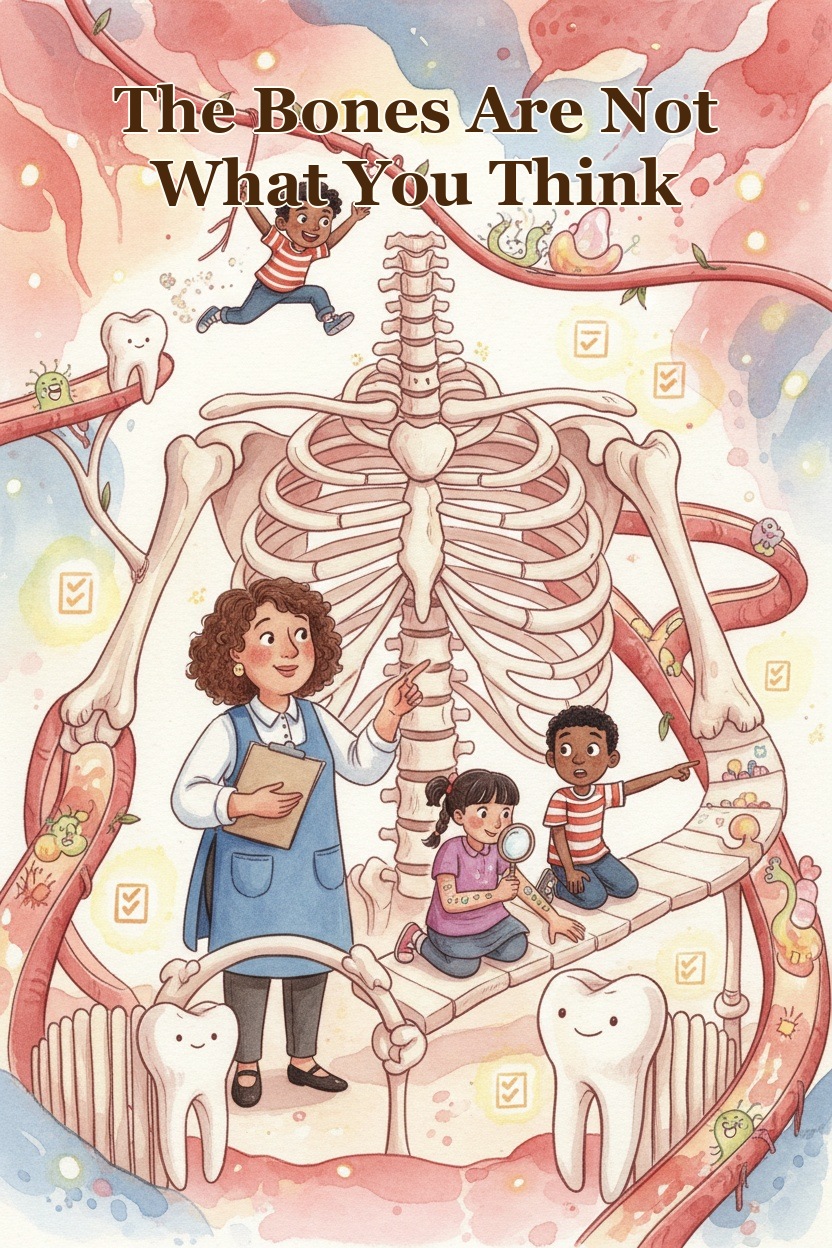
MS. VANCE'S CURRENT CHECKLIST
Location: Inside Mr. Gomez, approaching the left femur
Day 3 of unscheduled field trip
Students accounted for: 22 out of 22 (Leo is currently being supervised)
Items needed: Better lighting, a map of bone structure, possibly a snack break
Part One: The Solid Thing That Wasn't
The class had been walking for what felt like hours. The path had been getting darker, warmer, and stranger. Ms. Vance consulted her map—the one drawn on Sadie's energy bar wrapper—and announced that they were approaching the skeleton.
"Finally," Marcus said, cracking his knuckles. "Something simple. Bones. Hard, solid, boring. No moving parts, no confusing fluid dynamics. Just good old-fashioned calcium and collagen."
He was walking backward while he talked, which meant he didn't see the bone until he ran into it. Or rather, until his hand sank into it.
"Um," Marcus said, looking at his wrist. His hand had disappeared into what should have been solid bone. "That's not supposed to happen."
Fatima walked past him and placed her palm against the surface. She pressed gently. Her fingers sank in slightly. She withdrew them and looked at the pattern left behind. She was quiet for a long moment.
"It's not solid," she said finally. "It's a lattice."
"It can't be a lattice," Marcus said. "Bones are solid. That's the whole point of bones. They're the hardest material in the body. Stronger than steel by weight, that's a fact I read in a book—"
"Which book?" Sadie asked, arriving behind them. She was wearing her emergency medical kit crosswise over her chest, which she'd been doing since Tuesday. Nobody had asked her to. She'd just decided that if they were going to be inside a human body, someone should be prepared.
Marcus opened his mouth, paused, and closed it. "The point is—"
"The point is that bone tissue is made of two main types, and only one of them looks like what you'd expect." Sadie stepped up to the wall and ran her fingers across its surface. "Congratulations, Marcus. You've just discovered the difference between compact bone and spongy bone. I expect you'll want to take notes."
Marcus crossed his arms. "Dr. Sadie," he said, with maximum sarcasm, "thank you for your expertise."
Sadie did not acknowledge this. She did not even blink.
"Okay, hold on," Leo said, pushing through the group. He was holding the rope that he was always holding, even when there was nothing to rope. "So this is the bone. And it's... holey?"
"It's not holey," Sadie said. "It's structured. Compact bone is dense and solid—that's the outer layer, the part that takes all the weight and impact. But inside, bone has to be lighter. It has to leave room for blood vessels. It has to have space for marrow. So it forms a lattice—a series of struts and arches that distribute force in every direction."
She found a place where the structure was clearly visible—a cross-section, like a natural cliff face. The students gathered around and looked.
The bone was not solid.
It was a forest of tiny columns, bridges, and arches, all connected in an intricate pattern. It looked like honeycomb. It looked like a sponge. It looked, Leo said, like a climbing gym, which was exactly the wrong thing to say because suddenly everyone was looking at him with expressions that said no and absolutely not and Leo I will personally hold you down.
"Don't," said Ms. Vance, who had just arrived. "Don't you dare."
Leo's face fell. "I wasn't going to."
"You were."
"Okay, I was. But now I'm not."
"Good," said Ms. Vance, consulting her checklist. "Everyone present? Sadie, can you give us a proper introduction to what we're looking at?"
Sadie stepped forward like she'd been waiting for this invitation. She probably had.
"It's called the periosteum," she said, pointing to the thin, fibrous layer covering the bone's surface. "This is what you touch when you touch a bone—it's a membrane that supplies the bone with blood and nerves. The actual bone tissue—"
"That's just called bone tissue?" Marcus interrupted.
"Actually," Sadie said, "the compact bone is made of structures called osteons. They're cylindrical—layers of mineralized matrix arranged in rings, with a central canal for blood vessels. It's incredibly strong. But underneath, we transition to spongy bone. And that's what we're seeing here. It's also called cancellous bone."
"It looks like a maze," Fatima said quietly.
Sadie nodded. "It does. And if you think about it, that's what it is. The body is always solving multiple problems at once. It needs the bone to be strong enough to hold the body up. But it also needs it to be light enough to actually move. And it needs it to be hollow enough to produce blood cells. The spongy bone structure solves all of these simultaneously."
"Blood cells?" Leo perked up. "Bones make blood?"
"Red and white blood cells," Sadie said. "Millions of them every second. Production happens in the marrow, which is in the center of the bone."
"Hold on," Marcus said. "So this big hollow bit in the middle is what? The marrow? Like steak that you'd have with—"
"If you call human bone marrow 'steak,' I'll physically overpower you," said Sadie, leveling him with a look. Marcus opened his mouth, then closed it. There was something about Sadie's expression that suggested she wasn't joking.
Part Two: The Remodelers
The class had set up a small basecamp on the surface of the spongy bone, where the lattice created natural platforms. Ms. Vance had improvised a seating arrangement using the wrap from Sadie's emergency energy bar. They were, as she put it, "in conference."
"The thing you need to understand," Sadie was saying, "is that bone is alive."
"I know it's alive," Marcus said. "It's part of a living body."
"No," Sadie said. "I mean it's alive. It's constantly being torn down and rebuilt. There are cells called osteoclasts that break down old bone tissue, and cells called osteoblasts that build new bone. They're working all the time. The entire skeleton gets replaced every ten years or so."
"Wait." Leo looked down at the bone he was standing on. "So this bone we're standing on—some of it might not even be the same bone Mr. Gomez had when we got here?"
"That's right."
"And some of it might be new."
"That's right."
"So we're standing on a building that's literally renovating itself while we're inside it?"
Sadie considered this. "Yes. It's very safe, though. The process is tightly regulated. Unless something goes wrong with the balance—"
"What happens then?"
Sadie's face took on the expression that everyone in the class had learned to recognize. It was the okay-technically expression, the one that meant she was about to describe a worst-case scenario in clinical detail.
"Osteoporosis happens when osteoclasts outpace osteoblasts," she said. "The bone becomes weaker. More porous. Brittle. That's why exercise is important—mechanical stress tells the osteoblasts to build more bone. The bone responds to what you do. It's always adapting."
"Like muscles," said Marcus.
Sadie blinked. She had never before allowed Marcus to be right about anything without correcting him. But this time, she simply nodded. "Like muscles," she said. "Bone is incredibly responsive. It's not static at all."
Fatima had been quiet throughout this conversation, but now she spoke. "So the bone is... remembering?"
"Remembering what?"
"What happens to it. The stresses and strains. It's recording its own history." She looked at the lattice around them. "It's a library, isn't it."
Nobody knew what to say to that.
Part Three: The Deepest Part
"It's too dark to see the marrow," Ms. Vance said. "But it's important you know what it is before we move on. Sadie, can you—"
Sadie didn't need to be asked. "There are two types of marrow. Yellow marrow, which is mostly fat. And red marrow, which is where blood cells are made. In children, most bones have red marrow. In adults, it's mostly converted to yellow—red marrow survives only in certain places. The spine, the ribs, the pelvis. The breastbone."
"So Mr. Gomez's blood is being made right now in his bones?" Leo asked.
"Right now," Sadie confirmed. "You're standing on the factory floor of the circulatory system. Well, not this exact spot—but close."
Leo was looking at the darkness where the bone marrow would be. His face had gone very serious.
"What does it look like?" he asked.
Sadie paused. "I've never actually seen it. I've only read about it."
"It looks like red jelly," Ms.