Chef Sparks Kitchen Lab
THE ROADS THAT SPICE TRAVELED
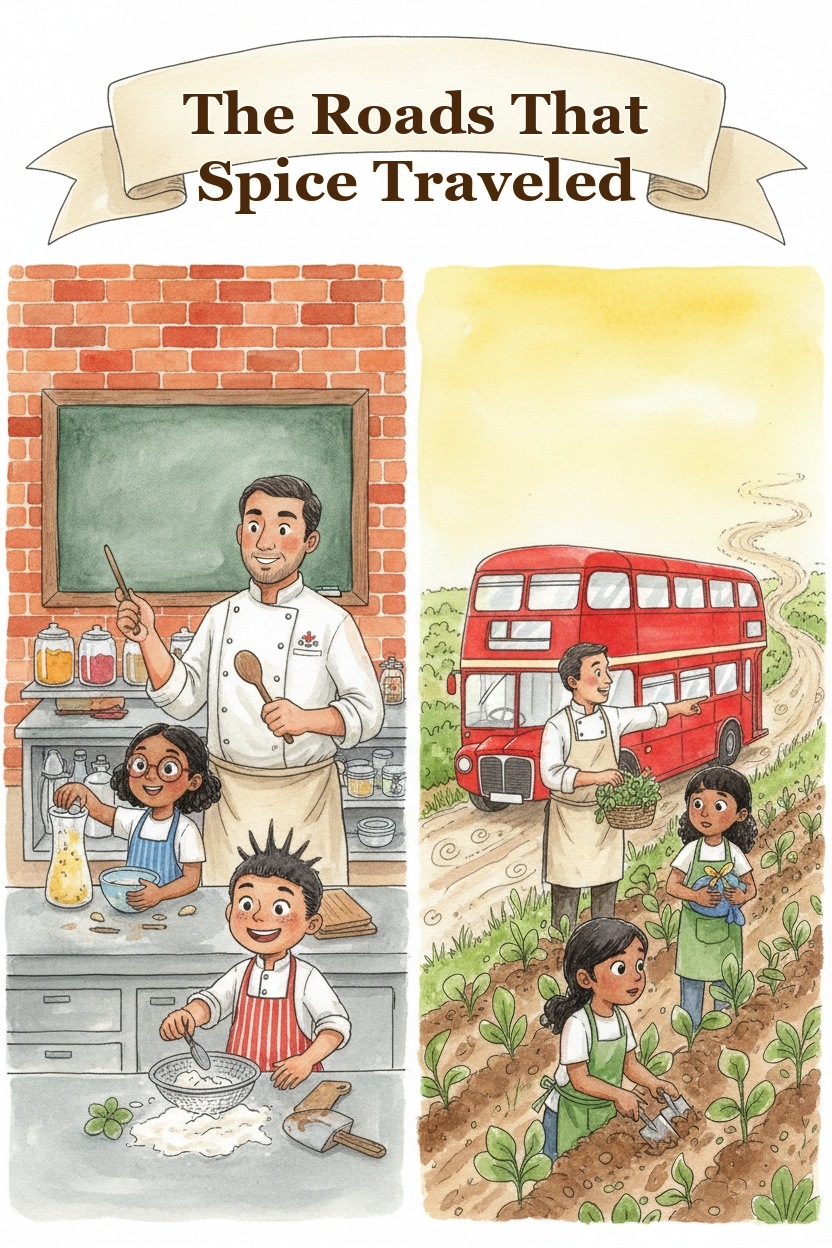
The Thirty Jars
The Riverside Fire Station smelled like a library made of food.
Not paper and ink—something better. Cinnamon and cardamom and something sharp that made your nose wake up and pay attention. The students filed in to find Chef Iggy standing at the center table, and on that table, in three neat rows, sat thirty small glass jars with brass lids.
"Spices," Iggy said, his voice hushed like he was introducing important guests. "Thirty of them. Every one of them traveled farther to get here than any of you have ever been."
Sam raised a hand. "They came from a store."
"That's the last mile," Iggy said. "The tiny journey at the end. I'm talking about the whole road. Every jar has a story that stretches back hundreds—sometimes thousands—of years. Before planes. Before trains. Before anyone had even invented the wheel."
Dev leaned in, counting the jars. "Why do some of them look like sticks?"
"That's cinnamon. It's bark, actually. The inner bark of a tree that grows in Sri Lanka. Someone had to peel it by hand, let it dry, and roll it into those curls you see in there." Iggy picked up the jar and held it out. "Smell."
Dev sniffed. His eyes went soft. "It smells like... the holidays. And also like something I don't have a word for."
"Ammamma's kitchen," Priya said, reaching for the jar. She opened it and inhaled deeply. "She puts cinnamon in her rice. It's not sweet there—it's different. Warm and deep."
"Same spice," Iggy said. "Different story."
The Spark Effect knocked a wooden spoon off the edge of the counter.
"Speaking of stories," Maya said, looking at the spoon on the floor, "are you going to tell us all thirty?"
"In one class? No." Iggy grinned. "But I'm going to tell you the stories of the seven spices we're cooking with today. And we're going to cook with all of them. In one pot."
Lucia had already started drawing a cinnamon curl. "What are we making?"
"A slow-cooked lamb stew," Iggy said. "It's a dish that exists in different forms all across the world—because the spices in it traveled different roads to get to different kitchens. But before we cook, we smell."
He opened the first jar.
The Roads
Iggy lined up seven jars in front of him like soldiers.
"First," he said, "we understand what makes spices spicy. Not all of them are spicy the same way. That's part of the story."
He held up three jars.
"Capsaicin," he said, opening the first. Inside were small, dried red chilies. "This is the chemical that makes chili peppers hot. It comes from a plant that was first domesticated in the Americas—Mexico, Central America, places like that. Before Columbus crossed the Atlantic, nobody in Europe, Africa, or Asia had ever tasted anything like this."
"They didn't have chili?" Tommy looked stricken. "At all?"
"Not a single chili pepper. Not in Indian food. Not in Thai food. Not in Sichuan food. All of those cuisines, the ones we think of as 'spicy food' cuisines—they didn't have chilies until after the Americas were colonized and the peppers were carried across the ocean by ships."
Priya's eyes went wide. "So Ammamma's chili powder—"
"Comes from a plant that traveled," Iggy said. "The Columbian Exchange. When Europe started colonizing the Americas, plants and animals moved across the ocean in both directions. Chilies went east. And they changed everything."
He opened the second jar. Inside were black peppercorns, tiny and wrinkled.
"Piperine," he said. "That's the chemical that makes black pepper spicy. And black pepper has an even older story. It grows in India—the Malabar Coast, specifically. People have been trading it for at least four thousand years. It was so valuable in ancient Rome that people used it to pay taxes. There was a time when pepper was literally worth more than gold."
"More than gold?" Maya repeated. "That little jar?"
"People would travel thousands of miles, across oceans and deserts, just to buy pepper and carry it back." Iggy's hands moved as he talked. "There were trade routes called the Silk Road and the Spice Route. Caravans of camels crossing Asia. Ships sailing from India to the Arabian Peninsula, then overland to the Mediterranean, then all the way to Europe. By the time pepper reached a kitchen in England, it had passed through ten pairs of hands, and each pair of hands had added a little to the price."
He opened the third jar, and a sharp, piercing smell cut through the kitchen.
"Allicin," Iggy said. "This one's not from a trade route at all—it's garlic. And garlic doesn't travel as a dried spice, it travels as itself: a bulb, planted, grown, harvested, carried. But here's the thing about allicin—it's not present in the garlic when it's whole. It only forms when you cut or crush the garlic, when two chemicals that were separated inside the cell combine."
Tommy looked at the garlic clove in his hand, then at Iggy. "So the spicy part is... made?"
"Its born the moment you damage the cell," Iggy said. "That's why crushed garlic tastes stronger than whole garlic. You're activating the chemistry."
"Capsaicin," Maya said, checking the jar labels. "Piperine. Allicin. Three ways to be spicy."
Iggy nodded. "Three different chemicals, three different stories, three different roads. But this dish uses seven spices, and the other four traveled their own ways. Cardamom, from India—one of the most expensive spices in the world, because it has to be picked by hand. Coriander, from the Mediterranean and Middle East—it's mentioned in the Bible and in ancient Egyptian tombs. Cumin, which was used in ancient Egypt too, and which seeds itself so well that it's now grown all over the world. And cinnamon."
The four jars stood in a row.
Iggy's voice got quieter, and the class leaned in.
"Here's what I want you to understand. Spices were not a luxury. They were not a nice extra. For most of human history, spices were one of the most valuable things in the world. Cities were built on them. Wars were fought over control of the trade routes. Explorers like Vasco da Gama and Christopher Columbus were trying to find new ways to reach the spice sources—because if you could bring spices directly from India to Europe without paying middlemen, you would become unimaginably rich."
Dev frowned. "So exploration was about spices?"
"And gold," Iggy said. "And spreading empires. But spices were the engine. When Portugal found a sea route to India, it made Portugal one of the most powerful nations in Europe. When the Dutch took control of the nutmeg trade from the Spice Islands—the Moluccas, in Indonesia—they only gave up a small island called Manhattan to the British as part of a treaty. They thought Manhattan was the worse deal."
Sam laughed. "They traded New York for nutmeg?"
"Essentially, yes. See, Manhattan didn't seem useful. Nutmeg was worth more." Iggy shrugged. "We look back now and think they were wrong. In the moment, it was a reasonable trade."
"Colonization," Priya said slowly. "We learned about this. Europeans colonized countries to control their resources. Spices were one of those resources."
"Exactly." Iggy's voice was gentler now. "The spice trade is not just a story of exciting journeys and interesting flavors. It's also a story of harm. When Europeans wanted to control the spice trade, they didn't ask the people who already grew those spices. They took control. They made rules. They hurt people. And the wealth from that trade built European empires while the places where the spices grew were often exploited and made poorer."
Maya was quiet for a moment. "So when we cook with these spices, we're touching that history?"
"You're touching the result of that history," Iggy said. "The spices are here because people grew them, traded them, carried them, fought over them, and in some cases, were hurt because of them. That doesn't mean you shouldn't cook with them. But it means when you cook, you should know what you're cooking with. Where it came from. Who grew it. And what it took for it to reach your pan."
The Stew
The lamb stew came together in three stages.
Iggy had already browned cubes of lamb in a deep pot, then set them aside. Now the class chopped onions and garlic—ten hands working around the table, with Iggy weaving between the students, correcting grips and offering tips.
"Garlic first," Priya said, pressing the flat of a knife over a clove to crush it. "Ammamma always says garlic comes first, so it can wake up."
"It does wake up," Iggy said. "That's exactly it. The allicin forms when the garlic is cut. It's at its strongest right away. If you let it sit for a few minutes before cooking, it becomes more mellow. But if you cook it immediately, you get that sharp, immediate punch."
The onions went in next, softening in olive oil. The garlic followed, and the kitchen filled with the warm, familiar smell of something being built.
"Now the spices," Iggy said. "This is the moment. We're going to add seven spices to bloom in the oil."
"What's blooming?" Tommy asked.
"The heat releases the flavor compounds in the spices," Iggy explained. "They're mostly in oils. When the spices hit the hot oil, those oils move into the fat, and the flavor spreads through the whole dish instead of staying trapped in the spice itself. This is a technique used all over the world—it's not just Indian cooking. Mexican cooking does it. North African cooking does it. It's one of those techniques that appears everywhere because it works."
He held up the first jar.
"Cardamom," he said. "We'll crush the pods to let the seeds out. Priya, you want to do this one?"
Priya took the jar. She knew exactly what to do—she'd seen Ammamma crush cardamom a hundred times. She pressed down with the flat of her knife, and the pods cracked open, releasing tiny dark seeds.
"These are the flowers' armor," Iggy said. "Cardamom grows in a pod that protects the seeds. The plants have to be hand-pollinated. That's why it's expensive."
Dev took the coriander jar and opened it, smelling. "It's green. Like... fresh grass. And citrus?"
"That's why coriander shows up in so many spice blends," Iggy said. "It's not loud. It's a background note that makes everything else work together. It's like the friend who doesn't talk much but somehow makes the whole conversation better."
"So the spices have personalities," Lucia said, drawing the coriander seeds with careful strokes.
"Spices are like a cast of characters," Iggy said. "Cumin is the sturdy one—earthy and warm. Coriander is the binding one. Cardamom is sweet and expensive and a little mysterious. Cinnamon adds depth and sweetness without being sugar. And the chilies, the pepper, the garlic—they're the sharp edges, the things that wake you up."
He added the cumin, coriander, cardamom, and cinnamon to the oil. The room filled with a scent that was suddenly, unmistakably, somewhere else—a market in a city none of them had ever been to, a kitchen in a country they'd only seen in globes.
"Smell that," Iggy said. "That's the bloom. The whole point of this dish is that seven different roads met in this pot—from India, from Sri Lanka, from the Mediterranean, from the Americas, from a garden in Greece. Colonizers tried to control those roads. They fought over them. But the spices kept traveling anyway. They can't be locked in one place."
"Because they're seeds," Priya said. "People carry them. They plant them. They grow."
Iggy pointed at her. "Yes. Spices can't be fully contained. The chilies escaped. The peppercorn rooted in new soils. The roads kept opening."
Maya looked at the stew pot as the spices sizzled. "So the stew is history in a pot."
"Everything you cook is history," Iggy said. "You just have to smell it to find out."
The Tasting
The stew simmered for two hours.
While it cooked, Iggy walked the class through the chemistry again, drawing on the chalkboard a diagram of the spice molecules. Capsaicin was a jagged shape that he compared to a key that fit into a receptor on your tongue—fooling your body into thinking something was hot, physically hot, like a fire, when actually the chili was at room temperature.
"The capsicum receptor is for temperature," he said, drawing a little mouth with a cartoon tongue. "It's designed to detect heat. But capsaicin fits into it like an imposter key. Your tongue says, 'There is a fire here,' and your brain responds by making you sweat, making your face flush. Technically, it's having a protective response to a fire that isn't there."
"Then why do people like it?" Dev asked.
"Because for most of us, it's a good surprise. Your brain says 'fire,' and then it discovers the fire is a flavor. And the chemicals in the spice also make your brain release endorphins—the same chemicals that make you feel good when you exercise. That's why eating spicy food can feel exhilarating."
"When does the stew," Tommy asked, "taste ready?"
Iggy stirred the pot. "When the lamb is tender enough that a spoon slides through it. The slow cooking breaks down the collagen in the meat—the connective tissue—and turns it into gelatin. That's what makes the stew feel rich and thick."
He lifted the lid, and the smell hit them again—this time deeper, rounder, transformed. The spices had stopped being separate notes. They were one thing now, a single chord that smelled like warmth and time.
"I think it's ready," Iggy said.
The bowls came out. Each student got a portion with rice, and Iggy served it carefully, making sure the lamb and sauce were balanced.
"Spoons up," he said. "You can't feed anyone if you don't know what you're feeding them—and that includes yourselves."
Tommy took the first bite. He closed his eyes. The Tommy hum started—that two-note sound, low and satisfied.
Priya took her bite slowly. When she swallowed, she said, "It smells like Ammamma's house. But also like I'm somewhere new."
Maya took a bite. The stew was warm, not painfully spicy—the chilies had mellowed into the slow cook, the way Iggy had said they would. She ate another spoonful.
"This is what people traded cities for?" Dev asked.
"This is what people crossed oceans for," Iggy said. "But now look—there's no ocean between you and this stew. The roads have all converged in a pot on a converted fire station, in a city that didn't exist when those first spices started traveling. Every spoonful is a distance." He raised his own spoon. "Fourteen thousand miles, at least, in every bowl."
Lucia was sketching the bowl. "What happened to the people who grew the spices?"
"The people who grew them are still doing it," Iggy said. "In Kerala, in Sri Lanka, in Indonesia. The big difference under colonization was who got to make money from their work. That's the part of the story we don't stop telling." He paused. "This stew is not a victory. It's a harvest. The spices are here because of that history—the harm and the exchange, the theft and the seed. Our job, when we cook, is to honor the work of everyone whose hands touched these spices along the way."
"Even if they didn't mean to?" Tommy asked.
"Especially then," Iggy said. "Because we get to decide what happens next. We get to know the story. And knowing the story is what makes the food alive." He took a bite of his own stew. "This is the best I've ever made it."
The Spark Effect launched the cinnamon jar off the counter, where it bounced on the floor and rolled in a circle before coming to rest against Dev's shoe.
Dev picked it up and put it back in its place.
Recipe Card
IGGY'S SEVEN-SPICE SLOW-COOKED LAMB STEW
Makes 6 servings
Ingredients:
-
2 lbs lamb shoulder, cubed
-
2 tbsp olive oil
-
1 large onion, finely chopped
-
4 cloves garlic, crushed
-
5 cardamom pods, lightly crushed
-
1 tsp ground cumin
-
1 tsp ground coriander
-
1 cinnamon stick
-
1 dried chili, crumbled (or ½ tsp chili flakes)
-
1 tsp black peppercorns, crushed
-
2 cups beef or vegetable broth
-
1 can (14 oz) crushed tomatoes
-
1 cup water
-
Salt to taste
-
3 cups cooked rice, to serve
Steps:
-
Heat olive oil in a large pot. Brown lamb in batches until deep golden on all sides. Set aside.
-
In the same pot, sauté onion until soft. Add garlic and stir 1 minute.
-
Add cardamom, cumin, coriander, cinnamon, chili, and pepper. Stir until fragrant—about 1 minute.
-
Return lamb to pot. Add broth, tomatoes, and water. Bring to a simmer.
-
Cover and cook on low heat 1½–2 hours, until lamb is tender and sauce has thickened.
-
Season with salt. Serve over rice.
Chef's Note: The spices bloom in the oil at step 3—that's when the magic happens. Let them smell their way into the stew before you add any liquid. That's what makes the flavor deeper than a stew where spices are just added at the end.
Iggy's Kitchen Lab Notes
Dear Students,
Today we cooked a stew that held four thousand years of history. You smelled the roads that spices traveled—from the Malabar Coast to ancient Rome, from the Spice Islands to the next street over. You learned that capsaicin tricks your tongue into feeling heat, that piperine was once worth more than gold, and that allicin only exists when garlic is cut. You learned that some of the most loved spices in the world were taken, not traded, and that the story doesn't end just because the food tastes good.
Here's my question for you: If you could make one spice travel anywhere in the world—as a gift, not as something to be sold—where would you send it, and why?
I want to know what you think.
Until next time, keep cooking, keep asking, and keep smelling everything.
—Chef Iggy