Professor Plunks Impossible Lab
The Sound of Disaster
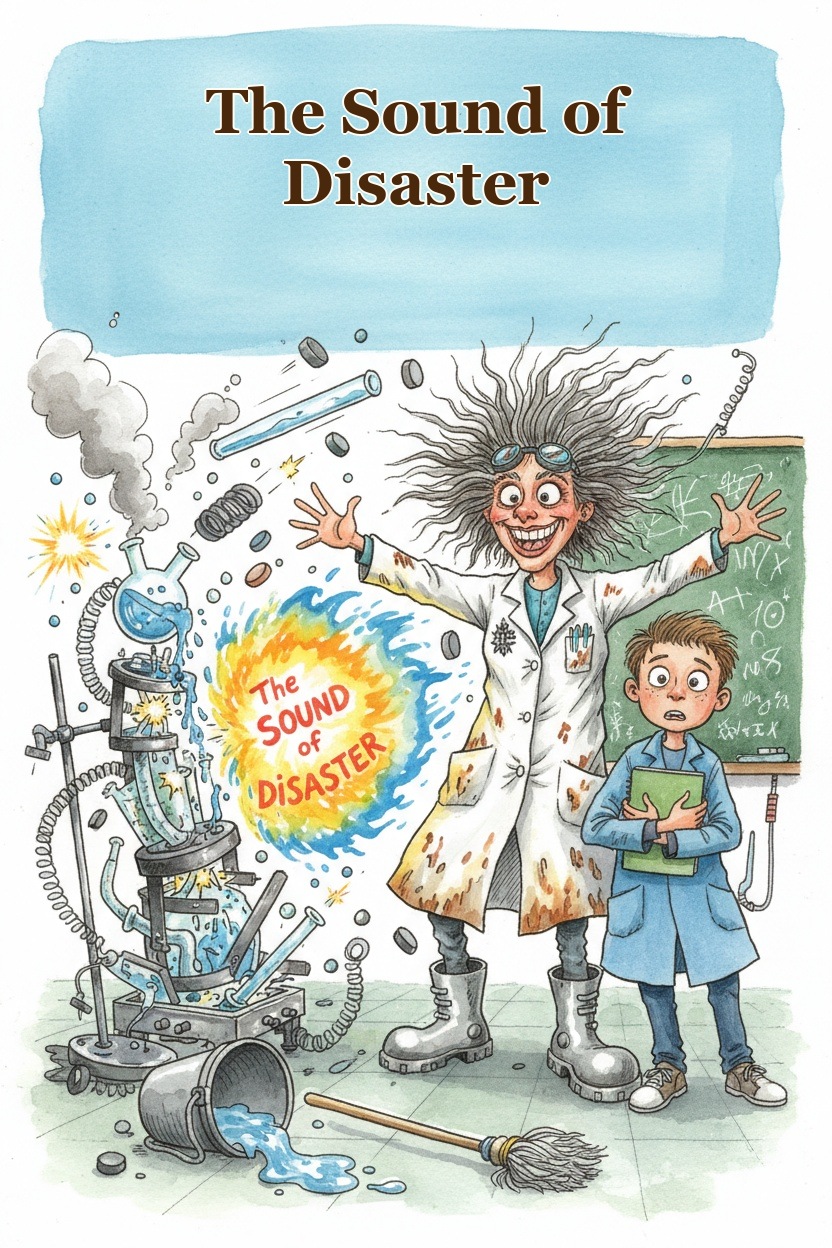
Section 1: The Very Loud Idea
Professor Plunk burst through the lab door with a box the size of a small refrigerator. Her wild grey hair crackled with static electricity, and her safety goggles bounced on her forehead.
"Otto! My careful colleague! Today we make SOUND VISIBLE!"
Otto looked up from his lab notebook. He had been carefully drawing a diagram of yesterday's temperature experiment—specifically, the part where the lab's left half froze solid and the right half melted the jam cupboard.
"Visible?" Otto asked. "Sound is... invisible. That's kind of its whole thing."
"NOT WITH THIS!" Professor Plunk slapped the box triumphantly. "This is the Sound Wave Visualisation and Demonstration Apparatus, Mark One!"
She ripped off the cardboard to reveal a complicated machine covered in dials, tubes, and one very large speaker cone. The speaker was bigger than Otto's head. Actually, it was bigger than Otto's whole torso.
"I call her ROAR," Plunk announced.
"ROAR?"
"Rapid Oscillation Amplification Receptor!" Plunk grinned. "Sound is a vibration, Otto. A wave that travels through matter. When something vibrates—like a drum skin, or your vocal cords, or Gloriana's mop hitting a bucket—it pushes the air around it. Those pushes travel as waves, just like ripples in a pond."
Otto opened his notebook to a fresh page and wrote:
Sound = vibration traveling through matter as a wave.
"That's why sound needs a medium," he said slowly. "It can't travel through empty space because there's no air to push."
"EXACTLY!" Plunk clapped her hands together. "And this beautiful machine will take a tiny sound and AMPLIFY it! The amplifier makes the vibrations bigger—we call that increasing the AMPLITUDE. Bigger amplitude means LOUDER!"
Otto wrote:
Amplitude = loudness.
"Show me," he said.
Section 2: ROAR Comes to Life
Plunk connected ROAR to a small device that looked like a music box. She wound it up, and a tiny tinny melody tinkled out—something that might have been a lullaby in its original form.
"Now," Plunk said, "I will plug ROAR into the amplifier system. The music box's vibrations will travel through the wire as electrical signals. The amplifier will make those signals bigger, and the speaker will convert them back into sound waves—much, much LARGER sound waves!"
She flipped a switch. The machine hummed.
"This is going to be very loud, isn't it?" Otto asked.
"Just the right amount of loud!" Plunk adjusted a dial. "I've set the amplifier to a scientifically determined perfect volume. Watch the speaker cone, Otto—you can literally SEE the sound waves!"
The speaker cone began to vibrate. Otto watched as it pushed outward, compressing the air in front of it, then pulled backward, creating a space where the air was less dense. Push. Pull. Push. Pull.
"The compressions and rarefactions!" Otto scribbled in his notebook. Push-pull = wave pattern!
The lullaby emerged from the speaker—but now it sounded like a giant was humming. Otto could feel the vibrations in his feet. The windows rattled gently. A pen rolled off the desk.
"Beautiful!" Plunk said. "Now let's talk about FREQUENCY!"
Otto looked up from his notebook. "Frequency?"
"How many vibrations happen each second! Fast vibrations make HIGH-pitched sounds. Slow vibrations make LOW-pitched sounds." She pointed to the dial. "This controls the frequency. Watch!"
She turned the dial, and the humming dropped—lower, lower, lower—until the whole building seemed to be groaning. Otto's teeth buzzed.
"That's low frequency!" he shouted, though he wasn't sure why.
Plunk turned the dial the other way, and the pitch rose until it was so high Otto could barely hear it. But the dog across the street started howling.
"Amazing!" Plunk declared. "We've demonstrated pitch, amplitude, and wave transmission! Now—"
She looked at ROAR. Then she looked at ROAR's power cable. Then she looked at the power cable's connection to the amplifier.
The connection was loose.
"I just need to tighten this," she said. "Be a dear and hold ROAR steady."
Otto grabbed the speaker's frame. "Should we turn it off first?"
"Nonsense! The volume is perfectly calibrated. I'll just—"
A small spark. A crackle. And then:
BZZZZZZZT.
The amplifier's dial spun wildly to maximum. ROAR's speaker cone slammed outward with the force of a punch.
And the lullaby became a THUNDERSTORM.
Section 3: The Sound of Everything
The sound that erupted from ROAR was beyond loud. It was a physical thing—a wall of compressed air that smashed into Otto like a wave at the beach. His glasses flew off his face. His notebook shot out of his hands. The entire lab seemed to leap sideways.
Otto clapped his hands over his ears and dove behind the workbench. Through the floor, he felt the vibrations—the building itself was resonating, shaking, singing along with ROAR's deafening song.
"PROFESSOR!" he screamed. No sound came out of his mouth. Well, it did, but he couldn't hear himself.
Plunk stood beside ROAR, her hair whipping around her head, her eyes WIDE with scientist delight. Her lips were moving—probably saying something like "Extraordinary!"—but Otto couldn't hear her.
Then the windows shattered.
All of them. At once. Every single pane in the entire building exploded outward in a glittering shower of glass, and the sound wave burst through the openings like water through a broken dam.
Otto saw the windows across the courtyard shatter too. Then the ones on the next street. Every dog in a kilometre radius began to howl—he could tell by the way their mouths opened in perfect canine harmony, even though he couldn't hear a single note of it.
The glass. The howling. The shaking.
And ROAR kept going.
Otto crawled to the power strip and kicked it. The plug flew out. The machine whirred down, the speaker cone settling back into stillness.
Silence.
Real silence. The kind that rings in your ears. The kind that makes the world feel like it's holding its breath.
Otto lay on the floor, panting. His ears were ringing. His heart was pounding. Every window in the building was gone, and the lab had a fresh layer of glass crystals sparkling on every surface.
Professor Plunk stood motionless, her lab coat fluttering in the breeze that now blew freely through the empty window frames. Her mouth slowly closed.
"Well!" she said, her voice slightly shaky. "That demonstrated sound waves rather more vividly than I intended."
Gloriana appeared in the doorway. She took one look at the destroyed windows, the sparkling floor, and the two glass-covered scientists.
Without a word, she reached into her tool belt and pulled out a dustpan the size of a surfboard.
Otto sat up. "She always has the right tool," he managed.
Gloriana looked at him. "Heard it coming." She swept the first pile of glass into the dustpan. "Brought my earplugs too." She held up a bright orange pair, already in her ears.
Otto's notebook lay on the floor nearby. He crawled over and picked it up. The page he'd been writing on caught his eye, and he read his own words:
Sound is a vibration that travels through matter as a wave.
He stared at the shattered windows. At the howling dogs, still going. At ROAR, sitting innocently silent.
Then he wrote, very carefully:
Amplitude = loudness.
Frequency = pitch.
Loudness = window destruction.
And at the bottom of the page, in increasingly large letters:
THIS WAS NOT IN THE PLAN.
Section 4: The Quiet Lesson
Later—much later, after Gloriana had swept up approximately seventeen buckets of glass and hung temporary plastic sheeting over the empty window frames—Otto and Plunk sat on the lab floor among the rubble.
Plunk was examining ROAR's speaker cone with a screwdriver, muttering about "unforeseen amplification ratios."
Otto held a glass marble in his hand. He dropped it on the metal workbench. Ting. He tapped the bench with his finger. Tap tap.
Plunk looked up. "What are you doing?"
"Testing the medium," Otto said. "The marble vibrates the metal, and the metal vibrates the air, and the air vibrates my eardrum, and my brain turns that into a sound." He tapped again. "The metal is the medium here. Sound needs something to travel through."
"Very good!" Plunk beamed. "And do you know why you could feel the sound in your chest when ROAR was at full power?"
Otto thought about it. "The sound waves were so big—so high amplitude—that they moved my whole body? Not just my eardrums?"
"EXACTLY! High amplitude means the air particles are pushed much further from their resting positions. The wave carries more energy. When there's enough energy, you don't just hear the sound—you FEEL it."
Otto picked up his notebook and looked at his notes. "And the pitch—the frequency—that's different from loudness."
"Frequency is the number of vibrations per second. Fewer vibrations per second—" Plunk hummed a low note. "That's low pitch. More vibrations per second—" She hummed high and fast. "That's high pitch. Frequency and amplitude are completely separate properties of a wave."
Otto wrote:
Loudness = amplitude (how big the wave is)
Pitch = frequency (how fast the wave wiggles)
Then he thought about something. "The windows didn't break because the sound was loud," he said slowly. "They broke because the sound wave pushed them. The wave hit the glass with enough energy to... to do that."
Plunk nodded, her face suddenly serious. "Sound is not just something you hear, Otto. It's a force. Sound waves carry energy—real, physical energy. That's why extremely loud sounds can damage your ears. That's why thunder can rattle buildings. That's why ROAR—" she patted the machine affectionately— "can shatter glass."
Otto looked around at the lab. The plastic sheeting flapped gently in the evening breeze. The dog across the street had finally stopped howling.
"I always thought sound was just... sound," he said. "Like it was nothing. Just something your ears do."
Plunk stood up and walked to the window. The sunset glowed through the plastic, turning the whole lab orange and pink. "Sound is movement, Otto. Everything you've ever heard was something moving. A guitar string, a drum skin, a voice, a thunderstorm—all of it moving. All of it pushing the air. All of it traveling to your ears as a wave."
She turned to him. "And when that wave is big enough? It can change the world."
Otto looked down at his notebook. He thought about the marble on the metal bench. The hum of the building's pipes. The distant bark of a dog. These were all vibrations, all waves, all sounds traveling through the air right now.
He wrote one more line:
Sound is everywhere. It's just matter, moving.
Then he added:
The windows will need replacing.
Gloriana says she knows a guy.
THIS WAS NOT IN THE PLAN—
BUT THE PLAN WAS BETTER THIS TIME.
Sort of.
"I'm going to finish my notes in my room," Otto said. "Somewhere without windows."
Plunk laughed. "Good idea, my careful colleague. Tomorrow, we'll work on something quieter."
"What could possibly be quieter than this?"
Plunk's eyes sparkled. "Light! Shadows! Perfectly silent things that don't shatter anything!"
Behind them, Gloriana appeared in the doorway with a roll of clear plastic and a stapler the size of a breadbox.
"Window film," she said. "Bought it yesterday."
Otto blinked. "How did you know—"
Gloriana shrugged. "Always know." She walked past them, already measuring the first window frame.
Otto closed his notebook. The sunset painted the lab in warm colours, and somewhere below, a dog barked—just once, a question, an echo of all the howling.
Otto smiled.
Sound was still traveling. It never stopped. Something, somewhere, was always vibrating.
And he was going to write it all down.