Chef Sparks Kitchen Lab
THE WASTE IN THE KITCHEN
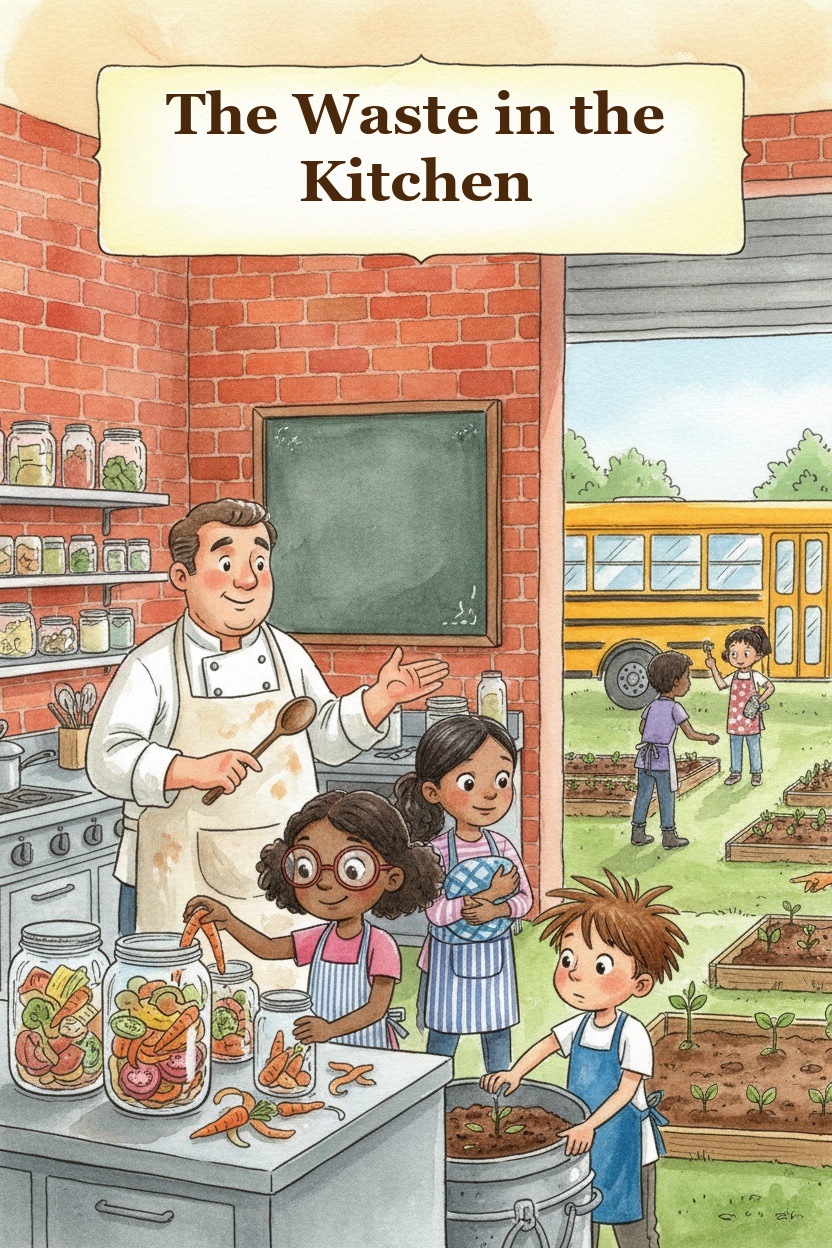
The Mystery of the Disappearing Food
The Kitchen Lab smelled like lemons and possibility. Chef Iggy Spark stood at the great range, his apron already dusted with flour, and surveyed his students with the look of a man about to reveal something magnificent.
"Today," he announced, "we begin an investigation."
Tommy's hand shot up. "Are we investigating why the pudding disappeared from the fridge yesterday?"
"That was me," said Dev. "It was an experiment."
"The pudding was the experiment," Iggy said. "And no, that is not our investigation. Our investigation is much more mysterious. Much more troubling. Much more—"
He swept his arm toward the counter in a dramatic arc. The wooden spoon resting there launched itself into the air and clattered to the floor. The Spark Effect, as always, went unacknowledged.
"Chef," said Maya, picking up the spoon, "you knocked the spoon off the counter."
"Did I? Excellent. The spoon is where it belongs now, on the floor, which is not where food tools belong. Speaking of food not being where it belongs—" Iggy produced a large plastic bin from under the prep table. Inside was a sad collection of vegetable peels, bread crusts, eggshells, and a single wilting carrot.
"This," Iggy said, "is our breakfast. No, no, don't look so alarmed. This is our subject. This is what we're going to investigate for the next week."
Priya leaned in and examined the contents. "Chef, this is garbage."
"This is potential," Iggy corrected. "This is the mystery. Every day, this kitchen produces food that we throw away. And I want to know exactly how much of it there is, where it comes from, and what happens to it after it leaves our sight."
"Like a detective!" said Lucia, already pulling out her sketchbook.
"Exactly like a detective. But first—" Iggy's eyes twinkled. "We need to understand the scale of the crime."
He turned to the chalkboard and drew a circle. Then he divided it into three uneven pieces.
"Every year, the world produces enough food to feed everyone on Earth. Every single person. But one third of it never gets eaten. One third! That's like going to the market, buying three bags of groceries, and dropping one bag in the parking lot on the way home."
"That's a lot of dropped groceries," Tommy said.
"It's a lot of wasted food," Iggy agreed. "And here's the part that keeps me up at night: while that food rots in landfills, people go hungry. The food we waste could feed the people who need it most. But instead, we throw it away."
Maya frowned. "But why does food go to waste? If people need it—"
"Many reasons," Iggy said. "Food goes bad before we can eat it. We buy too much and cook too much. Restaurants make more than they sell. Farms grow produce that's too ugly to sell to grocery stores. And in this kitchen—" He gestured to the bin. "We peel vegetables and throw away the peels. We cut off the broccoli stems and throw them away. We trim the carrot tops and throw them away."
"But that's just how you cook," said Sam. "You don't eat the peels."
Iggy smiled. "Do you want to know a secret? The peels are delicious. The stems are delicious. The tops are delicious. We've just gotten so used to throwing them away that we never stopped to ask if we could eat them."
He held up the sad, wilting carrot.
"This carrot has been sitting in our fridge for two weeks. It's gone soft. Maybe it's past its best. But what if I told you that this carrot—even this tired, droopy carrot—can still become something wonderful?"
"What can it become?" asked Tommy, who was already looking hungry.
"That," Iggy said, "is what we're going to find out. But first, we need to understand the problem. So here's your assignment: for the next week, every time you cook or eat something in the Kitchen Lab, I want you to write down everything you throw away. Every peel. Every scrap. Every crust. And we'll weigh it at the end of the week."
"A food waste audit," Maya said, writing in her notebook.
"Exactly." Iggy beamed. "We are going to catch the waste in the act."
The Week of Shame
The first day of the audit, the students made a simple tomato sauce.
"The tomatoes are fresh, so we don't need to peel them," Iggy explained, "but I want you to notice what we would throw away if we were cooking a different way."
He held up an onion. "The skin. We throw it away. But it can flavor a stock." He held up a garlic clove. "The papery wrapper. Out. But you know what? Garlic skins have flavor too." He held up a bunch of basil. "The stems. We pick off the leaves and throw away the stems. But the stems can infuse oil."
"Everything is food?" Tommy asked, his eyes wide.
"Everything can be food," Iggy said. "The question is whether we decide to use it."
By day three, the students had filled an entire poster board with their findings.
"Day one: potato peels," Dev read aloud. "Day two: broccoli stems, carrot tops, celery leaves, and the ends of green beans. Day three: eggshells, bread crusts, and—"
"—twelve banana peels," Maya said, looking at the board. "Chef, who eats twelve bananas in three days?"
"The same person who ate the experimental pudding," Iggy said mildly.
Tommy looked away, whistling.
"When we weigh all this at the end of the week, we're going to find something disturbing," Iggy said. "Across the whole world, the food we throw away creates something called methane. Does anyone know what methane is?"
"It's a gas," Priya said. "It comes from—wait, when food rots in a landfill, it doesn't have oxygen. So it produces methane instead of carbon dioxide."
"The class has been paying attention." Iggy wrote METHANE on the board. "Methane is a greenhouse gas. It traps heat in the atmosphere. And when food rots in a landfill, it releases methane. All that food we threw away becomes gas that warms the planet. And it does nothing. It feeds no one. It nourishes nothing. It just wasts."
"Wasts?" said Sam.
"Wastes," Iggy corrected. "I was so passionate I invented a verb."
By day seven, the students stood around the scale in the middle of the kitchen. On it sat one week's worth of the Kitchen Lab's food waste—all of it collected, weighed, and documented.
"Fourteen kilograms," Maya said quietly.
"Fourteen kilograms in one week. From one kitchen. With one class of students." Iggy shook his head. "Now multiply that by every restaurant, every home, every grocery store, every farm in the world. Every single day."
"That's so much," Priya said. "It makes me feel—I don't know how to describe it."
"Sick?" Tommy offered.
"Yeah. Kind of sick."
Iggy nodded slowly. "That sick feeling is what it feels like to realize you're part of a problem. But here's the good news: that sick feeling can turn into something else. It can turn into action."
He pulled a second bin from under the counter. This one was empty.
"Today, we are going to cook an entire meal. A complete, delicious, satisfying meal. And we are going to use only the things that would normally go into the waste bin."
The students exchanged glances.
"Chef," Maya said carefully, "we're going to eat the garbage?"
"We are going to eat the potential," Iggy said. "And by the end of this lesson, you're going to be angry at every vegetable peel you've ever thrown away."
The Root-to-Stem Revolution
Iggy arranged four stations around the horseshoe prep table. At each station sat a bowl of ingredients that had been rescued from the waste bin.
"Before we start, here's the principle: nose-to-tail when the animal is involved. Root-to-stem when it's a plant. Every part of the plant can be used. The stems. The leaves. The peels. The seeds. And when we use them, we honor the plant that grew for us."
He held up a head of broccoli. "What do we usually do with broccoli?"
"Eat the florets," said Tommy.
"Eat the florets and throw away the stems," Iggy confirmed. "But the stems are sweet and crunchy. They cook beautifully. They're full of fiber and vitamins. The trick is to peel the tough outer layer and slice the stem thin."
He demonstrated, cutting the stem into coins.
"And the leaves?" he asked. "Broccoli leaves can be sautéed like kale. They're delicious."
"But nobody eats broccoli leaves," Maya said.
"Nobody ate broccoli leaves yesterday. Today, we're pioneers."
He moved to the next bowl, where a pile of carrot tops lay. "Carrot tops. Usually thrown away. But they taste like a mix of parsley and carrot. You can make pesto from them. You can chop them into salads. You can—" He sniffed them appreciatively. "They're herb-y and bright."
"The peels," Priya said, holding up a potato peel. "What do we do with potato peels?"
"Crisp them in oil. Salt them. Eat them like chips. I'm going to show you something even better though." Iggy pulled a bag of bread crusts from the bowl. "Stale bread. Old bread. Bread crusts we cut off and throw away. In my childhood, my grandmother used to say that waste was a sin and a shame. She would take bread crusts and turn them into breadcrumbs, or toast them and serve them in soup, or soak them in milk and eggs to make a pudding."
"My Ammamma does that," Priya said. "She has a jar in her kitchen where she saves bread ends, and when it's full she makes something with them."
"Your Ammamma knows the secret." Iggy smiled. "The secret is that there is no such thing as 'waste' food. There is only food we haven't learned how to use yet."
He moved to the final station, where a collection of citrus peels and apple cores sat.
"Citrus peels. We squeeze the juice and throw away the peel. But the peel contains essential oils that can perfume a whole dish. You can candy it. You can dry it and grind it into powder. You can use it to infuse sugar."
"The apple cores?" Tommy asked.
"The apple cores can be simmered with water to make a sweet, fragrant tea. Or you can use them to make fruit scrap vinegar—but that's a future lesson. For today, we're going to use every single part of our ingredients."
Iggy clapped his hands. "Now! Here's our menu."
He turned the chalkboard to reveal:
THE NOT-A-SCRAP FEAST
-
Crispy potato peel chips with sea salt
-
Broccoli stem and carrot top stir-fry with garlic-skin-infused oil
-
Stale bread and vegetable scrap soup
-
Citrus peel and apple core tea
"You can't be serious," Sam said.
"I am completely serious," Iggy said. "Let's get cooking."
The Feast
The kitchen erupted into controlled chaos.
Maya took charge of the potato peels, tossing them in oil and laying them on a baking sheet. "They're so thin," she said. "They'll crisp up fast."
"Exactly," Iggy said. "Potato peels are already the right shape for chips. We've been paying a premium for something we've been throwing away."
Tommy handled the broccoli stems. "They're really crunchy," he reported. "Like water chestnuts."
"Sliced thin, they'll soften when we fry them," Iggy explained. "But they'll keep their bite. That texture is something a floret can't give you."
Dev and Lucia tackled the soup. Iggy had made a stock earlier that morning from vegetable scraps—onion skins, celery ends, carrot peels, and herb stems simmered in water for an hour. Now, into that fragrant stock went the stale bread crusts, torn into pieces.
"The bread will soak up the stock," Iggy explained. "It'll thicken the soup and give it body. This is how peasant soups have been made for centuries: you take what you have, you take what you would throw away, and you turn it into something that fills you up."
"What if it doesn't taste good?" Sam asked.
"Then we learn something," Iggy said. "The worst outcome is we make soup that tastes like bread and vegetables, and we've learned a lesson. But I think you're going to be surprised."
Priya worked on the tea. She had collected orange peels, apple cores, and a cinnamon stick that had been marked for disposal because it was slightly cracked. She simmered them together in a pot with water, and the smell filled the kitchen—sweet and warm and comforting.
"The water is turning golden," she said.
"That's the citrus oils and the apple tannins," Iggy said. "We're extracting all the flavor that we used to throw away."
When everything was ready, Iggy had them carry the dishes to the long table in the center of the kitchen. The potato peel chips were golden and crisp. The stir-fried broccoli stems were bright green and tender-crisp. The soup was thick and aromatic. The tea steamed in mismatched mugs.
"One rule," Iggy said, sitting down. "Everyone tries everything before they decide what they think about it."
"Tommy's going to eat the table," Maya said.
Tommy was already spooning soup into his mouth. He paused mid-spoonful. His eyes widened. He made the sound—the two-note hum that the class had come to recognize as the highest form of approval.
"This is good," he said, his voice full of wonder. "This is soup made from garbage and it's better than the soup my school serves."
"Your school serves soup made from powder and regret," Iggy said. "Mine is made from the parts of vegetables that were too beautiful to waste."
Maya bit into a potato peel chip and closed her eyes. "It's like a chip. It tastes like a real chip."
"Because it is a real chip," Iggy said. "You're just used to the version that comes in a bag."
Dev tried the stir-fry. "The broccoli stems are the best part. Why do we throw away the best part?"
"You don't know that it's the best part until you try it," Iggy said. "That's the whole point. We throw things away without ever asking what they could become."
Priya sipped her tea. "It smells like winter," she said. "It smells like Ammamma's kitchen when she's making something special."
"It smells like what happens when you decide to use everything," Iggy said. "And that's a choice. Every day, at every meal, you can choose to throw something away, or you can choose to ask: what could this become?"
The class ate in silence for a moment, the only sound being the comfortable clink of spoons and Tommy's hum of approval.
Finally, Sam put down his spoon. "So this whole week, all that food we threw away—we could have eaten all of it?"
"Most of it," Iggy said. "Some things are genuinely compostable—eggshells are too hard to eat, though you can use them in the garden. But most of what we threw away was food. We just didn't recognize it."
"What about the economics?" Lucia asked. "Does this save money?"
"A grocery store throws away thousands of dollars of food every week," Iggy said. "A family can cut their food budget by a third if they stop throwing away food. If you buy a head of broccoli and use the florets, the stems, and the leaves, you got three meals from one purchase. If you use the carrot tops and the celery leaves and the onion skins, you get flavor without paying extra."
"Chef," Maya said slowly, "at the beginning of the week, I thought you were going to teach us to cook. But you're teaching us to think."
"Those are the same thing," Iggy said. "Cooking is thinking with your hands."
The Promise
After the dishes were washed, the class gathered around the table. On the chalkboard, Iggy had drawn one final diagram: a circle.
"A circle has no waste," he said. "Everything flows back into everything else. The food we don't eat becomes compost. The compost feeds the garden. The garden grows more food. That's how nature works. That's how we should work too."
"But we're not nature," Tommy said.
"We are nature," Iggy said. "We are nature that learned how to cook. And that means we can choose to be the kind of nature that doesn't throw away one third of everything it grows."
He reached into his pocket and pulled out a small notebook. "I'm going to give each of you a challenge. For the next week, I want you to keep a food waste journal at home. Every time you throw away food, write it down. Ask yourself: could this have been used?"
"That's a lot of work," Sam said.
"It's a lot of awareness," Iggy corrected. "And awareness is the first step to change. You can't fix a problem you can't see."
He passed out the notebooks. The students paged through them, finding blank pages and one question printed on the first page:
"What could this become?"
"Whenever you're cooking—at home, at school, anywhere—ask that question. The answer might surprise you." Iggy smiled. "It surprised me this week. I didn't think we could make a feast from scraps. But look what happened."
He gestured to the empty plates on the table. Every single bite had been eaten.
"We should do this every week," Tommy said. "Eat the garbage. It's the best meal we've had."
"It's not garbage," Priya said. "It's just food we didn't understand yet."
Maya was still holding her notebook. "Chef, when I write in this at home, what do I do with the food I can't use? The stuff that's really waste?"
"Compost it, if you can. Your family has a yard, right? Start a compost bin. It turns food waste into soil. And soil grows more food. It's the circle again."
"And if we can't compost?"
"Then at least you know. At least you measured. At least you asked the question." Iggy stood up and began clearing the plates. "That's more than most people do."
The Spark Effect chose that moment to strike. Iggy's elbow, reaching for a plate, caught the salt cellar on the counter. It tipped over, salt spilling across the wood in a white drift.
The students watched in silence.
"I knocked over the salt," Iggy said, as if noticing for the first time.
"That's bad luck, isn't it?" Dev asked.
"No," Iggy said. He swept the salt into his palm and opened the kitchen door, throwing it over his shoulder into the courtyard. "It's food. And food goes back to the earth. Now it will nourish the soil where the tomatoes grow. Nothing is wasted. Not even luck."
He came back inside and washed his hands.
"Next week," he said, "we're going to plant our spring garden. And I want you all to think about one thing between now and then: the next time you throw something away, where does it go? What happens to it? And what would happen if you decided to use it instead?"
"The answer is in the question," Maya said quietly.
"The answer is always in the question," Iggy agreed. He smiled at his class. "Now, who wants the last crust of bread?"
Tommy's hand shot up.
Kitchen Lab Notes
Dear Students,
This week we learned that the food we waste is not just food—it's money, it's labor, it's land, it's water, it's energy, and it's the difference between plenty and hunger for too many people on this planet. One third of all food produced globally is never eaten. That's not just a problem in far-off places. It's a problem in our own kitchen, in our own homes, in our own habits.
But here's the beautiful thing: we can fix it. We can use the whole vegetable. We can save our scraps for stock. We can compost what we can't eat. We can buy less and cook smarter. And when we do, we discover that the "waste" was never waste at all—it was potential.
This week, I want you to notice. Look at what you throw away. Ask the question. Then come back and tell me what you discovered.
What could this become?
—Chef Iggy Spark
The Not-a-Scrap Feast
From Chef Spark's Kitchen Lab
A meal made entirely from parts of food you'd normally throw away.
Ingredients
For the Crispy Potato Peel Chips:
-
Peels from 4 potatoes
-
1 tablespoon olive oil
-
Sea salt
For the Broccoli Stem and Carrot Top Stir-fry:
-
Stems from 2 bunches broccoli, outer peel removed, thinly sliced
-
Leaves and tender stems from 1 bunch carrot tops, chopped
-
2 cloves garlic
-
2 tablespoons oil
-
Pinch of salt
For the Stale Bread and Vegetable Scrap Soup:
-
Stale bread crusts (about 2 cups, torn into pieces)
-
4 cups vegetable stock (see note)
-
Leftover vegetable scraps (onion skins, carrot peels, celery ends, herb stems)
-
Salt and pepper
For the Citrus Peel and Apple Core Tea:
-
Peels from 2 oranges
-
Cores from 2 apples
-
1 cinnamon stick
-
4 cups water
-
1 tablespoon honey (optional)
Directions
-
For the chips: Preheat oven to 425°F. Toss potato peels in olive oil and salt. Spread on baking sheet. Roast 10–15 minutes until crispy.
-
For the stir-fry: Heat oil in a large pan. Add garlic and cook until fragrant. Add broccoli stem slices and cook until tender-crisp. Add carrot tops and cook 1 minute more. Season with salt.
-
For the soup: Simmer vegetable scraps in water for 1 hour. Strain (or leave the scraps in for extra flavor). Add vegetable stock and stale bread. Simmer until bread softens and soup thickens. Season to taste.
-
For the tea: Combine all ingredients in a pot. Simmer 20 minutes. Strain. Add honey if you like it sweet.
-
Eat everything. Waste nothing.
Chef's Note: This meal proves that "scraps" are just food you haven't figured out yet. The stock you make from vegetable scraps is the foundation of dozens of soups and stews. Keep a bag in your freezer for vegetable ends, onion skins, and herb stems, and you'll never buy stock again. And when you're done with this meal, compost whatever you didn't eat. It will grow you more food. That's the circle.